At a Glance
The shape of the event
- Date
- 1821
- Place
- Mexico City
- Type
- Independence
Mexico achieved independence after years of insurgency, royalist realignment, and the Plan of Iguala.
1821; place the event in Mexico City before comparing causes or consequences.
The event links independence to the difficult work of building durable national institutions.
Agustin de Iturbide / Vicente Guerrero are the first names or groups to compare before widening the story.
New Spain became an independent Mexican state with unresolved conflicts over monarchy, republic, church, army, and social order.
New Spain became an independent Mexican state with unresolved conflicts over monarchy, republic, church, army, and social order.
The event links independence to the difficult work of building durable national institutions.
Follow the sequence of 1820s and 1830s events to see how the questions left unresolved in 1821 were fought over in law, politics, and occasional violence.
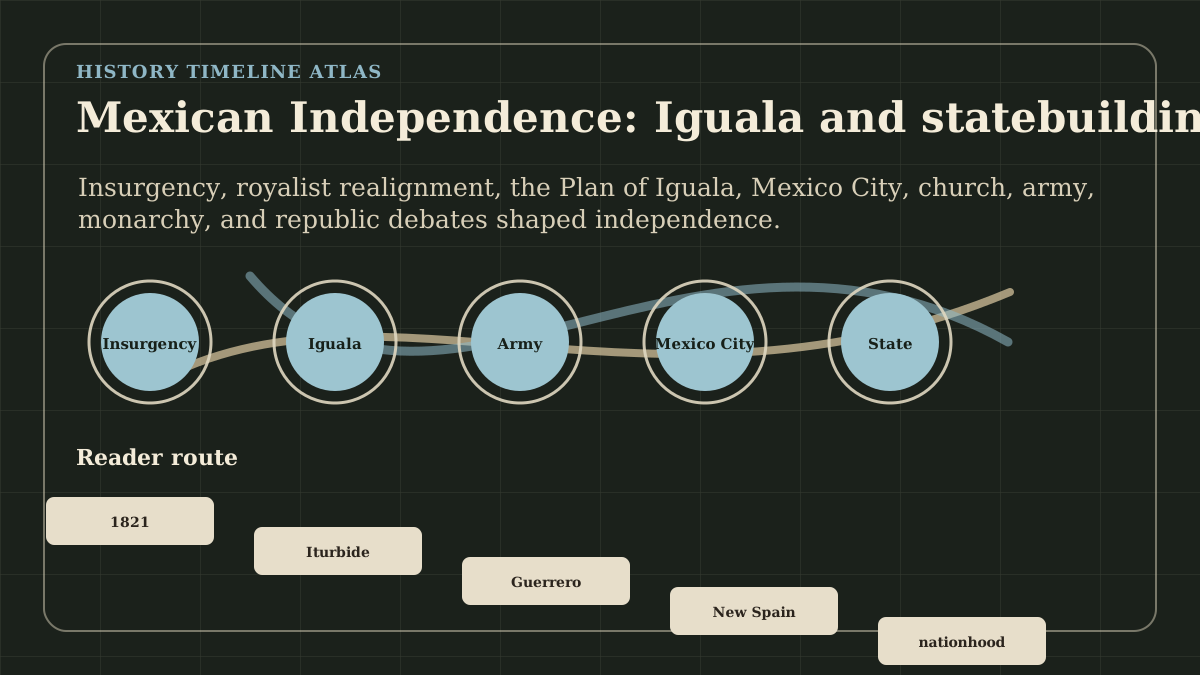
Background
By 1821 New Spain had endured decades of conflict. Insurgent campaigns, often centered in the provinces and drawing on local grievances, undermined metropolitan authority. At the same time, the Spanish monarchy’s own crises and shifting loyalties produced moments when royalist officers reconsidered their commitments. Creole elites worried over trade, taxation, and political exclusion; indigenous and mixed-race communities faced continuing pressures on land, labor, and customary rights. Overseas and metropolitan diplomatic developments weakened the old chains of command and opened space for negotiated settlements. Rather than a single cause, these pressures—military exhaustion, political realignment among royalists, local social strains, and diplomatic opportunity—created conditions in which leaders could propose a new constitutional and symbolic order.
The Plan of Iguala emerged into that unsettled field as the instrument that attempted to translate bargaining among elites and insurgents into a foundational program for independence. Yet the surrounding social conflicts did not vanish with a proclamation: they remained embedded in daily life and law. Mexican independence should not be flattened into a single declaration. It came after years of insurgency, repression, regional war, social fear, Spanish imperial crisis, and royalist realignment. By 1821, some former defenders of colonial order concluded that independence could protect religion, hierarchy, and local power better than continued loyalty to a changing Spain. The Plan of Iguala gives the event its structure.
It promised religion, independence, and union while trying to bring insurgents, royalists, clergy, army officers, creoles, and local elites into one settlement. That coalition was powerful, but it also carried contradictions into the new state. Readers need the social layer. Indigenous villages, mixed-race communities, miners, merchants, clergy, soldiers, regional leaders, and urban crowds did not all want the same future. Independence answered the question of Spanish sovereignty, but it did not resolve land, caste, church power, military influence, regional autonomy, or the choice between monarchy and republic.
The Turning Point
The decisive change in 1821 came when armed conflict, political negotiation, and shifting loyalties converged into a compact that would end colonial rule as a de facto reality. Vicente Guerrero, a leading insurgent figure, had continued the anti-colonial fight in the countryside; Agustín de Iturbide, a former royalist officer, negotiated with insurgent leaders and assembled political support within Mexico City and among creole elites. The Plan of Iguala set out a triune program: independence from Spain, the protection of the Catholic Church’s privileged position, and equality for civilians under a new constitutionally-oriented order—while also proposing a monarchy to stabilize the state. That formula appealed to conservatives fearful of social upheaval and to insurgents seeking recognition and security.
When royalist forces in the capital and elsewhere realigned or stood down, the proclamation of independence became achievable without a definitive battlefield victory over all royalist forces. The choices made by Iturbide and Guerrero—pragmatic alliances, public ceremonies, and legal instruments—converted fragile political momentum into the birth of an independent Mexican polity centered symbolically in Mexico City. But those choices also deferred deeper disagreements about sovereignty, social hierarchy, and institutional form. The turning point was the alliance between Agustin de Iturbide and Vicente Guerrero. Their agreement transformed a long insurgency into a broader political coalition. The Army of the Three Guarantees made independence appear orderly enough for many elites and flexible enough to absorb former opponents.
Entry into Mexico City mattered because it made independence visible at the political center. Yet visibility did not equal stability. The new country inherited debts, damaged regions, competing visions of sovereignty, and powerful institutions with their own interests.
Consequences
In the short term, 1821 produced a formal rupture: New Spain ceased to be an imperial dependency and an independent Mexican state emerged. That result opened immediate questions that could not be resolved merely by declarations. Did Mexico become a monarchy or a republic? What power would the Catholic Church retain? How would the army be integrated into civilian governance? Which social orders would survive or change? In the longer term, independence linked political sovereignty to the arduous business of state formation. Legal codes, diplomatic recognition, property disputes, and the distribution of political power all required negotiation, often contentious and slow.
The social realities on the ground—indigenous legal traditions, patterns of labor and landholding, municipal authorities—did not automatically conform to the new national institutions. Public memory and legal records would come to tell competing stories about 1821: official proclamations emphasized the end of colonial subjection, while local communities remembered contested continuities in governance, labor obligations, and church influence. The event thus marks both the end of direct imperial rule and the beginning of contested national construction, where building durable institutions proved at least as consequential as winning independence. The immediate consequence was the end of New Spain and the creation of an independent Mexican state.
The longer consequence was a difficult process of statebuilding marked by monarchy, republic, federalism, centralism, military politics, church-state conflict, regional rebellion, and foreign pressure. The event also changes how readers understand Latin American independence. Mexico's path was not identical to South American campaigns led by Bolivar or San Martin, nor to Brazil's monarchical break from Portugal. It shows independence as a family of different settlements rather than one ideological script.
Interpretation Notes
Interpretations of Mexico Achieves Independence depend on whose evidence is centered: rulers and official records, affected communities, oral memory, archaeology, law, diplomacy, labor, and later public memory do not always tell the same story.
Why Keep Reading
Follow the sequence of 1820s and 1830s events to see how the questions left unresolved in 1821 were fought over in law, politics, and occasional violence. The early years after independence reveal how fragile alliances held together—or broke apart—over debates about monarchy versus republic, the role of the military, and the church’s social power. Reading what came next shows how leaders turned the Plan of Iguala from a proclamation into policies, how local communities resisted or adapted, and how Mexico’s diplomatic standing in the hemisphere took shape. If 1821 was a foundation, the following decades test whether that foundation could carry a modern, plural polity. Read Mexican Independence after the Grito de Dolores and before Brazil, Ayacucho, and Gran Colombia.
That route shows why Latin American independence was a set of regional compromises, wars, and statebuilding problems.
Reading Path
Follow the story without losing the thread
Before This
After This
Same Period
Wider Timeline
Mind Map
How to think about Mexico Achieves Independence
Insurgency
Prolonged provincial rebellions that eroded metropolitan control and kept pressure on royal authorities
Map Layer
Where this event sits geographically
Gold pins mark the approximate locations of published event pages. This is a schematic locator map, not a historical border map.
Coordinates are approximate and are used to help readers orient themselves before opening a full event page.
References
Where to Check the Facts
- Primary Source Set: Latin American RevolutionariesPrimary-source set reference for Latin American revolutionary leaders, documents, and independence politics.
- Library of Congress: Hispanic Reading Room CollectionsArchive and collection reference for Latin America, the Caribbean, Iberian worlds, and related primary materials.
- Cambridge University Press: The Cambridge History of Latin AmericaSpecialist scholarly synthesis for colonial society, independence, republic-building, regional variation, and modern Latin American historiography.
- Oxford Research Encyclopedia of Latin American HistoryPeer-reviewed reference for Latin American history themes, regional debates, social history, and competing interpretations.
- John Carter Brown Library: Spanish America collectionPrimary-source collection reference for Spanish American independence, printed political culture, maps, and early republican debate.
- Encyclopaedia Britannica: Latin America independenceReference for Spanish American and Portuguese American independence movements.
- Encyclopaedia Britannica: History of Latin AmericaReference for Latin American colonial, independence, national, and modern history.
- Official UNESCO World Heritage Centre: City of PotosiInstitutional reference for Potosi's mining city, colonial extraction, and global silver economy.