At a Glance
The shape of the event
- Date
- 1819
- Place
- Boyaca
- Type
- Battle
Simon Bolivar's victory at Boyaca secured control of Bogota and accelerated independence in New Granada.
1819; place the event in Boyaca before comparing causes or consequences.
The battle connects military movement, highland geography, and the creation of new republics.
Simon Bolivar / Patriot forces are the first names or groups to compare before widening the story.
Patriot forces gained the political center needed to form Gran Colombia.
Patriot forces gained the political center needed to form Gran Colombia.
The battle connects military movement, highland geography, and the creation of new republics.
Follow next to see how a captured capital translates into a new political map: the immediate aftermath of Boyaca set in motion conventions, diplomatic outreach, and the administrative work needed to turn victory into...
Background
In the years before Boyaca the territory known as New Granada was under acute strain. Imperial government, local elites, Creole officers, and popular communities had been pulled in different directions by war, taxation, and the disruption of colonial legal orders. Simon Bolivar emerged within a broader Patriot movement that combined veterans of earlier uprisings, provincial militias, and political exiles seeking authority beyond Spanish rule. The highland geography of the northern Andes shaped every choice: mountain passes, river valleys, and sudden weather could halt columns or conceal them, and control of corridors leading toward Bogotá meant control of communication and legitimacy.
By 1819, campaigns had already shifted momentum in favor of the Patriots, but political control was fragile; holding capital cities was central to making revolutionary claims stick. Diplomatic recognition, the ability to convene assemblies, and the capacity to administrate taxation and justice all depended on seizing and holding urban centers. These pressures—military, political, economic, and geographic—intersected at Boyaca. Different witnesses recorded those pressures in different records: official dispatches, local accounts, and later memories would not always tell the same story about causes and responsibility. Economic pressures in the countryside magnified local resentments. Boyaca is easiest to misunderstand when it becomes only a heroic Bolivar moment.
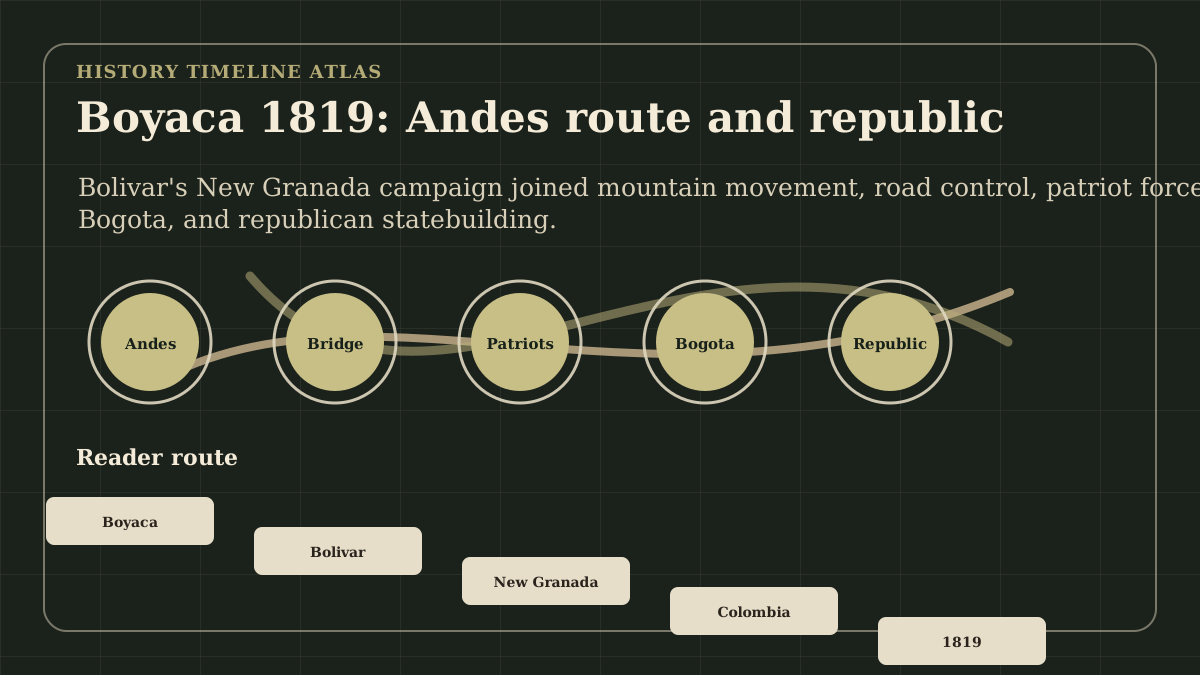
The battle belonged to a wider New Granada campaign shaped by the Andes, llanero cavalry, exhausted royalist forces, local patriot networks, supply problems, and the political prize of Bogota. Independence depended on roads, bridges, weather, animals, food, and trust as much as on speeches about liberty. The campaign's geography matters because movement created surprise. Patriot forces crossed difficult terrain before the decisive fight near Boyaca, turning highland routes and river crossings into political weapons. Control of a road could decide whether a royalist force reached Bogota, whether a capital stayed loyal, and whether republican authority could claim a center from which to govern. The page should keep statebuilding in the frame.
Winning a battle did not automatically create a stable republic. It created opportunity: access to treasury, archives, officials, printing, symbolic capital, and the networks needed to turn military victory into the project later known as Gran Colombia.
The Turning Point
At Boyaca the immediate balance of authority shifted. Simon Bolivar and the Patriot forces translated battlefield success into political advantage by seizing the route to Bogotá and taking control of the capital’s institutions. That was more than a military conquest: it was a deliberate move to occupy the administrative center that made legal and diplomatic claims possible. For magistrates, merchants, and provincial leaders the arrival of Patriot authority forced choices—whether to accept new governments, negotiate terms, or retreat into exile. For communities in the highlands the change was ambiguous: some saw relief from royal reprisals, others feared the disorder that comes with regime change.
The geography of the Andes amplified the outcome; control of highland passes constrained the movement of royalist reinforcements and allowed Patriots to consolidate gains rapidly. Politically, the capture of Bogotá allowed Patriot leaders to convene assemblies and to assert authority across a wider territory—steps that accelerated moves toward independence for New Granada and laid practical groundwork for forming Gran Colombia. That conversion depended on urgent administrative decisions and regional alliances. The turning point was the patriot seizure of the route to Bogota. By disrupting royalist movement near the bridge and road, Bolivar's army converted a campaign of endurance into a decisive political opening.
The result mattered because Bogota was not just another city; it was the administrative heart of New Granada. Boyaca also changed the credibility of independence. Before the victory, republican claims could look fragile and regional. After it, patriot leaders could speak from a captured center, recruit more confidently, and connect military success to constitutional plans.
Consequences
In the months after Boyaca the Patriots held what they had won. Control of Bogotá gave Bolívar and his allies access to administrative machinery: treasuries, courts, and symbolic seats of power that made declaring and organizing independence tangible rather than aspirational. That immediate political center allowed Patriot leaders to convene new assemblies and to pursue diplomatic and legal claims on behalf of New Granada, accelerating the region’s move away from Spanish rule. Over the longer term the victory helped create the conditions for Gran Colombia by providing a contiguous political core around which broader union could be imagined and attempted. But the consequences were uneven on the ground.
Rural communities experienced shifts in taxation, labor demands, and local justice that were not uniform benefits; merchants and local elites negotiated new privileges or losses. Interpretations of Boyaca depend on which evidence is centered: rulers’ dispatches and administrative records emphasize decisive command; oral memories and community accounts recall displacement and negotiation; archaeology, legal records, and diplomatic correspondence each highlight different outcomes. Public memory later wrapped the battle into national origin narratives, sometimes simplifying the frictions that followed. The result is a layered legacy: military breakthrough and political consolidation, traced through competing archives and living memory. The immediate consequence was patriot control of Bogota and a stronger basis for creating Gran Colombia. The longer consequence was more uneven.
New republics still faced regional rivalries, war finance, slavery and caste questions, church-state tensions, military power, and disagreements over federal or centralized government. Boyaca's memory became part of national identity in Colombia and a wider Bolivarian story across northern South America. A rich page should honor the event's importance while showing that independence was not a single act of liberation; it was a contested sequence of campaigns, bargains, and institutions.
Interpretation Notes
Interpretations of Battle of Boyaca depend on whose evidence is centered: rulers and official records, affected communities, oral memory, archaeology, law, diplomacy, labor, and later public memory do not always tell the same story.
Why Keep Reading
Follow next to see how a captured capital translates into a new political map: the immediate aftermath of Boyaca set in motion conventions, diplomatic outreach, and the administrative work needed to turn victory into a functioning republic. Read on to trace how Bolívar and his colleagues attempted to knit together provinces into Gran Colombia, how local communities responded to legal and economic change, and how competing archives—official papers, letters, and oral testimony—offer variant accounts. Understanding the next steps reveals the ambiguities of founding moments: how leaders balanced military authority, legal legitimacy, and popular consent while shaping a state that would endure unevenly across a vast highland region.
Read Boyaca after the Grito de Dolores and San Martin's Andes campaign, then continue to Ayacucho, Brazil's independence, and the dissolution of Gran Colombia. The route shows why Latin American independence was continental, regional, and institutionally unfinished.
Reading Path
Follow the story without losing the thread
Before This
After This
Same Period
Wider Timeline
Mind Map
How to think about Battle of Boyaca
Highland geography
Mountain passes and valleys shaped movement and made control of corridors decisive for access to Bogotá
Map Layer
Where this event sits geographically
Gold pins mark the approximate locations of published event pages. This is a schematic locator map, not a historical border map.
Coordinates are approximate and are used to help readers orient themselves before opening a full event page.
References
Where to Check the Facts
- Primary Source Set: Latin American RevolutionariesPrimary-source set reference for Latin American revolutionary leaders, documents, and independence politics.
- Library of Congress: Hispanic Reading Room CollectionsArchive and collection reference for Latin America, the Caribbean, Iberian worlds, and related primary materials.
- Cambridge University Press: The Cambridge History of Latin AmericaSpecialist scholarly synthesis for colonial society, independence, republic-building, regional variation, and modern Latin American historiography.
- Oxford Research Encyclopedia of Latin American HistoryPeer-reviewed reference for Latin American history themes, regional debates, social history, and competing interpretations.
- John Carter Brown Library: Spanish America collectionPrimary-source collection reference for Spanish American independence, printed political culture, maps, and early republican debate.
- Encyclopaedia Britannica: Latin America independenceReference for Spanish American and Portuguese American independence movements.
- Encyclopaedia Britannica: History of Latin AmericaReference for Latin American colonial, independence, national, and modern history.
- Official UNESCO World Heritage Centre: City of PotosiInstitutional reference for Potosi's mining city, colonial extraction, and global silver economy.