At a Glance
The shape of the event
- Date
- 1988
- Place
- Brasilia
- Type
- Constitution
Brazil's 1988 constitution marked a democratic turn after military rule, expanding rights language and civilian institutions.
1988; place the event in Brasilia before comparing causes or consequences.
The event gives the Latin America route a democratization chapter after revolution and dictatorship.
Brazilian lawmakers / Civil society movements are the first names or groups to compare before widening the story.
The constitution became the framework for Brazil's post-dictatorship political order.
The constitution became the framework for Brazil's post-dictatorship political order.
The event gives the Latin America route a democratization chapter after revolution and dictatorship.
Follow this chapter to see how a written constitution becomes a living instrument: subsequent elections, judicial decisions and social struggles tested the promises of 1988.
Background
The constitution of 1988 emerged from a period in which Brazil was negotiating the end of military rule and attempting to rebuild civilian authority. That negotiation took place in public arenas and private halls: elected lawmakers gathered in Brasilia to draft institutional rules, while civil society movements pushed for protections, recognition and new rights language. The pressure for change was not monolithic. Different groups — labor organizers, neighborhood associations, human-rights advocates, legal professionals and political parties — arrived with competing priorities about how far the state should guarantee social, economic and political claims. At the same time, those who had governed under the old regime resisted some changes or insisted on protecting institutional prerogatives.
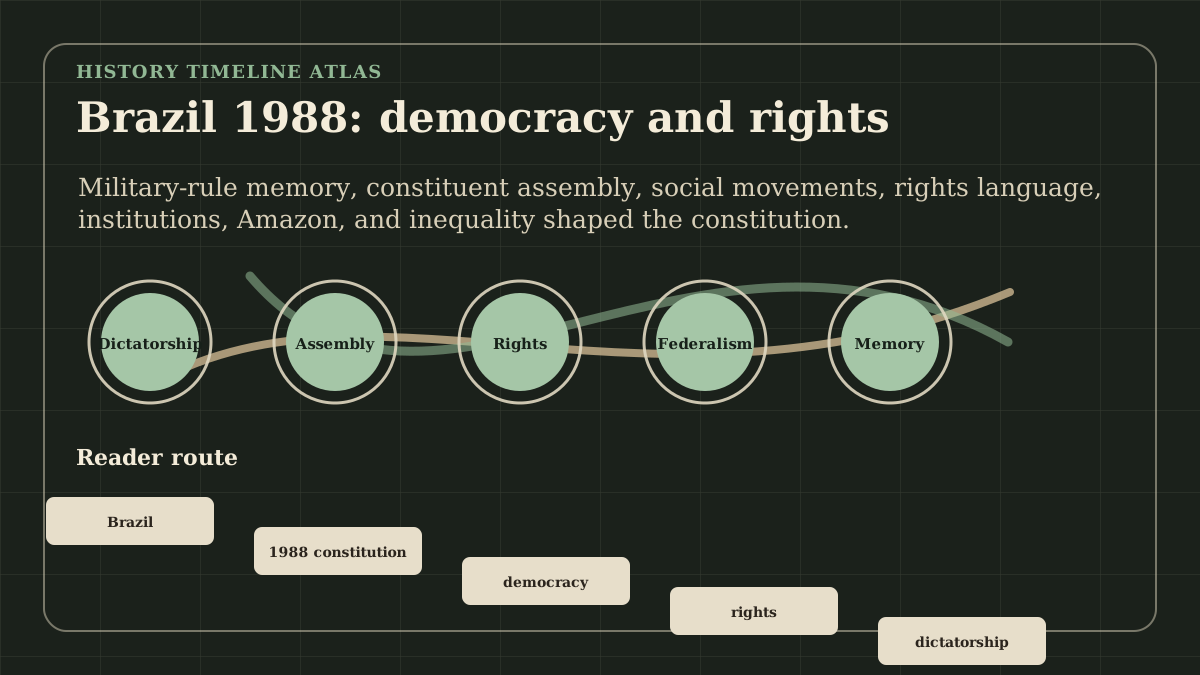
Interpreting the 1988 constitution therefore depends on which records you center — official minutes, activists’ testimonies, legal texts, or later public memory — because each source frames the story differently and highlights different consequences. Brazil's 1988 constitution is a democratization event, not only a legal milestone. It followed military rule, censorship, political violence, social mobilization, labor activism, church organizing, Indigenous claims, urban movements, and demands for a civilian state that could not simply return to old habits. The constitution became a public answer to dictatorship. The constituent process matters because rights were argued into the state by many actors. Lawmakers, unions, lawyers, social movements, health reformers, rural communities, Indigenous representatives, feminists, and neighborhood organizations all pushed claims into constitutional language.
The text is therefore a record of pressure as well as design. Brazil's size makes the constitution more complex. Federalism, regional inequality, Amazon land conflicts, racial inequality, urban poverty, policing, labor rights, education, health, and environmental protection all made democracy practical rather than abstract. A constitution had to speak to institutions and lived inequalities at the same time.
The Turning Point
What shifted during 1988 was less a single decisive act than a set of consequential choices about form and language. In Brasilia, Brazilian lawmakers drafted and approved a constitution that translated public demands into legal commitments: it expanded the language of rights in ways that reached beyond narrowly electoral politics and gave civilian institutions renewed authority. Civil society movements shaped the document’s tone and content, pressing for protections and legal recognition that had been absent or suppressed under military governance. Lawmakers had to decide where to grant guarantees, where to leave discretion to future administrations, and how to build institutions that would check power while enabling democratic governance.
The result was a constitution intended to break with the past: it set out a new legal framework, articulated an expanded set of rights, and attempted to embed civilian control over political life, even as debates over the scope of those commitments continued in courtrooms, streets and legislatures. The turning point was the move from authoritarian memory to constitutional commitment. The new order expanded civil, political, social, and collective rights while trying to rebuild trust in civilian institutions. It did not erase military-rule legacies, but it created a framework for contesting them. The constitution also made rights justiciable and visible.
Courts, parties, social movements, journalists, prosecutors, and ordinary citizens gained a language for claims about health, land, labor, environment, and dignity. That language became part of Brazil's democratic practice.
Consequences
In the immediate aftermath, the constitution became the organizing framework for Brazil’s post-dictatorship political order: new institutions, procedures and legal claims took shape under its terms. Over the longer term, it supplied a legal architecture that political actors, social movements and courts have used to contest policy, demand services, and defend civil liberties. The document also gave the Latin America route a democratization chapter: it stands as one prominent pathway through which societies moved from authoritarian rule toward constitutional democracy. Yet its legacy is not straightforward. Different communities read the constitution through different evidentiary lenses — official records, oral memory, legal battles, and diplomatic or labor archives — and these perspectives do not always agree.
The constitution opened avenues for rights and participation, but it also produced new arenas of conflict over interpretation and implementation that have shaped Brazil’s politics and public memory in varied and ongoing ways. The long consequence is double. Brazil gained a durable democratic framework after military rule, but constitutional promise has had to operate inside inequality, corruption, violence, polarized politics, and institutional strain. The event matters because it created tools for conflict, not because it solved every conflict. The page also connects Latin American democratization to wider rights history. Brazil's constitution belongs beside truth commissions, human-rights movements, transitions from dictatorship, Indigenous claims, and debates over whether formal democracy can change material power.
Interpretation Notes
Interpretations of Brazil's Democratic Constitution depend on whose evidence is centered: rulers and official records, affected communities, oral memory, archaeology, law, diplomacy, labor, and later public memory do not always tell the same story.
Why Keep Reading
Follow this chapter to see how a written constitution becomes a living instrument: subsequent elections, judicial decisions and social struggles tested the promises of 1988. Readers who want to trace the constitution’s reach should watch how rights language translated into policy debates, how civilian institutions asserted themselves in moments of crisis, and how different communities preserved or contested the memory of transition. The next events will show how laws meet politics on the ground and why a single document can produce many competing histories. Read Brazil's 1988 constitution beside Chile, Argentina, South African transition, human-rights history, and Latin American democratization. That route asks how societies write law after authoritarian violence.
Reading Path
Follow the story without losing the thread
Before This
- Solidarity Movement in Poland1980
- Fifth Pan-African CongressOctober 1945
- Women's Suffrage in the United StatesAugust 18, 1920
After This
- Tiananmen Square Protests1989
- Nelson Mandela ReleasedFebruary 11, 1990
- Fall of Apartheid1994
Same Period
Wider Timeline
Mind Map
How to think about Brazil's Democratic Constitution
Demand for civilian rule
Public pressure and political negotiation after military governance created the impulse for a new constitutional order
Map Layer
Where this event sits geographically
Gold pins mark the approximate locations of published event pages. This is a schematic locator map, not a historical border map.
Coordinates are approximate and are used to help readers orient themselves before opening a full event page.
References
Where to Check the Facts
- Constitute Project: Brazil's Constitution of 1988Reference text for Brazil's 1988 constitution, later amendments, institutional design, and rights language.
- Encyclopaedia Britannica: Brazil: The return of civilian governmentReference for Brazil's democratic transition after military rule and the post-1988 political setting.