At a Glance
The shape of the event
- Date
- 1810
- Place
- Buenos Aires
- Type
- Revolutionary Junta
The May Revolution in Buenos Aires formed a local junta amid the crisis of Spanish monarchy and imperial authority.
1810; place the event in Buenos Aires before comparing causes or consequences.
The event shows how Latin American independence began through local power vacuums as well as ideology.
Buenos Aires revolutionaries / Creole elites are the first names or groups to compare before widening the story.
The Rio de la Plata region entered a long revolutionary process that led toward Argentine independence.
The Rio de la Plata region entered a long revolutionary process that led toward Argentine independence.
The event shows how Latin American independence began through local power vacuums as well as ideology.
Follow the next chapters to see how a local junta becomes a node in a wider contest over statehood, diplomacy, and war.
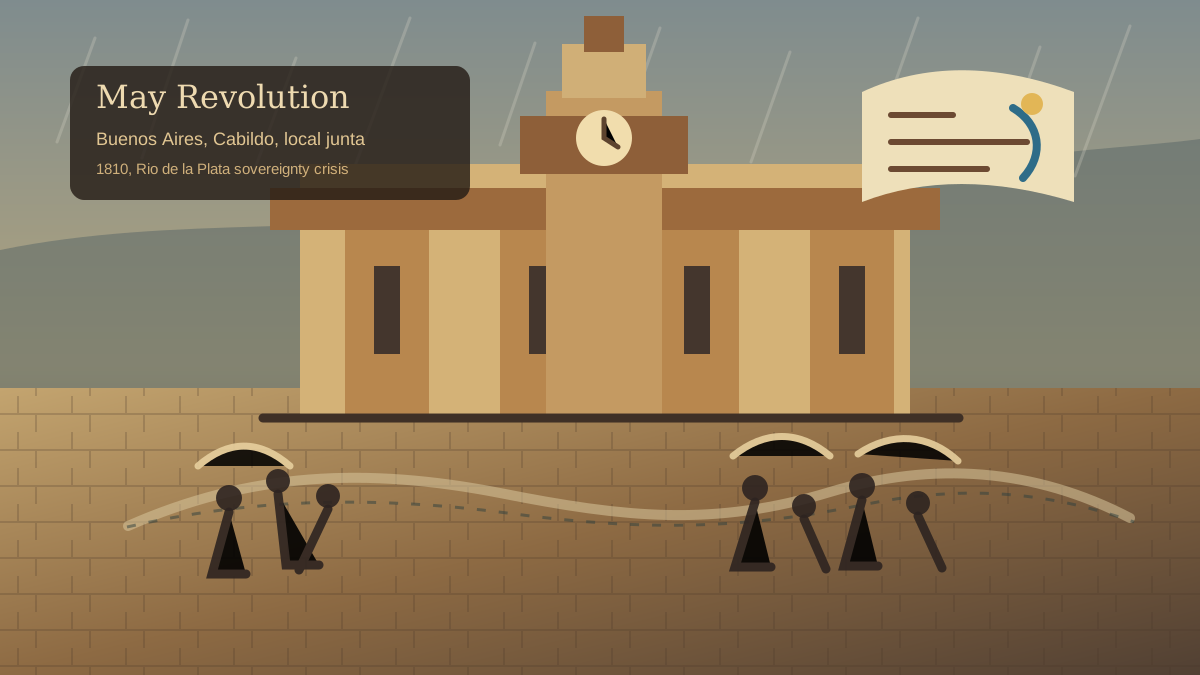
Background
By 1810 the Spanish Empire’s hold on its Atlantic possessions had been strained by events and by internal questions of legitimacy. In the ports and plazas of the Rio de la Plata, Buenos Aires elites and popular actors watched imperial directives arrive late, altered, or not at all. Creole elites—locally born men of property, office, and influence—faced a dilemma: accept distant authority whose capacity to govern appeared compromised, or claim a substitute authority on local ground. At the same time, Buenos Aires had its own commercial and civic rhythms: harbor traffic, municipal councils, guilds, and legal institutions that made power visible and negotiable. Those structures could be marshaled to justify a new arrangement of rule, and they were.
The crisis in the Spanish monarchy created a practical opening; local networks of influence and the resources they commanded supplied the means to fill it. Yet this was not a single cause event. Political argument, economic interest, legal reasoning, and the contingencies of communication and diplomacy all overlapped—and different observers then and since have emphasized different threads in that weave. The May Revolution should be read as an Atlantic imperial crisis localized in Buenos Aires. Napoleon's invasion of Spain, uncertainty over legitimate authority, Creole ambitions, militia experience, trade interests, and cabildo politics all shaped the events of May 1810. The revolution did not instantly create modern Argentina; it opened a struggle over sovereignty in the Rio de la Plata.
The page also needs to show that independence movements were not identical across Latin America. Buenos Aires politics, rural provinces, Indigenous frontiers, royalist resistance, ports, armies, and regional rivalries made the path from junta to nation uneven.
The Turning Point
The decisive move in Buenos Aires was not a battle but a public reallocation of authority. Faced with competing claims over who represented legitimate sovereignty, a coalition of Buenos Aires revolutionaries and segments of the Creole elite convened and established a local junta. That choice turned the ambiguity of imperial crisis into concrete governance: municipal orders, public proclamations, and new councils replaced the accustomed chain of command. Actors mattered: merchants and local officials controlled ports and fiscal levers; civic notables controlled councils and legal arguments; popular assemblies and public pressure shaped what was politically feasible. The junta did not claim absolute independence in a single breath; it lodged the right to govern locally while imperial structures faltered.
By assembling local administrative, judicial, and military authority under a junta, those who acted in Buenos Aires created a working center of power in the Rio de la Plata where before there had been reliance on directives from over the ocean. That reorientation—choosing local rule in a time of imperial breakdown—marked the turning point that propelled the region into a protracted revolutionary process. The turning point was the removal of the viceroy and the formation of a local governing junta. Authority shifted from imperial appointment toward claims that local political communities could act during the Spanish monarchy's crisis.
Consequences
In the near term the formation of a local junta reorganized political life in the Rio de la Plata. Offices, loyalties, and chains of command were reconstituted around locally sanctioned institutions rather than direct Spanish rule. Those changes produced immediate administrative and diplomatic ripples: new proclamations, shifts in trade regulation, and contested jurisdiction over military forces. Over the longer term, the May Revolution initiated a political trajectory that pushed the region toward the independence movements later associated with Argentina. It demonstrated a pattern that reappeared elsewhere in Spanish America: when metropolitan authority weakened, local actors often asserted governance, creating revolutionary processes that combined legal argument, material interest, and public pressure.
Importantly, the event also complicates our narratives: historians and communities read it differently depending on whether they center rulers’ archive records, oral memory, labor histories, legal petitions, archaeological evidence, or later public commemorations. Those divergent evidential paths mean the May Revolution can be seen at once as an elite-driven reordering of power, a popular assertion of local autonomy, and the opening of a broader independence movement—each interpretation highlighting different consequences. Its afterlife includes wars of independence, conflict between Buenos Aires and interior provinces, debates over federation, and later Argentine national memory. The event matters because it began a long argument over who could speak for the territory.
Interpretation Notes
Interpretations of May Revolution depend on whose evidence is centered: rulers and official records, affected communities, oral memory, archaeology, law, diplomacy, labor, and later public memory do not always tell the same story.
Why Keep Reading
Follow the next chapters to see how a local junta becomes a node in a wider contest over statehood, diplomacy, and war. The process after 1810 was neither linear nor uniform: some provinces negotiated with Buenos Aires, others resisted; commercial ties were reworked even as military fronts opened; law and custom were invoked to legitimate opposing projects. Tracking subsequent events clarifies how decisions taken in plazas and councils shaped institutions that lasted, how different social groups experienced the shifting order, and how memory and myth later folded the May Revolution into national stories. If you want to understand how an imperial crisis translated into concrete institutions and contested loyalties, the next timelines and documents show that translation in motion.
Read the May Revolution with San Martin, Paraguay independence, Gran Colombia, Brazil, and Latin American independence explainers to compare how imperial crisis became different state-building paths.
Reading Path
Follow the story without losing the thread
Before This
After This
Same Period
Wider Timeline
Mind Map
How to think about May Revolution
Imperial crisis
A breakdown in metropolitan authority created a practical opening for local governance.
Map Layer
Where this event sits geographically
Gold pins mark the approximate locations of published event pages. This is a schematic locator map, not a historical border map.
Coordinates are approximate and are used to help readers orient themselves before opening a full event page.
References
Where to Check the Facts
- Primary Source Set: Latin American RevolutionariesPrimary-source set reference for Latin American revolutionary leaders, documents, and independence politics.
- Library of Congress: Hispanic Reading Room CollectionsArchive and collection reference for Latin America, the Caribbean, Iberian worlds, and related primary materials.
- Cambridge University Press: The Cambridge History of Latin AmericaSpecialist scholarly synthesis for colonial society, independence, republic-building, regional variation, and modern Latin American historiography.
- Oxford Research Encyclopedia of Latin American HistoryPeer-reviewed reference for Latin American history themes, regional debates, social history, and competing interpretations.
- John Carter Brown Library: Spanish America collectionPrimary-source collection reference for Spanish American independence, printed political culture, maps, and early republican debate.
- Encyclopaedia Britannica: Latin America independenceReference for Spanish American and Portuguese American independence movements.
- Encyclopaedia Britannica: History of Latin AmericaReference for Latin American colonial, independence, national, and modern history.
- Official UNESCO World Heritage Centre: City of PotosiInstitutional reference for Potosi's mining city, colonial extraction, and global silver economy.
- Encyclopaedia Britannica: Argentina, Revolution and IndependenceSpecific reference for Buenos Aires, the May Revolution, the Rio de la Plata crisis, and Argentina's independence process.
- Library of Congress: Latin American RevolutionariesTeaching reference for Latin American independence movements, revolutionary actors, Spanish imperial crisis, and republican claims.