At a Glance
The shape of the event
- Date
- 1482
- Place
- Elmina
- Type
- Fortified Trading Post
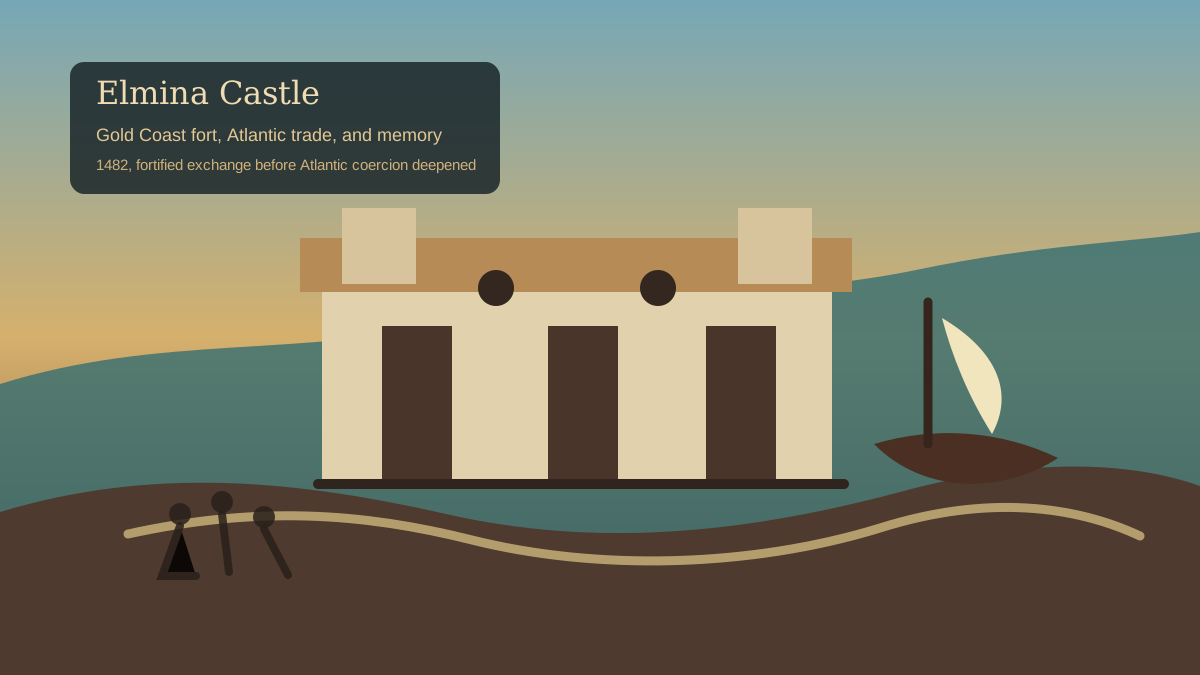
Portuguese traders established Elmina Castle on the Gold Coast, linking West African commerce to expanding Atlantic routes.
1482; place the event in Elmina before comparing causes or consequences.
The event gives the slavery route a West African coastal anchor before plantation slavery expands in the Americas.
Portuguese traders / Akan coastal communities are the first names or groups to compare before widening the story.
Elmina became a fortified commercial post and later a major site in Atlantic slave-trade history.
Elmina became a fortified commercial post and later a major site in Atlantic slave-trade history.
The event gives the slavery route a West African coastal anchor before plantation slavery expands in the Americas.
Follow the subsequent threads to see how a single fort became entangled with wider Atlantic transformations: how coastal commerce shifted as inland routes were redirected; how local authorities negotiated or resisted...
Background
In the late fifteenth century a web of pressures converged along the Gulf of Guinea: European mariners and merchants were carving ever-longer sea routes, Portuguese state interests sought footholds beyond coastal trade, and West African polities and coastal communities were already engaged in wide-ranging inland and maritime exchanges. Coastal towns and markets around the Gold Coast were nodes in networks of gold, kola, cloth, and human labor; they were not blank spaces waiting for European arrival. At the same time, the Atlantic was becoming a growing highway for goods, ideas and people, and a fortified presence on the shore could change who controlled access and how profits were organized.
This moment cannot be reduced to a single cause: it was shaped by metropolitan ambitions, local commercial strategies, shifting alliances among Akan communities, and the technical and logistical choices of seafarers who needed secure places to offload goods and take on supplies. Different kinds of evidence—state records, travelers’ lists, oral histories and archaeology—illuminate different pressures, and they sometimes point in different directions. Elmina Castle began as a Portuguese fortified trading post on the Gold Coast, but its meaning changed as Atlantic commerce became more violent and coercive. It connected gold, diplomacy, European rivalry, African coastal politics, and eventually the infrastructure of the slave trade. The page should not make Europeans the only actors.
Akan and other coastal communities negotiated, resisted, traded, and adapted under unequal pressure, while forts became places where local politics, commercial opportunity, and imperial coercion met.
The Turning Point
The establishment of Elmina Castle in 1482 marked a deliberate choice by Portuguese traders to turn a coastal anchorage into a permanent fortified trading post. Rather than relying solely on seasonal or ad hoc barter, the construction of a fort physically imposed a year-round locus for exchange under Portuguese control. That choice reconfigured everyday interactions: merchants, local leaders and coastal communities now faced a built, defended space where goods, credit and negotiation would be mediated through a European-controlled installation. The fortification itself signaled intentions beyond casual trade—it was a platform for diplomacy, for storing commodities, and for protecting maritime routes that linked the Gold Coast to Atlantic circuits.
For Akan coastal communities the castle presented new opportunities and risks: access to new markets and manufactured goods, but also a new center through which external actors could exert influence. The immediate moment in 1482 therefore shifted how commerce was conducted, who profited directly from certain kinds of exchange, and how coastal mobility and political bargaining would be shaped in the decades that followed. The turning point was the building of a durable fortified node in Atlantic exchange. Stone walls, cannon, warehouses, chapels, cells, and harbor access made commerce territorial and helped tie West Africa to expanding oceanic empires.
Consequences
In the near term Elmina’s stone walls turned a fluctuating coastline into a fortified commercial post where Portuguese traders could aggregate goods, negotiate with local intermediaries, and project a measure of security over shipping. That physical concentration of trade altered commercial patterns: some exchanges moved toward the fort as a convenient site for storage and payment; others continued outside its shadow. Over the longer term Elmina became an enduring point on Atlantic routes and, as trade patterns evolved, a major site in the history of the Atlantic slave trade. In that trajectory the castle functioned as a coastal anchor for a route that would connect West African captives to markets across the ocean before plantation slavery expanded in the Americas.
The consequences were not only economic: law, diplomacy, labor practices and memory were all reframed around a built colonial presence. Yet interpretations of those consequences depend on which evidence is foregrounded. Official Portuguese records emphasize trade, treaties and imperial control; oral memory, local chronicles and archaeology reveal disrupted communities, shifting labor regimes and contested meanings. The multiplicity of sources complicates any single narrative: Elmina’s walls were both a practical structure for exchange and a stage on which very different human experiences unfolded and were later remembered or suppressed. The afterlife includes Dutch seizure, Atlantic slavery, diaspora memory, Ghanaian heritage work, UNESCO protection, and debates over how to interpret sites that are both architectural monuments and places of trauma.
Its walls force commerce, violence, and remembrance into the same frame.
Interpretation Notes
Interpretations of Elmina Castle Established depend on whose evidence is centered: rulers and official records, affected communities, oral memory, archaeology, law, diplomacy, labor, and later public memory do not always tell the same story.
Why Keep Reading
Follow the subsequent threads to see how a single fort became entangled with wider Atlantic transformations: how coastal commerce shifted as inland routes were redirected; how local authorities negotiated or resisted European presidios; and how, over time, the infrastructure of trade hardened into systems that trafficked in enslaved people. Exploring the timelines that follow Elmina’s founding lets readers trace how law, diplomacy, material culture and memory each tell part of the story—often at cross-purposes—and why the castle’s meaning continues to be contested in public histories, archaeology and community memory. Read Elmina with Portuguese-Kongo contact, the Zong Massacre, British abolition, the Berlin Conference, and African decolonization to follow how Atlantic commerce became empire and memory.
Reading Path
Follow the story without losing the thread
Before This
- Songhai Empire Risesc. 1464 CE
- Mali Empire Foundedc. 1235 CE
- Ghana Empire Flourishesc. 800 CE
After This
Same Period
- Ghana Empire Flourishesc. 800 CE
- Mali Empire Foundedc. 1235 CE
- Songhai Empire Risesc. 1464 CE
Wider Timeline
Mind Map
How to think about Elmina Castle Established
Atlantic demand
Growing European markets and longer sea routes created demand for West African commodities, encouraging permanent trading sites.
Map Layer
Where this event sits geographically
Gold pins mark the approximate locations of published event pages. This is a schematic locator map, not a historical border map.
Coordinates are approximate and are used to help readers orient themselves before opening a full event page.
References
Where to Check the Facts
- Encyclopaedia Britannica: Transatlantic slave tradeReference for the forced migration system, Atlantic paths, and slavery's global consequences.
- Official database: Slave VoyagesReference database for transatlantic slave trade paths, voyages, forced migration, and estimates.
- UNESCO World Heritage Centre: Forts and Castles in GhanaWorld Heritage reference for Portuguese fortified trading posts from 1482 onward, including Elmina and Ghana's Atlantic coast.
- Ghana Heritage Conservation Trust: Elmina CastleLocal heritage reference for Elmina Castle, Portuguese construction, Fort St. Jago, UNESCO status, and public memory.