At a Glance
The shape of the event
- Date
- 1781
- Place
- Atlantic Ocean
- Type
- Massacre and Insurance Case
The killing of enslaved Africans aboard the slave ship Zong became a notorious example of how commerce treated human life as insurable property.
1781; place the event in Atlantic Ocean before comparing causes or consequences.
The event makes the violence of the Middle Passage impossible to reduce to numbers alone.
Enslaved Africans aboard the Zong / British insurers are the first names or groups to compare before widening the story.
The legal dispute and public outrage strengthened abolitionist arguments against the slave trade.
The legal dispute and public outrage strengthened abolitionist arguments against the slave trade.
The event makes the violence of the Middle Passage impossible to reduce to numbers alone.
Follow the Zong case into the wider Atlantic slavery route: the Middle Passage, British abolition, the Haitian Revolution, and later emancipation struggles.
Background
By the late eighteenth century the transatlantic slave trade was organized around contracts, ships, insurers and legal routines that treated captives as commercial cargo. Long ocean voyages exposed captives and crews to disease, violence, and shortages; masters and owners navigated tight profit margins and constant risk calculations. Marine insurance was an ordinary part of maritime business: insurers underwrote voyages and losses under specified conditions. When the ‘‘cargo’’ was human, the accounting of loss followed commercial logic rather than humanitarian ones. At the same time, a growing abolitionist movement in Britain was challenging the moral and legal foundations of slavery through pamphlets, petitions and parliamentary pressure. The Zong incident unfolded inside these overlapping pressures.
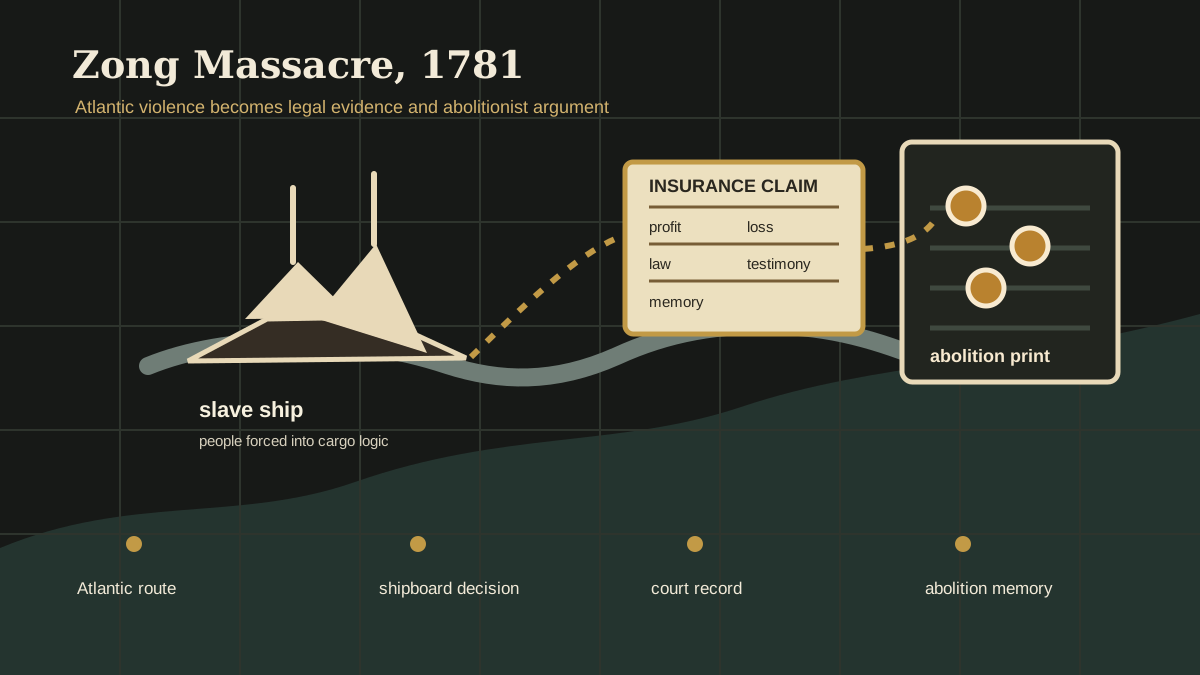
It cannot be reduced to a single cause: it was a collision of mercantile practice, maritime danger, and shifting public sensibilities. How historians reconstruct it depends on the records they center: official insurance papers and court filings tell one story; the lives and memories of the captives, largely absent from those archives, tell another; later public memory frames the episode as emblematic of systemic cruelty. The Zong Massacre exposes the Atlantic slave trade at its most chillingly bureaucratic. Enslaved Africans aboard the ship were not only subjected to violence at sea; after the killings, the legal dispute turned on insurance and commercial loss. That movement from murder to claim paperwork is the center of the history.
The event belongs to maritime law, abolition, capitalism, and Black Atlantic memory at once. Evidence comes through court records, abolitionist publicity, shipboard practice, insurance logic, and later historical reconstruction, each revealing how a system built for profit tried to make human death legible as property damage.
The Turning Point
On the Zong the ordinary business of slavery and insurance fractured into a public crisis. Faced with deadly conditions aboard, actors on the ship—crew and owners—made choices that resulted in the killing of enslaved men, women and children. Those killings were not left to remain only a shipboard catastrophe: the ship’s owners pressed an insurance claim, framing the loss in commercial terms. British insurers and the courts were thereby drawn into a dispute that treated the deaths primarily as a question of property and indemnity. That legal framing turned the episode outward, from the deck of a ship to courtrooms and the public sphere.
Witness statements, commercial papers and press reports circulated, allowing different audiences to interpret events through legal, moral or economic lenses. Some legal actors pursued narrow questions of contract and policy; abolitionists and critics used the publicity to argue that the mercantile order itself enabled lethal treatment. The turning point was therefore both the violence inflicted and the decision to litigate the loss as an insurance matter, forcing institutions to articulate how law and commerce understood human life. The turning point was the decision to throw enslaved people overboard and then treat the deaths as an insurable loss.
That choice did not emerge from a moral vacuum; it was enabled by a commercial world that had already converted captives into cargo on manifests and balance sheets. The later court case did not prosecute murder in the modern sense. It exposed how law could be organized around property claims while avoiding the humanity of the victims. Abolitionists seized on that gap, using the case to show the brutality hidden behind respectable commerce.
Consequences
The immediate consequence was a high-profile legal dispute that exposed the assumptions embedded in maritime insurance and mercantile law. Public reaction—sharpened by abolitionist activists—translated the dry language of policies and claims into a moral indictment of the trade. In the near term the case did not end the slave trade, but it amplified scrutiny of how law treated enslaved people and how commercial institutions allocated risk and value. Over time the episode became a recurring touchstone for abolitionists who argued that legal and financial structures made systemic brutality possible. It also altered public memory: newspapers, pamphlets and later histories invoked the incident to illustrate the human cost of trafficking in human beings.
Subsequent scholarly debates show that interpretation depends on which evidence is foregrounded—court records, insurance documents, oral memory or material remains—each emphasizing different aspects. Above all, the Zong incident makes clear that the violence of the Middle Passage cannot be reduced to statistics; it was produced by decisions, institutional logics and legal frameworks that normalized deadly outcomes when it served profit and indemnity. The massacre became a powerful abolitionist reference because it condensed the violence of the slave trade into a legal scandal that could not be dismissed as rumor. Yet the case also reveals the limits of public outrage. It did not instantly end British slave trading, and many victims' names remain unknown.
Its importance lies in how it forced readers, judges, activists, and merchants to confront the logic of a system that made atrocity financially arguable. The Zong is therefore not only a story of one ship; it is a window into the machinery that made mass violence ordinary. The evidence itself is part of the historical problem. Much of the surviving record comes from owners, insurers, lawyers, and abolitionist publication rather than from the Africans killed on the voyage. The case that became public was an insurance dispute, not a murder prosecution, and the names of most victims were not preserved in the official record.
That imbalance is why the event needs careful wording: the legal archive reveals the violence of property thinking, but it also shows whose voices the system tried to erase.
Interpretation Notes
Interpretations of Zong Massacre depend on whose evidence is centered: rulers and official records, affected communities, oral memory, archaeology, law, diplomacy, labor, and later public memory do not always tell the same story.
Why Keep Reading
Follow the Zong case into the wider Atlantic slavery route: the Middle Passage, British abolition, the Haitian Revolution, and later emancipation struggles. The comparison helps readers see how a single legal dispute exposed a larger system in which ships, insurance, courts, and public print could turn human suffering into commercial language while abolitionists fought to make that violence visible.
Reading Path
Follow the story without losing the thread
Before This
After This
Same Period
- Stono Rebellion1739
- Columbus's First Atlantic Voyage1492 CE
- Zimmermann TelegramJanuary 1917
Wider Timeline
Mind Map
How to think about Zong Massacre
Commodification
Enslaved people were treated in commercial documents as cargo and subject to insurance accounting.
Map Layer
Where this event sits geographically
Gold pins mark the approximate locations of published event pages. This is a schematic locator map, not a historical border map.
Coordinates are approximate and are used to help readers orient themselves before opening a full event page.
References
Where to Check the Facts
- Encyclopaedia Britannica: Transatlantic slave tradeReference for the forced migration system, Atlantic paths, and slavery's global consequences.
- Gilder Lehrman Institute: Olaudah Equiano, 1789Primary-source teaching reference for Equiano's abolitionist narrative and remembered Middle Passage experience.
- Official database: Slave VoyagesReference database for transatlantic slave trade paths, voyages, forced migration, and estimates.
- Library of Congress: U.S. History Primary Source TimelinePrimary-source timeline reference for Atlantic settlement, colonial expansion, reform, and later U.S. history paths.