Look for how new machines changed time discipline, urban life, class conflict, and the bargaining power of workers.
Timeline
Industrial Revolution Timeline
A timeline of industrialization, infrastructure, capital, labor, and the global pressures that followed mechanized production.
Timeline Guide
How did industrialization move from mills and machines into labor conflict, empire, infrastructure, and financial risk?
Read this edited guide as a path through dates, places, affected lives, source limits, and contested memory rather than as an exhaustive database.
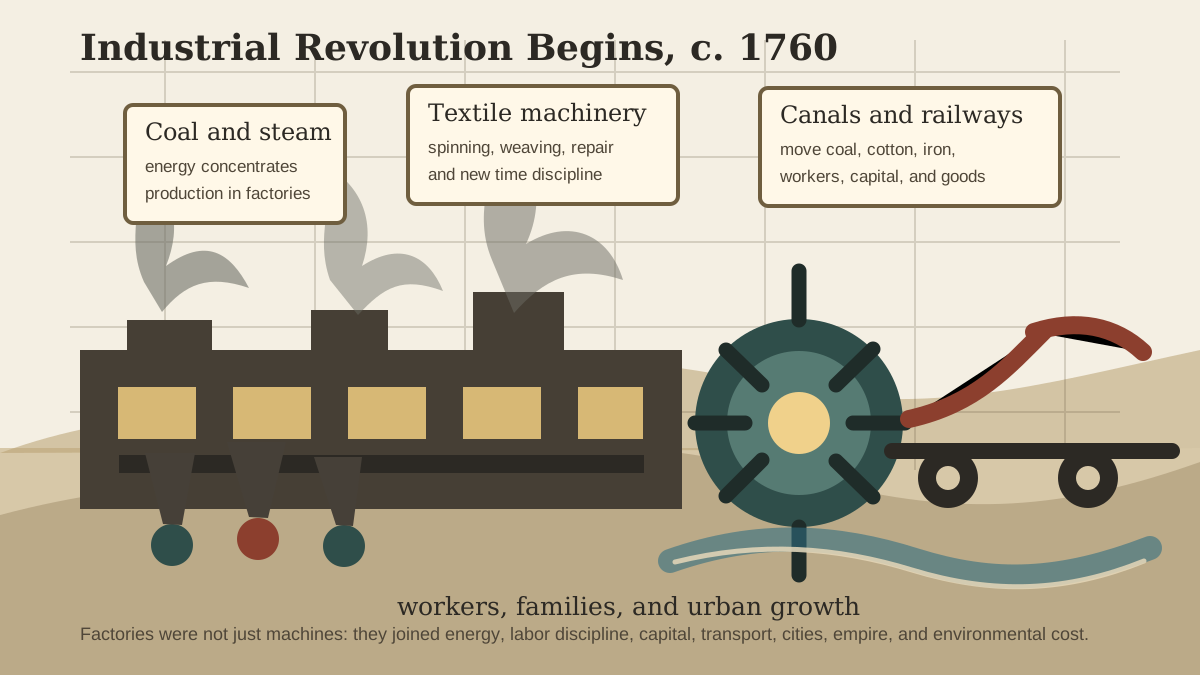
Begin in a mill town, not with an abstract word. In Manchester, cotton machines, coal smoke, canals, warehouses, investors, child workers, mechanics, and crowded streets made industrial change visible before it became a global category. The Industrial Revolution proper is usually dated from the mid-eighteenth to the mid-nineteenth century, especially in Britain, even though its background reached into earlier Atlantic commerce, agrarian change, colonial markets, and energy use.
That periodization matters. The Columbian Exchange, Potosi silver, early modern empire, and plantation economies created world connections before industrialization, but they were background conditions rather than the mechanized factory system itself. Cotton spun in British mills depended on Atlantic slavery, plantation land, merchant credit, and imperial shipping as well as on machines. Industrialization changed how work, energy, capital, machines, and infrastructure could be coordinated at speed.
The story also has actors outside Britain. Indian textile producers, enslaved laborers in the Americas, Chinese consumers and officials facing opium pressure, African communities confronted by partition, Japanese reformers in the Meiji state, and workers organizing in Europe and Latin America all shaped the industrial world. Some supplied raw materials or markets under coercion; others adopted machines, built railways, resisted taxes, or used new political language against empire.
The Industrial Revolution begins the route because it changed the material base of production. The Suez Canal then shows how industrial and imperial priorities reshaped geography itself by shortening routes and intensifying strategic competition. The Berlin Conference shows how European powers tried to formalize imperial claims in Africa while excluding African political voices from the rules being written.
Start With These Dates
- 1492 onwardColumbian Exchange Begins
After sustained transatlantic contact, plants, animals, pathogens, people, and forced labor systems moved across the Atlantic with world-changing consequences.
- 1545Potosi Silver Boom Begins
Silver mining at Potosi became a massive colonial enterprise linking Andean labor, Spanish finance, and global silver flows.
- 1602 CEDutch East India Company Founded
The Dutch East India Company was founded as a chartered corporation with commercial and political powers in Asian trade.
- 1757 CEBattle of Plassey
The British East India Company defeated the nawab of Bengal at Plassey, turning commercial power into a much deeper political and military foothold in India.
- 1876 CETelephone Patented
Alexander Graham Bell received a patent for the telephone, helping launch a new era of voice communication over distance.
- 1956 CESuez Crisis
The Suez Crisis followed Egypt's nationalization of the canal and a British, French, and Israeli attack that exposed the limits of old imperial power.
- 1980Solidarity Movement in Poland
Polish workers formed Solidarity, an independent labor movement that challenged communist authority through organization, strikes, and civil society.
- 1997Hong Kong Handover
Britain transferred Hong Kong to China under the one country, two systems framework, linking treaty-port history, decolonization, capitalism, sovereignty, and civic memory.
Sources Used Here
- Cambridge University Press: The British Industrial Revolution in Global Perspective
Academic reference for industrialization in global economic perspective, wages, energy, commerce, and comparative development.
- Oxford University Press: The Industrial Revolution
Accessible scholarly synthesis for periodization, productivity, manufacturing technology, and social transformation.
- Encyclopaedia Britannica: The First Industrial Revolution
Specific reference for the first phase of industrialization and its spread.
- Science and Industry Museum
Institutional reference for industrial heritage, technology, and public interpretation.
- Science and Industry Museum: Objects and Stories
Museum reference for industrial collections, Manchester, invention, and social transformation.
The Wall Street Crash makes clear that industrial capitalism produced systemic vulnerability as well as growth. A timeline that begins with mills and machines ends with finance because the industrial world depended on capital flows, speculation, demand, debt, and confidence. The route is useful because it connects factory floors to global power.
Read the events as connected layers. Technology changes production; production demands routes and raw materials; routes increase strategic pressure; imperial rules reorganize territory; finance turns confidence into a historical force. The timeline becomes richer when the reader sees industry not as progress alone, but as a new machinery of power.
This timeline treats the Industrial Revolution as a world-history route rather than a narrow story of British machines. Mechanized production is central, but factories depended on older flows of silver, cotton, sugar, capital, ocean routes, chartered companies, colonial power, and coerced labor. The opening nodes therefore begin before 1760. They show how exchange and extraction created some of the conditions that later industrial systems would intensify.
The Columbian Exchange and Potosi silver boom make the timeline uncomfortable in a useful way. Industrial capitalism did not emerge from clean invention alone. It inherited ecological change, forced labor, mining wealth, plantation production, and expanding Atlantic and Pacific circuits. These earlier systems were not yet industrial factories, but they shaped prices, consumption, credit, empire, and the global imagination of what could be extracted and moved.
The Dutch East India Company and the Battle of Plassey show commerce becoming rule. Companies could act through ships, forts, contracts, investors, soldiers, and political bargains. In Bengal, company power joined trade to revenue and territorial control. That relationship matters because industrial production later needed markets, raw materials, transport, and state protection. The route helps readers see why economic history and imperial history cannot be kept in separate boxes.
The core industrial node around 1760 is not just a machine date. It asks how coal, steam, textiles, wages, patents, workshops, factories, canals, ports, and labor discipline changed the scale of production. The transformation was uneven. Some regions industrialized earlier, some supplied raw materials, some were reorganized as markets, and some paid the cost through dispossession, unsafe labor, debt, or colonial pressure.
A short debate layer belongs near the machinery. Cambridge and Oxford references point readers toward arguments over why Britain industrialized early, how far high wages and cheap energy mattered, and whether early factories improved or damaged workers' living standards. The page does not settle the debate in one sentence. It shows that periodization, wages, energy, and worker welfare are questions historians argue over with evidence.
The visible chronology reads like a route, not only a theme. First come exchange, silver, companies, and imperial revenue. Then come coal, steam, textiles, factories, and canals. After that the route follows Suez, railroads, telephones, Berlin, Japan's modernization, labor politics, crashes, decolonization, and handovers. That ordered movement helps a reader see why the Industrial Revolution page is a timeline rather than an essay with dates attached.
The timeline keeps resistance inside the story. Tupac Amaru II's rebellion, the First Fleet in Australia, Zanzibar's clove economy, and the Revolutions of 1848 show that industrial modernity did not simply spread as progress. It moved through plantation labor, convict transportation, imperial settlement, urban unrest, rural anger, and political demands. The sharper question is who experienced new production as opportunity and who experienced it as coercion.
Infrastructure is the second hinge. The Meiji Restoration, Suez Canal, transcontinental railroad, telephone, and Berlin Conference show a world being compressed by transport, communication, and imperial planning. These events belong together because speed changed power. Goods moved faster, armies and officials moved differently, news traveled farther, and states could imagine projects that earlier administrations could not manage at the same scale.
Industrialization changed empire's map. The Berlin Conference was not a factory, but it belongs on the timeline because industrial states used railways, steamships, rifles, finance, and administrative confidence to intensify territorial claims in Africa. The First Sino-Japanese War shows another version: industrial reform and military modernization changing East Asian power. The route is stronger when it follows Japan, Africa, India, the Atlantic, and Europe together.
Labor and citizenship form a third reading path. The Maji Maji Rebellion, Mexican Revolution, Mexican Constitution, and Solidarity later in Poland remind readers that workers, peasants, colonized communities, and citizens did not merely live inside industrial systems. They challenged them. Land, wages, food, taxation, unions, constitutions, and political voice became part of the industrial story because production changed the terms of social life.
The Wall Street Crash gives the timeline a systems-risk checkpoint. Industrial capitalism created enormous productive capacity, but it also created financial interdependence, speculative bubbles, unemployment, and state crises. The crash does not cancel the earlier story of invention and infrastructure. It shows the other side of a connected economy: shocks can travel through banks, factories, households, governments, and empires.
The late nodes show afterlife. Pan-African organizing, the Suez Crisis, Solidarity, and the Hong Kong handover all point to worlds shaped by industrial empire, ports, finance, labor, and decolonization. The Industrial Revolution was not only a moment in eighteenth-century Britain. It became a long global condition that shaped nationalism, cities, inequality, communication, and the politics of who controlled infrastructure.
A useful reader habit is to separate invention from adoption. A device or process matters when people can finance it, build it, repair it, discipline labor around it, move its inputs, sell its outputs, and defend the rules that make it profitable. That is why the timeline keeps returning to companies, ports, railroads, canals, constitutions, strikes, crashes, and anti-colonial pressure. Technology becomes historical through systems.
The story is strongest when read in layers. First, follow the dates from 1492 onward to 1997. Then read across the event types: biological and commercial exchange, mining expansion, company founding, battle and company rule. The timeline becomes more than chronology when those dates reveal decisions, institutions, violence, reform, and memory.
Telephone Patented sits near the middle of the sequence. Ask what had already become unavoidable by 1876 CE, what actors still believed they could control, and which consequences were already beginning to move beyond the original setting.
The named events are Columbian Exchange Begins, Potosi Silver Boom Begins, Dutch East India Company Founded, Battle of Plassey, Industrial Revolution Begins, Tupac Amaru II Rebellion. Each one pushes a more precise question: what changed, who benefited, who paid the cost, and what later page explains the aftermath more clearly?
Read the timeline against geography too. Places matter because power moves through corridors, borders, cities, ports, capitals, and frontiers. The map below keeps those distances visible while the event pages explain the human and institutional consequences.
A good timeline has a pulse: pressure, decision, expansion, resistance, and aftermath. When you move through Early Modern Atlantic, Colonial Latin America, Early Modern World, Early Colonial South Asia, and Modern World, keep asking whether an event is creating a new problem, revealing a hidden weakness, or making an earlier choice harder to reverse.
The human layer matters because timelines can become too abstract. Figures such as Indigenous communities, Atlantic colonizers, Andean laborers, Spanish colonial officials, Dutch merchants, Robert Clive, and Siraj ud-Daulah help the sequence feel lived rather than mechanical. Their choices do not explain everything, but they show where institutions, ideas, military systems, social movements, and public fear entered real decisions.
The ending is not only the last date. With closing events such as Fifth Pan-African Congress, Suez Crisis, Solidarity Movement in Poland, and Hong Kong Handover, the reader can ask what remained unsettled: which institutions survived, which arguments continued, which victims or opponents were left outside the official story, and which later crisis reused the same vocabulary.
Read this page once quickly for order, then read it again for contrast. Compare early confidence with later uncertainty, local decisions with global consequences, and visible turning points with slower changes in law, economy, belief, technology, borders, or memory. That second pass is where a timeline becomes an explanation.
Causation in this sequence is layered. One event may supply the trigger, another may reveal an older weakness, and a later event may show the consequence that people at the beginning did not expect. The useful habit is to separate background pressure, immediate decision, turning point, and aftermath before deciding which event matters most.
Consequences are uneven. A political settlement might look successful in one capital while creating resentment elsewhere; a military victory might end a campaign while deepening civilian trauma; a scientific or institutional breakthrough might solve one problem while creating new risks. The timeline is strongest when those mixed outcomes remain visible.
The final pass is comparative. After reading this sequence, open a neighboring topic or person page and ask whether the same pattern appears again. Repetition usually points to a structure; contrast usually points to a historical choice that could have gone another way.
Importance is not the same thing as drama. Some events are remembered because they were spectacular, while others matter because they changed rules, expectations, alliances, legal categories, technologies, or public language. Use the timeline to test both kinds of importance before deciding what belongs at the center of the story.
The page rewards moving outward. A timeline gives order, but the event pages give causes, maps, people, sources, and reading paths. When a date feels too compressed, open the full event page and then return here; the sequence becomes clearer with each pass instead of asking the reader to memorize a list.
Canals, ports, railways, and ships turned production into a global logistics problem.
Industrial power expanded demand for raw materials, markets, and strategic control.
Growth brought crises when finance, production, and confidence moved together.
Follow canals, railways, ports, telephones, factories, steamships, mines, and financial systems as tools that changed what states and companies could attempt.
Ask who worked, who was coerced, who migrated, who organized, and who absorbed the risks created by new production systems.
Compare factory growth with colonial extraction, market expansion with famine risk, and communication speed with stronger state surveillance.
Columbian Exchange Begins gives the opening problem a date and place. Ask what was already unstable before it happened.
Telephone Patented is a compression point: earlier causes are now crowded together with decisions that will shape the sequence's ending.
Follow the path through Atlantic World, Potosi, Amsterdam, Plassey, Britain, and Cusco region and ask how distance changed communication, logistics, fear, and control.
Hong Kong Handover works as both an ending and a beginning: it closes one sequence while opening later disputes, institutions, memories, or reforms.
Which conditions existed before the first event, and which later decision turned those conditions into visible historical change?
Who had the power to choose, who had fewer choices, and who is missing when the story is told only through leaders or institutions?
Which facts are date anchors, which are interpretations, and which claims need checking through the event sources before being repeated?
Which linked event, person, year, or topic page would change your interpretation if you read it next?
Interactive Timeline
Explore Industrial Revolution Timeline by sequence
Columbian Exchange Begins
After sustained transatlantic contact, plants, animals, pathogens, people, and forced labor systems moved across the Atlantic with world-changing consequences.
Read the full event pageNarrative Stages
Read this timeline in chapters
Global Inputs Before Factories
Early modern exchange, silver, chartered companies, and imperial finance supplied some of the routes and inequalities that industrial capitalism later intensified.
- Columbian Exchange Begins1492 onward
- Potosi Silver Boom Begins1545
- Dutch East India Company Founded1602 CE
- Battle of Plassey1757 CE
Mechanization, Labor, and Social Strain
Industrial production changed factories, labor, cities, plantations, mines, and political expectations across Britain, the Atlantic world, Africa, and Asia.
- Industrial Revolution Beginsc. 1760 CE
- Tupac Amaru II Rebellion1780-1781
- First Fleet Arrives in Australia1788
- Zanzibar Clove Economy Expands1832 CE
- Revolutions of 18481848 CE
Infrastructure, Communication, and Empire
Canals, railroads, telegraph-era communication, modernizing states, and colonial conferences tied industrial power to territorial expansion.
- Meiji Restoration1868 CE
- Opening of the Suez CanalNovember 17, 1869
- First Transcontinental Railroad CompletedMay 10, 1869
- Telephone Patented1876 CE
- Berlin Conference1884-1885
- First Sino-Japanese War Begins1894
Industrial Conflict and Revolutionary Pressure
Mass politics, anti-colonial resistance, constitutional claims, and war showed that industrial modernity produced conflict as well as productivity.
- Maji Maji Rebellion1905-1907 CE
- Mexican Revolution Begins1910
- Mexican Constitution of 19171917
- Armistice of 1918November 11, 1918
Crisis and Late Industrial Memory
Financial shock, decolonization, labor movements, and handovers reveal the long afterlife of industrial capitalism and empire.
- Wall Street Crash of 1929October 1929
- Fifth Pan-African CongressOctober 1945
- Suez Crisis1956 CE
- Solidarity Movement in Poland1980
- Hong Kong Handover1997
Map Layer
Industrial Revolution Timeline geography
Gold pins mark the approximate locations of published event pages. This is a schematic locator map, not a historical border map.
Event location Simplified land areaClick a pin to open the event page
Coordinates are approximate and are used to help readers orient themselves before opening a full event page.
References
Where to Check the Facts
- Cambridge University Press: The British Industrial Revolution in Global PerspectiveAcademic reference for industrialization in global economic perspective, wages, energy, commerce, and comparative development.
- Oxford University Press: The Industrial RevolutionAccessible scholarly synthesis for periodization, productivity, manufacturing technology, and social transformation.
- Encyclopaedia Britannica: The First Industrial RevolutionSpecific reference for the first phase of industrialization and its spread.
- Science and Industry MuseumInstitutional reference for industrial heritage, technology, and public interpretation.
- Science and Industry Museum: Objects and StoriesMuseum reference for industrial collections, Manchester, invention, and social transformation.