At a Glance
The shape of the event
- Date
- c. 1760 CE
- Place
- Britain
- Type
- Economic Transformation
Mechanized production, coal energy, factory organization, and new transport systems began transforming work and wealth in Britain before spreading globally.
c. 1760 CE; place the event in Britain before comparing causes or consequences.
Industrialization changed class relations, empire, technology, environmental pressure, and the daily rhythm of modern societies.
James Watt / Richard Arkwright are the first names or groups to compare before widening the story.
Manufacturing capacity grew, cities expanded, and industrial labor systems became more central to economic life.
Manufacturing capacity grew, cities expanded, and industrial labor systems became more central to economic life.
Industrialization changed class relations, empire, technology, environmental pressure, and the daily rhythm of modern societies.
Follow the next pages to see where these beginnings led: the spread of factory systems across regions, debates about labour and regulation, and how transport innovations reshaped markets and migration.
Background
The decades before c. 1760 saw several pressures converge without a single, tidy cause. Agricultural change and population growth altered labour availability; expanding markets—local, colonial, and continental—created steady demand for textiles and other manufactured goods; and commercial capital was increasingly mobile, seeking profitable outlets. Energy matters differently in this period: coal was already a familiar fuel in parts of Britain, and incremental technical improvements made it more useful for tasks beyond domestic heating. At the same time, transport improvements—roads, canals, and coastal shipping—reduced the cost of moving bulky raw materials and finished goods. These forces interacted with existing institutions: property rights, credit networks, guild practices, and imperial trade links.
Important individuals appear in the story, but historians caution against treating them as sole drivers. Interpretations differ over the balance between individual decisions and deeper structural forces; this page keeps those disputed points visible rather than treating one explanation as final. A richer Industrial Revolution page has to avoid treating machines as if they arrived without land, labor, fuel, and empire. Britain's early industrialization rested on coalfields, water power, skilled mechanics, commercial credit, expanding consumer markets, patents and workshops, agricultural change, and Atlantic connections that supplied raw cotton and buyers. No single cause carries the whole weight. The shift also began inside older work systems.
Domestic spinning, weaving households, small workshops, apprenticeships, seasonal labor, and rural by-employment all existed before factories became dominant. Industrialization changed these worlds unevenly. Some workers gained wages or new skills; others lost control over pace, place, family time, and bargaining power. Global context matters because cotton did not grow in Lancashire and because industrial growth was tied to slavery, colonial trade, and unequal exchange. Raw materials, plantation labor, shipping insurance, credit, and imperial markets connected the mill to the Atlantic and Indian Ocean worlds. The factory was local, but its supply lines were not.
The Turning Point
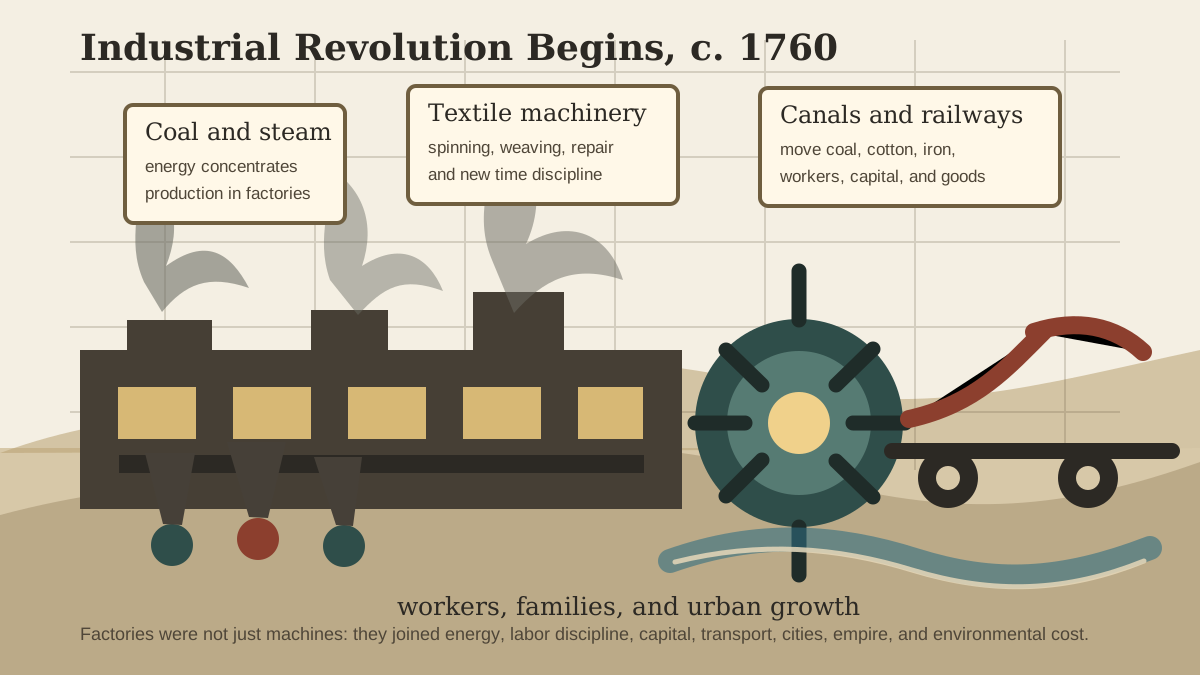
Around the mid‑eighteenth century the pace of change quickened because several practical choices and experiments spread from person to person and place to place. Entrepreneurs and engineers adopted mechanized production methods in workshops and then in purpose-built factories. Coal was harnessed more widely as an energy source to power machines and concentrate production in fixed locations. Proprietors organized labour differently—bringing workers together under one roof, setting work hours, and supervising processes—to get more from both machines and people. Figures whose names people still cite, such as James Watt and Richard Arkwright, stand for a larger pattern: individuals who experimented with new technologies and new ways of organising work, while others adapted existing craft knowledge to mechanised systems.
Transport systems—the improvement of inland routes and the growth of shipping capacity—made it feasible to obtain raw materials and ship manufactured goods at scales previously difficult. None of these changes happened overnight or in isolation: they spread unevenly across Britain and Western Europe, through imitation, investment decisions, and local conditions that either supported or slowed adoption. The turning point was the joining of mechanized production with concentrated power and disciplined labor. Inventions such as the spinning jenny, water frame, mule, improved steam engines, and factory systems mattered because they could be organized into repeatable production routines, financed, repaired, supervised, and connected to transport. Places like Cromford, Manchester, Birmingham, the coalfields, canal corridors, and later railway landscapes show the change spatially.
Industrialization made energy visible in new forms: coal smoke, steam engines, water wheels, ironworks, mills, warehouses, canals, and streets of workers moving to timed shifts. The event is therefore about geography as much as technology.
Consequences
In the near term, manufacturing capacity increased in places that adopted mechanised methods and factory organization. Towns grew as people moved for wage labour, and urban life took on new patterns of time and regulation. In the longer term, the shift toward industrial labour systems reoriented economic life: production centered more on factories and wage labour, capital invested more heavily in machinery and infrastructure, and market relations deepened. These shifts had broad social and geopolitical effects.
Class relations changed as households and communities adapted to wage dependence and new forms of employer authority; imperial networks supplied raw materials and markets, linking industrial growth to colonial expansion; technological momentum encouraged further innovation; and environmental pressures—most visibly the heavier use of coal—began to reconfigure landscapes and local air quality. Historians continue to debate how much credit to assign to particular inventors or firms versus structural trends, and how immediate some consequences were. This account holds those debates open while tracing the more visible outcomes of expanding industrial production. The consequences were creative and destructive at once. Output rose, prices changed, towns expanded, engineering advanced, and new fortunes were made.
At the same time, child labor, dangerous mills, crowded housing, pollution, wage dependence, workplace discipline, and public health crises turned progress into conflict. Industrialization also created new politics. Friendly societies, trade unions, Chartism, factory acts, reform campaigns, political economy, socialist critique, and arguments over free trade all grew from the lived experience of industrial society. The page should help readers see why technology generated both optimism and resistance. The global consequences were uneven. British industry altered markets for textiles, intensified demand for cotton, pressured artisans in other regions, and helped give industrial states military and financial advantages. A careful account keeps innovation visible without separating it from colonial power and environmental cost.
Interpretation Notes
Industrial Revolution Begins raises a debate about scale: did the decisive change come from the visible economic transformation, or from older pressures around Industry and Technology that had already narrowed what people could do?
Why Keep Reading
Follow the next pages to see where these beginnings led: the spread of factory systems across regions, debates about labour and regulation, and how transport innovations reshaped markets and migration. Understanding the first decades of industrial transformation clarifies later conflicts over work, public health, and imperial policy. If you want to trace a thread—technology, urban change, or the experience of workers—pick the related timelines that follow; each highlights concrete choices and local responses rather than offering a single inevitable story. Read this page beside cotton, slavery, steam power, railways, urban public health, labor movements, imperialism, and science-and-technology routes. That path turns the Industrial Revolution from a machine story into a history of energy, work, empire, class, and environment.
Reading Path
Follow the story without losing the thread
Before This
- English Civil War Begins1642 CE
- Dutch East India Company Founded1602 CE
- Magna CartaJune 15, 1215
After This
- Battle of WaterlooJune 18, 1815
- First Opium War Begins1839 CE
- Revolutions of 18481848 CE
Same Period
- Battle of WaterlooJune 18, 1815
- First Opium War Begins1839 CE
- Revolutions of 18481848 CE
Wider Timeline
Mind Map
How to think about Industrial Revolution Begins
Energy shift
Coal used more extensively to power machines and concentrate production in fixed locations
Map Layer
Where this event sits geographically
Gold pins mark the approximate locations of published event pages. This is a schematic locator map, not a historical border map.
Coordinates are approximate and are used to help readers orient themselves before opening a full event page.
References
Where to Check the Facts
- Science and Industry Museum: Revolution in ProgressMuseum reference for industrial change, technology, railways, and public interpretation of industrial history.
- Encyclopaedia Britannica: Industrial RevolutionReference for industrialization, technology, labor, capital, and economic change.
- Science Museum: Objects and StoriesMuseum reference hub for science, technology, medicine, invention, and public understanding.