At a Glance
The shape of the event
- Date
- 1832 CE
- Place
- Zanzibar
- Type
- Commercial and plantation expansion
Zanzibar's clove economy expanded under Omani-linked rule, tying plantation labor, slavery, Indian Ocean commerce, port politics, and global demand together.
1832 CE; place the event in Zanzibar before comparing causes or consequences.
The page connects East African trade history to labor coercion and commodity capitalism, not only to picturesque port culture.
Said bin Sultan / Swahili and Omani merchants are the first names or groups to compare before widening the story.
Zanzibar became a major commercial center whose wealth depended on cloves, enslaved labor, merchants, and ocean routes.
Zanzibar became a major commercial center whose wealth depended on cloves, enslaved labor, merchants, and ocean routes.
The page connects East African trade history to labor coercion and commodity capitalism, not only to picturesque port culture.
Follow the threads from Zanzibar's clove expansion to see how local choices connected to global circuits.
Background
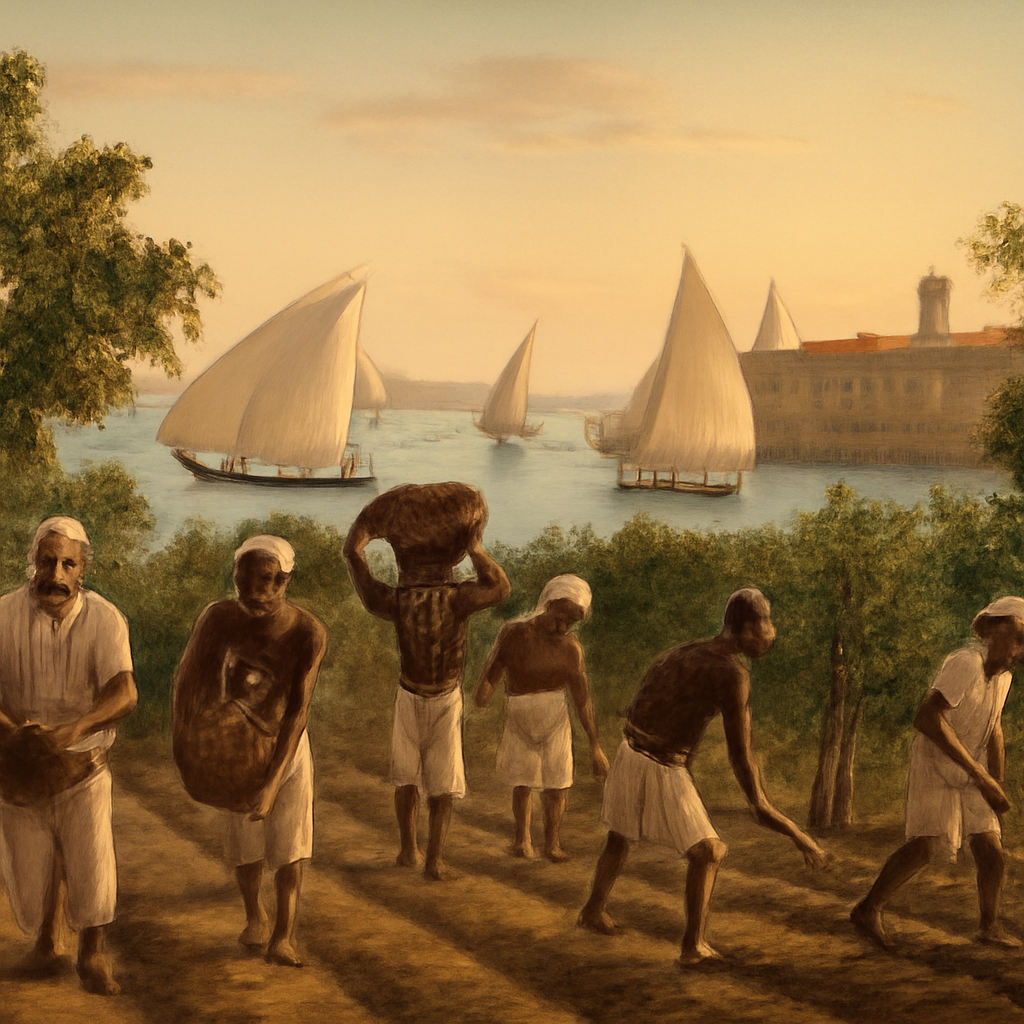
Zanzibar sat at the heart of the Indian Ocean’s long-running exchange networks: monsoon winds, dhows, and merchant families connected East Africa to the Arabian Peninsula, Persia, India and beyond. Long before 1832, Swahili coast towns combined coastal trade, agriculture, and coastal social forms; the island’s geography and harbors made it attractive to traders and rulers who could marshal capital and ships. In the early nineteenth century, Omani political influence—represented by figures such as Said bin Sultan and linked Omani merchants—was increasingly woven into local Swahili commercial life. At the same time, global appetite for spices and plantation commodities made clove cultivation commercially tempting. Planting cloves required sustained labor and land commitments; on Zanzibar that labor increasingly involved enslaved people.
These layered pressures—marine commerce, merchant capital, political reach from the Arabian Gulf, and a global market for spices—set the conditions in which a focused expansion of clove production could rapidly alter the island's economy and social order. No single cause explains the change; political decisions, merchant strategies, environmental suitability and market signals combined. Zanzibar's clove economy should be read through island ecology, forced labor, Omani statecraft, and Indian Ocean trade. The move of the Omani court toward Zanzibar strengthened a commercial order in which plantations, credit, shipping, and enslaved labor connected the island to East Africa, Arabia, India, and wider imperial markets. Stone Town's cosmopolitan image cannot be separated from coercion.
Merchants, sailors, plantation owners, enslaved workers, freed communities, diplomats, and missionaries all moved through the same economy, but not with the same power. Cloves made wealth fragrant and violence ordinary.
The Turning Point
In 1832 the balance of forces began to tilt more decisively toward plantation-oriented clove production. Under Omani-linked rule, decisions by rulers, Swahili and Omani merchants, and local landholders favored investment in clove trees and the infrastructure to export them. Plantations—often organized around household holdings and larger estates—grew in scale and became integrated into Indian Ocean shipping networks. That integration was not automatic: merchants had to commit ships, credit and commercial relationships; rulers had to secure ports and the political stability that trade required; and estate owners had to convert land to long-term cultivation. The labor that sustained this growth was frequently coerced: enslaved men, women and children performed planting, care, harvest and transport tasks.
Port politics shifted as merchants reinforced routes and intermediaries who could move cloves to markets across the ocean. Those concrete choices—investing in cloves, linking island plantations to merchant networks, prioritizing export routes—transformed Zanzibar from a set of trading villages into a more centralized commercial hub whose rhythms were increasingly set by the clove trade and the ocean lanes that carried it. The turning point was the consolidation of Zanzibar as an Omani-centered commercial and political hub. Plantation expansion made the island a command point for both legal commerce and slave trading across the western Indian Ocean.
Consequences
In the near term, the island’s commercial profile changed. Zanzibar consolidated functions of a regional entrepôt: warehouses, shipping, and merchant houses concentrated where capital and connections were strongest. Wealth flowed to those who controlled plantations, ports and maritime credit. Social hierarchies hardened as economic returns from cloves reinforced the power of certain merchant families and political patrons. The reliance on enslaved labor meant that production gains were inseparable from systems of coercion; labor relations shaped daily life on estates and in port quarters. Over the longer term, these developments left legacies both material and interpretive. Economically, the island’s prosperity became linked to a single dominant commodity and to the vulnerabilities of ocean trade—prices, shipping, and geopolitical shifts could reshape fortunes.
Politically and culturally, the expansion influenced urban growth, migration patterns, and the composition of elite society. Historically, the 1832 moment often gets simplified into a single dramatic hinge, but its deeper causes—merchant strategies, imperial ties, labor regimes, and market demands—unfolded over decades. That complexity matters because later governments, historians and movements remembered the period selectively, sometimes celebrating port prosperity while eliding the central role of coerced labor and commodity dependency. Its afterlife leads to abolition pressure, British influence, changing labor regimes, Swahili urban culture, and later memory of Stone Town as both heritage landscape and evidence of exploitation. That dual memory is why the page should hold architecture, trade, and human coercion together instead of separating beauty from labor.
Interpretation Notes
Zanzibar Clove Economy Expands is easy to flatten into one dramatic date. A stronger reading separates immediate action from deeper causes, affected communities, and the memory later states or movements built around the event.
Why Keep Reading
Follow the threads from Zanzibar's clove expansion to see how local choices connected to global circuits. Read next about the island’s port politics and the merchants who linked dhow lanes to metropolitan markets, or trace the daily lives of the people who worked on clove estates and in the harbor. Exploring subsequent decades reveals how shifts in demand, changes in regional rule, and evolving labor practices remade the coast again and again. These linked stories show that a commodity’s rise is not just economic trivia: it reshapes places, memories and moral reckonings. Read Zanzibar with Kilwa, Omani Mombasa, the Atlantic slave trade, abolition, and Indian Ocean timelines to compare different forced-labor and port-city systems.
Reading Path
Follow the story without losing the thread
Before This
- Haitian Revolution Begins1791 CE
- Haitian Revolution Begins1791 CE
- Somerset Case1772
After This
- France Abolishes Colonial Slavery1848
- American Civil War BeginsApril 12, 1861
- Emancipation ProclamationJanuary 1, 1863
Same Period
- Haitian Revolution Begins1791 CE
- American Civil War BeginsApril 12, 1861
- Emancipation ProclamationJanuary 1, 1863
Wider Timeline
Mind Map
How to think about Zanzibar Clove Economy Expands
Market pressure
Rising global demand for spices made clove cultivation commercially attractive to merchants and rulers.
Map Layer
Where this event sits geographically
Gold pins mark the approximate locations of published event pages. This is a schematic locator map, not a historical border map.
Coordinates are approximate and are used to help readers orient themselves before opening a full event page.
References
Where to Check the Facts
- Encyclopaedia Britannica: ZanzibarReference for Zanzibar's Indian Ocean position, port economy, and later clove-export history.
- Official UNESCO World Heritage Centre: Stone Town of ZanzibarReference for Stone Town as an Indian Ocean Swahili trading center shaped by maritime commerce and cultural exchange.