At a Glance
The shape of the event
- Date
- 1969 CE
- Place
- California
- Type
- Technology Network
Researchers connected early ARPANET nodes, helping create the packet-switching network that later influenced the development of the internet.
1969 CE; place the event in California before comparing causes or consequences.
ARPANET became part of the technical ancestry of the internet and changed communication, research, commerce, and culture.
ARPANET researchers are the first names or groups to compare before widening the story.
Networked computing moved from theory and isolated systems toward practical interconnection.
Networked computing moved from theory and isolated systems toward practical interconnection.
ARPANET became part of the technical ancestry of the internet and changed communication, research, commerce, and culture.
Follow the subsequent milestones if you want to see how an experimental link became a global system.
Background
By 1969 computing was both brilliant and brittle. Laboratories and universities housed powerful but isolated mainframes that solved specialized problems but could not share sessions or resources easily. Theoretical ideas about breaking messages into packets and routing them across a network had circulated among engineers; they promised a more efficient and resilient way to move information than the circuit-based models then common in telephony. At the same time the geopolitical tension of the Cold War created a sense of urgency: communicators, funders, and technologists sought systems that could survive partial failure and support distributed work. The ARPANET experiment sat at the intersection of those pressures.
It was shaped by technical trade-offs (how to structure messages and manage connections), institutional choices (which machines to link and why), and human curiosity. Historians continue to debate how much the ARPANET story turns on individual choices by researchers and engineers versus larger structural forces — funding regimes, military priorities, and existing computing infrastructures. In California, researchers ran experiments connecting nodes over existing lines, wrestling with physical constraints and nascent software. Early tests were as much about organizational improvisation — agreements on standards, timed experiments, and troubleshooting between teams — as about pure theory. ARPANET's first connections make 1969 about infrastructure hidden beneath later digital life.
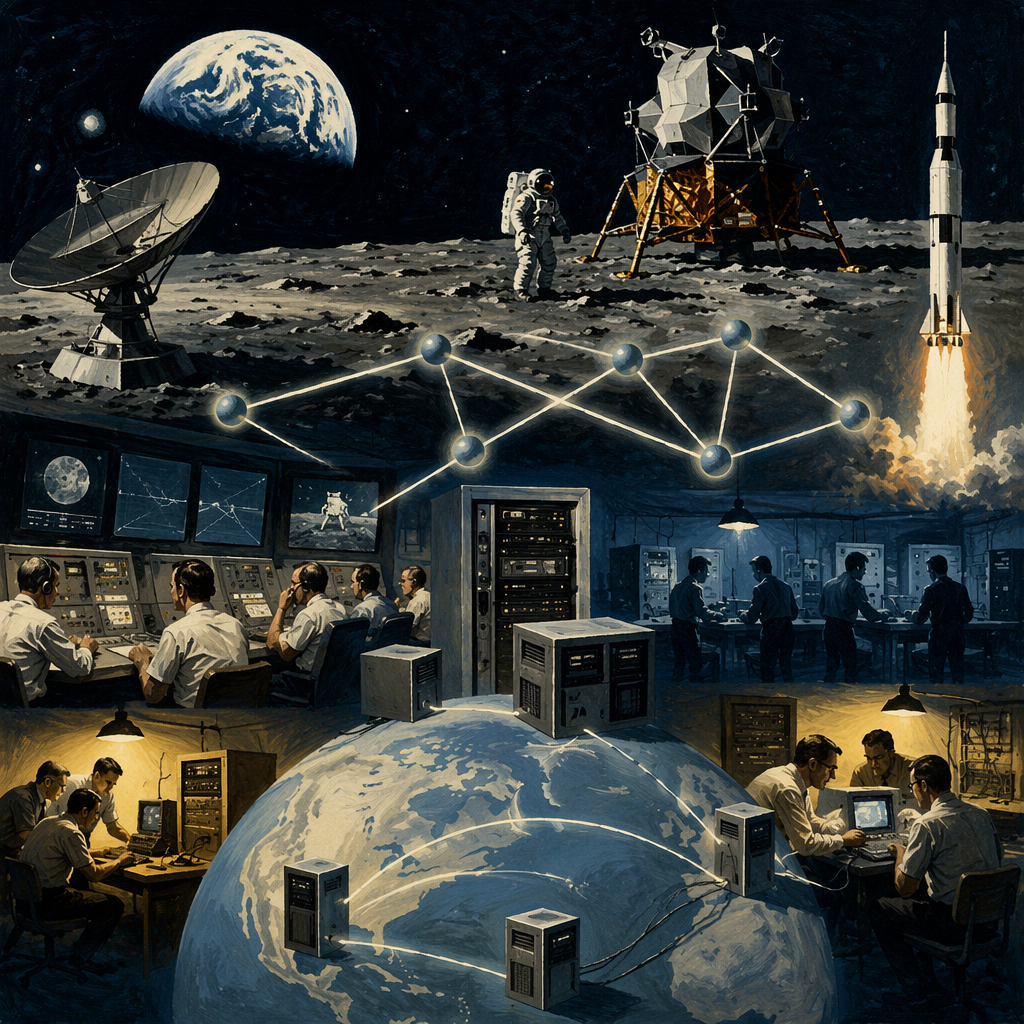
The story begins with packet switching, defense research funding, university laboratories, time-sharing computers, engineers, graduate students, and the practical need to let different machines communicate. It was not yet the public internet, but it created habits and protocols that later networks could build on. The event also helps readers compare two kinds of Cold War spectacle. Apollo made technological power visible on television; ARPANET made it durable in cables, interfaces, standards, and research communities. The quieter network mattered because it converted computing from isolated machines into a communication system shaped by institutions and shared rules.
The Turning Point
The decisive change in 1969 was not a single flash of invention but a set of deliberate, technical choices by ARPANET researchers that turned packet-switching from paper designs into working infrastructure. In California teams brought nodes online, configured equipment to route discrete packets of data, and tested the first exchanges between machines. Those tests forced practical decisions: how to format packets, how to recover from dropped transmissions, and how to coordinate across different computer systems. Each solution reflected trade-offs — simplicity versus functionality, reliability versus speed — and each required cooperation across institutional boundaries. The result was a working experiment that demonstrated interconnection at a scale small but convincing enough to alter expectations about computing.
Historians disagree about how much credit belongs to the engineers on the ground and how much to broader forces such as geopolitical priorities and funding environments; both mattered. In California, those early connections were small — only a handful of nodes — but they produced stubborn, informative failures that guided redesigns. The practical knowledge gained in those weeks reshaped research agendas and procurement choices in the months that followed. The turning point was the successful linking of sites into a working network. Once computers could pass information through packets across distance, the core problem shifted from one machine's capacity to the design of interoperable systems.
Consequences
Immediately after the 1969 connections, computing began to pivot. Networked computing moved from theoretical proposals and isolated experimental systems toward practical interconnection: teams prioritized interoperable interfaces, invested in compatible hardware and software, and treated remote collaboration as achievable. That near-term shift reshaped research practices — scholars could share data and compute resources more readily — and it nudged institutions to plan for networks rather than standalone machines. Over the longer term ARPANET entered the technical ancestry of what became the internet. It did not by itself produce the global system that followed, but its protocols, experiments, and the institutional habits it created informed later designs and policy choices.
The consequences were wide: communication habits altered as people expected more immediate information exchange; commerce found new channels for coordination; research became more collaborative across distances; culture absorbed new forms of connectivity. Technically, the experiment yielded lessons about routing, error recovery, and the social processes needed to maintain shared infrastructure; administratively, it taught organizations how to negotiate standards and manage shared resources. Historians and technologists continue to debate the causal weight of this single episode versus broader social, economic, and military forces. This account stresses caution: 1969's connections were pivotal and partial — necessary ingredients, not a solitary origin story.
The afterlife runs through email, TCP/IP, NSFNET, the World Wide Web, platform economies, cybersecurity, digital labor, and arguments over openness and control. ARPANET matters because the internet's later social scale depended on earlier technical choices that most users never saw.
Interpretation Notes
The hardest question around ARPANET Connection is causation. The event had immediate actors, but its meaning also came from institutions, geography, resources, and expectations already present in North America.
Why Keep Reading
Follow the subsequent milestones if you want to see how an experimental link became a global system. Read next about how protocols evolved to manage diverse networks, how researchers extended connections beyond California to other regions, and how institutions wrestled with governance and standards. Tracking the transition from military and academic testbeds to commercial infrastructure reveals why policy debates over access and control remain live today. If you care about the human side, look for the stories of the engineers and administrators who translated laboratory lessons into working agreements. The sequence from 1969's first nodes to later public and private networks shows how technical choices and political decisions together shaped the world we now call 'online.'
Read ARPANET with the Space Race, Cold War science, personal computing, the World Wide Web, and globalization routes to follow how research infrastructure became everyday life.
Reading Path
Follow the story without losing the thread
Before This
- Apollo 11 Moon LandingJuly 20, 1969
- Prague Spring1968
- ASEAN FoundedAugust 8, 1967
After This
- SALT I and Detente1972
- Arab Oil Embargo1973-1974 CE
- Chilean Coup1973
Same Period
- Cuban Missile CrisisOctober 1962
- Apollo 11 Moon LandingJuly 20, 1969
- Fall of the Berlin WallNovember 9, 1989
Wider Timeline
Mind Map
How to think about ARPANET Connection
Cold War urgency
Supported sustained attention to resilient communications and accelerated interest in network experiments
Map Layer
Where this event sits geographically
Gold pins mark the approximate locations of published event pages. This is a schematic locator map, not a historical border map.
Coordinates are approximate and are used to help readers orient themselves before opening a full event page.
References
Where to Check the Facts
- U.S. National Archives: The Cold WarArchive reference hub for Cold War records, federal documentation, and research guidance.
- Office of the Historian: The Early Cold War, 1945-1952Official diplomatic history reference for early Cold War foreign-policy context.
- Science Museum: Objects and StoriesMuseum reference hub for science, technology, medicine, invention, and public understanding.