At a Glance
The shape of the event
- Date
- 1347 CE
- Place
- Messina
- Type
- Pandemic
Plague entered Mediterranean Europe through trade routes and port cities, beginning a catastrophe that killed a large share of the population.
1347 CE; place the event in Messina before comparing causes or consequences.
The Black Death altered European labor relations, settlement patterns, religious life, and attitudes toward authority.
European communities are the first names or groups to compare before widening the story.
Communities faced mass mortality, labor shortages, fear, and religious and social strain.
Communities faced mass mortality, labor shortages, fear, and religious and social strain.
The Black Death altered European labor relations, settlement patterns, religious life, and attitudes toward authority.
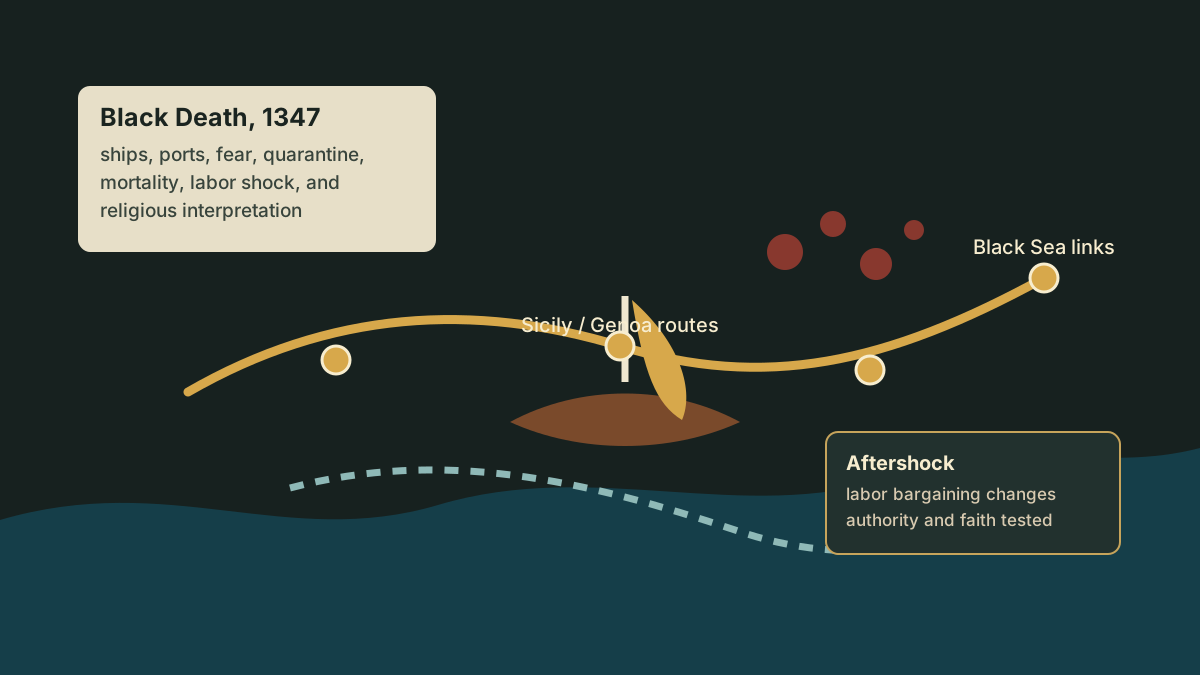
Follow the map from Messina to other Mediterranean and inland ports to see how similar choices produced different outcomes.
Background
By 1347 Europe was already a landscape of dense trade, mobile populations, and regional hubs linked by sea and land. Merchant ships crossed the Mediterranean carrying cloth, grain, and ideas; port cities like Messina were meeting points for sailors, merchants, and pilgrims. Those connections supported prosperity but also created fast channels for pathogens. At the same time, demographic pressures, urban crowding in some places, and variable public health practices left communities differently vulnerable. Political authority varied from city communes to feudal lordships, affecting how decisions about quarantine, burial, and relief were made. Scholarship debates persist about emphasis: some point to individual choices—flight, care, or religious responses—while others stress deeper structural forces such as long-distance trade, settlement patterns, and labor regimes.
This page keeps those interpretive tensions visible. It does not treat a single cause as definitive but explains how biological, economic, and social factors interacted at a moment of acute crisis. The Black Death reached Europe through connected trade and travel worlds. Mediterranean ports, Black Sea links, ships, merchants, soldiers, pilgrims, rats, fleas, and human bodies formed a network through which plague could move faster than understanding. The disease arrived in societies already shaped by war, famine memories, religious authority, urban crowding, and dependence on long-distance commerce.
The Turning Point
What changed in 1347 was not only the pathogen’s arrival but the rapid reordering of social life around it. When plague reached Mediterranean Europe through trade routes and port cities, the ordinary rhythms of work and worship fractured. In Messina and other ports, ship captains, merchants, and civic officials faced immediate choices: whether to admit ships, enforce isolation, or continue commerce. Communities confronted mass illness and death that overwhelmed existing care and burial practices. Families and neighborhoods saw labor drained by mortality, creating shortages that forced employers and tenants to renegotiate wages and obligations. Public rituals—processions, funerals, communal meals—were curtailed or transformed by fear of contagion.
Religious leaders and civic officials offered explanations and policies that ranged from practical isolation to moral interpretation; those responses shaped trust and compliance. Importantly, these were not uniform decisions made by a single actor. They were a series of local choices under extreme pressure, made within longer-term networks—trade, migration, and governance—that shaped both the spread of disease and the capacity to respond. The arrival in Messina thus marks a hinge: the immediate crisis exposed fault lines and catalyzed changes whose full effects unfolded over years. The turning point was the realization that ordinary movement had become dangerous. Ships and markets carried goods, news, and infection.
Communities tried flight, prayer, burial regulation, scapegoating, quarantine experiments, and local restrictions, often with limited knowledge of transmission. Mortality overwhelmed households, clergy, workshops, and civic institutions. The event forced medieval societies to confront a crisis that was biological, social, and spiritual at once.
Consequences
In the near term, communities faced mass mortality, overloaded caregiving networks, and acute labor shortages. Households reorganized when members died or fled; local economies contracted where trade routes were disrupted. Fear and grief intensified religious observance for some and provoked skepticism toward institutions for others. Over the longer term, the demographic shock altered labor relations—workers found greater bargaining power in some regions as landowners and employers adapted to a smaller workforce. Settlement patterns shifted where villages contracted or were abandoned and where cities adjusted housing and sanitation practices in response to recurrent outbreaks. Religious life changed too: devotional practices, clerical staffing, and popular piety all evolved, sometimes deepening faith and sometimes fueling criticism of ecclesiastical authority.
Attitudes toward secular authority were affected as communities judged leaders by their response to crisis. Historians still debate how much of this resulted from immediate choices versus structural transformations already underway, but the Black Death’s reach into Mediterranean Europe accelerated adjustments in economy, demography, and social expectations that shaped late medieval and early modern Europe. The consequences transformed labor, landholding, wages, religious life, family structure, and political bargaining. Survivors in some regions gained leverage because labor became scarce, while authorities attempted to freeze wages or restore old obligations. The plague also produced persecution, especially against Jewish communities falsely blamed for the disaster. A full account holds demographic shock beside moral panic, economic change, and institutional strain.
Because death struck clergy, nobles, artisans, peasants, and merchants unevenly, the plague changed relationships inside households and workplaces as well as in governments.
Interpretation Notes
The memory of Black Death Reaches Europe often depends on who tells the story. A court, army, religious community, merchant network, or later nation can emphasize different causes and make Messina stand for different lessons.
Why Keep Reading
Follow the map from Messina to other Mediterranean and inland ports to see how similar choices produced different outcomes. Tracking responses—quarantines, market closures, religious processions—reveals patterns of local adaptation and policy innovation. Readers who continue will find how the same epidemic that entered through trade routes also reshaped them, how labor shortages fed changes in property and wages, and how communities rebuilt social bonds afterward. If you want to understand how a single catastrophic season could redirect centuries of social and economic life, the next pages trace those pathways in concrete, place-by-place detail. Read next into medieval Europe, plague recurrence, labor law, urban public health, and trade networks.
The Black Death shows how disease can reveal the structure of an entire society. The same route also connects medieval catastrophe to later public-health habits, because authorities learned to watch ports, bodies, movement, and rumor together. Its afterlife remained visible for generations.
Reading Path
Follow the story without losing the thread
Before This
- Great Zimbabwe Risesc. 1100 CE
- Swahili Coast City-States Risec. 900 CE
- Srivijaya Maritime Empire Risesc. 650 CE
After This
- Majapahit Empire Peaksc. 1350 CE
- Malacca Sultanate Risesc. 1400 CE
- Fall of Constantinople, 1453: Siege Timeline, Causes, AftermathMay 29, 1453
Same Period
- Fall of Constantinople, 1453: Siege Timeline, Causes, AftermathMay 29, 1453
- Assassination of Julius CaesarMarch 15, 44 BCE
- Founding of the Roman Empire27 BCE
Wider Timeline
Mind Map
How to think about Black Death Reaches Europe
Trade routes
Maritime commerce linked distant ports and enabled rapid transmission of disease into Mediterranean cities.
Map Layer
Where this event sits geographically
Gold pins mark the approximate locations of published event pages. This is a schematic locator map, not a historical border map.
Coordinates are approximate and are used to help readers orient themselves before opening a full event page.
References
Where to Check the Facts
- Encyclopaedia Britannica: Black DeathReference for plague chronology, transmission debates, mortality, and social consequences.
- CDC: 1918 Pandemic H1N1 VirusPublic-health reference for the 1918 influenza pandemic and modern pandemic framing.