At a Glance
The shape of the event
- Date
- 680 CE
- Place
- Karbala
- Type
- Battle and martyrdom
Husayn ibn Ali and a small group of supporters were killed by Umayyad forces at Karbala, creating one of the most powerful memories of sacrifice, legitimacy, and mourning in Islamic history.
680 CE; place the event in Karbala before comparing causes or consequences.
The event shaped ideas of legitimate rule, martyrdom, protest, and communal memory across centuries of Islamic history.
Husayn ibn Ali / Yazid I are the first names or groups to compare before widening the story.
The Umayyad state survived the immediate crisis, but Karbala became a defining event in Shi'a memory and wider Islamic historical consciousness.
The Umayyad state survived the immediate crisis, but Karbala became a defining event in Shi'a memory and wider Islamic historical consciousness.
The event shaped ideas of legitimate rule, martyrdom, protest, and communal memory across centuries of Islamic history.
Read next through the Umayyad, Abbasid, and early Islamic pages to see how questions of caliphal legitimacy evolved.
Background
The first decades after Muhammad's death were marked by debate over leadership, community unity, and the relationship between piety and political authority. The Umayyad caliphate under Mu'awiya had stabilized rule after civil war, but the succession of Yazid I raised new questions because it looked increasingly dynastic. Husayn received appeals from Kufa, where some opponents of Umayyad rule wanted him to lead resistance. Yet support was uncertain, communications were dangerous, and the state could move faster than a scattered opposition. Karbala unfolded in this tense world of memory, family status, political calculation, and disputed legitimacy. After the first fitna, many Muslims longed for stability, but stability did not settle the question of legitimate leadership.
Was rule primarily a matter of order, lineage, communal consent, piety, or power held by a ruling house? The Umayyads had practical control, but Husayn's status as the Prophet's grandson gave his refusal enormous moral weight. Kufa's role is crucial because its invitations suggested that opposition existed, while its failure to sustain Husayn shows the danger of fragmented support under state pressure. Karbala unfolded in the space between promise and abandonment, where political hope collapsed into isolation.
The Turning Point
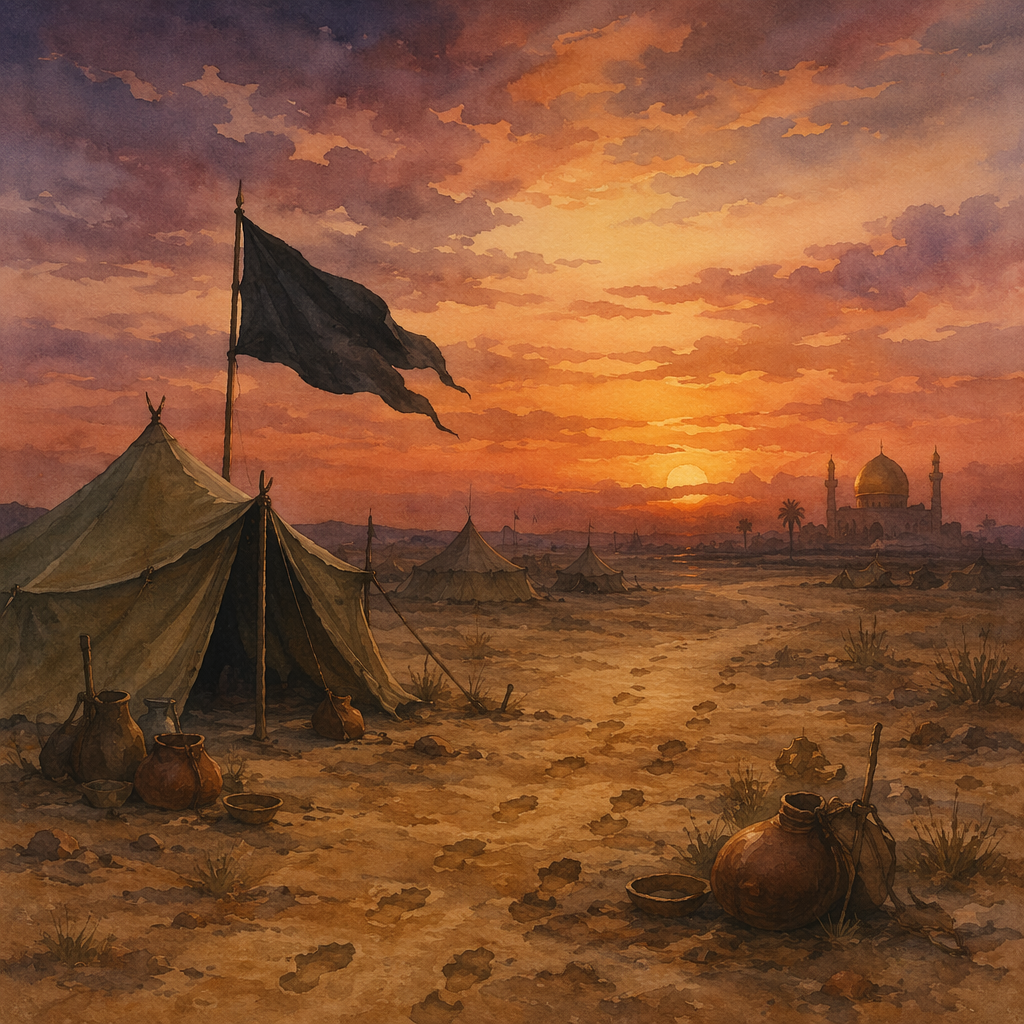
The turning point came when Husayn's small party was isolated near Karbala and cut off from meaningful support. The confrontation was not a symmetrical battle between large armies. It was a coercive crisis in which Umayyad forces demanded submission and Husayn refused. His death, along with the suffering of his family and followers, transformed a political dispute into a lasting language of martyrdom. For Shi'a Muslims, Karbala became central to devotion, mourning, and the idea that legitimate authority may require sacrifice against unjust rule. For Sunni traditions, the event is also tragic, though interpreted within different frameworks of communal history and political order.
The confrontation became decisive because Husayn did not accept a settlement that would make his submission a public endorsement of Yazid's rule. The denial of water, the small number of Husayn's companions, and the presence of family members deepened later memory of injustice. The military outcome was never the main measure of importance. What mattered was the meaning assigned to the refusal: a small community choosing death over a legitimacy it could not accept. That is why later retellings dwell on speeches, farewells, thirst, mourning, and witness. They are not marginal details; they are how the event became a moral archive.
Consequences
Karbala deepened the emotional and theological divide over early Islamic leadership and gave later communities a powerful ritual calendar through Ashura mourning and commemoration. Its consequences were not confined to doctrine. Movements across centuries have invoked Husayn as a symbol of principled resistance, while rulers have sometimes feared the political force of Karbala memory. The event also requires care from readers. It should not be flattened into a simple origin of sectarian hostility or used to imply that later Sunni-Shi'a relations were fixed from 680 onward. Its power lies in the way a specific historical tragedy became a durable moral vocabulary. Karbala's memory shaped Shi'a devotional life, but it also traveled into political culture more broadly.
Rulers, reformers, revolutionaries, poets, and ordinary mourners have invoked Husayn to speak about tyranny, conscience, sacrifice, and the responsibility to remember. At the same time, careful history avoids turning 680 into a simplistic explanation for all later Sunni-Shi'a relations. Communities interacted, disagreed, shared spaces, and changed over time. Karbala became foundational not because it froze history, but because it offered a recurring language through which later people could judge power and suffering. A careful page should also explain why Karbala is not only about the past. Commemoration makes the event present each year through mourning gatherings, poetry, passion narratives, pilgrimage, and ethical reflection. That continuing practice means historical explanation must be respectful without becoming uncritical.
Readers can ask what early sources can and cannot prove, how memory developed, and why different communities emphasize different parts of the story. The point is not to strip away devotion in favor of a cold timeline. It is to show how a historical event became a living framework for grief, justice, and political conscience.
Interpretation Notes
Readers need to separate the brief seventh-century battle from the much larger devotional, political, and sectarian meanings later attached to it.
Why Keep Reading
Read next through the Umayyad, Abbasid, and early Islamic pages to see how questions of caliphal legitimacy evolved. Karbala also connects to broader atlas themes: how martyrdom becomes memory, how ritual carries history, and how a small battlefield can shape political language long after armies leave. Read onward to the Umayyad caliphate, Abbasid Revolution, Islamic law and memory pages. Karbala is the point where a political succession dispute becomes a durable ritual and ethical tradition, making it essential for understanding how events live beyond their immediate military outcome. Evidence note: Karbala's sources include early Islamic narratives, later devotional literature, sermons, ritual performance, and political memory. They do not all do the same job.
Some try to preserve sequence, some teach moral meaning, and some help communities mourn. A responsible page should acknowledge that layered transmission while still explaining the historical core: Husayn's refusal, isolation, death, and the transformation of that death into a lasting vocabulary of justice and sacrifice. Reader bridge: the page also belongs in a wider study of how communities remember defeat. Karbala shows that an event can be historically small in military scale and enormous in ethical scale. That contrast helps readers compare it with other martyrdom traditions without treating any tradition as identical.
Reading Path
Follow the story without losing the thread
Before This
After This
Same Period
- Rashidun Conquest of Jerusalem637 CE
- Umayyad Caliphate Founded661 CE
- Dome of the Rock Completed691-692 CE
Wider Timeline
Mind Map
How to think about Battle of Karbala
Succession dispute
Yazid's accession sharpened debates over dynastic rule, legitimacy, and moral authority.
Map Layer
Where this event sits geographically
Gold pins mark the approximate locations of published event pages. This is a schematic locator map, not a historical border map.
Coordinates are approximate and are used to help readers orient themselves before opening a full event page.
References
Where to Check the Facts
- Encyclopaedia Britannica: Battle of KarbalaReference for the battle, participants, outcome, and Shi'a commemorative significance.
- Encyclopaedia Britannica: KarbalaReference for Karbala as a city and shrine landscape tied to the battle's memory.