At a Glance
The shape of the event
- Date
- 1498 CE
- Place
- Calicut
- Type
- Voyage
Vasco da Gama reached India by sea from Europe, opening a Portuguese route into established Indian Ocean trade networks.
1498 CE; place the event in Calicut before comparing causes or consequences.
The voyage linked European expansion to older Asian trade systems and helped reshape global commercial and imperial competition.
Vasco da Gama are the first names or groups to compare before widening the story.
Portugal began building fortified trading positions and naval power around the Indian Ocean.
Portugal began building fortified trading positions and naval power around the Indian Ocean.
The voyage linked European expansion to older Asian trade systems and helped reshape global commercial and imperial competition.
Follow the next pages to see how a single sea route became a network of fortified harbors and naval patrols, and to trace responses from port cities, merchants and rulers across the Indian Ocean.
Background
By the late fifteenth century, the Indian Ocean trade network linked East Africa, Arabia, South Asia and Southeast Asia in a dense pattern of exchange. Spices, textiles, metals and ideas moved along well-established coastal routes and across monsoon winds that experienced mariners knew intimately. European merchants and rulers, especially in Portugal, sought more direct access to these goods to reduce dependence on overland intermediaries and to capture lucrative margins. Improvements in navigation, cartography and ship design in Europe made longer Atlantic voyages more feasible. At the same time, well-equipped city-states and port authorities in the Indian Ocean managed their own commercial systems, with local customs, credit arrangements and diplomatic practices.
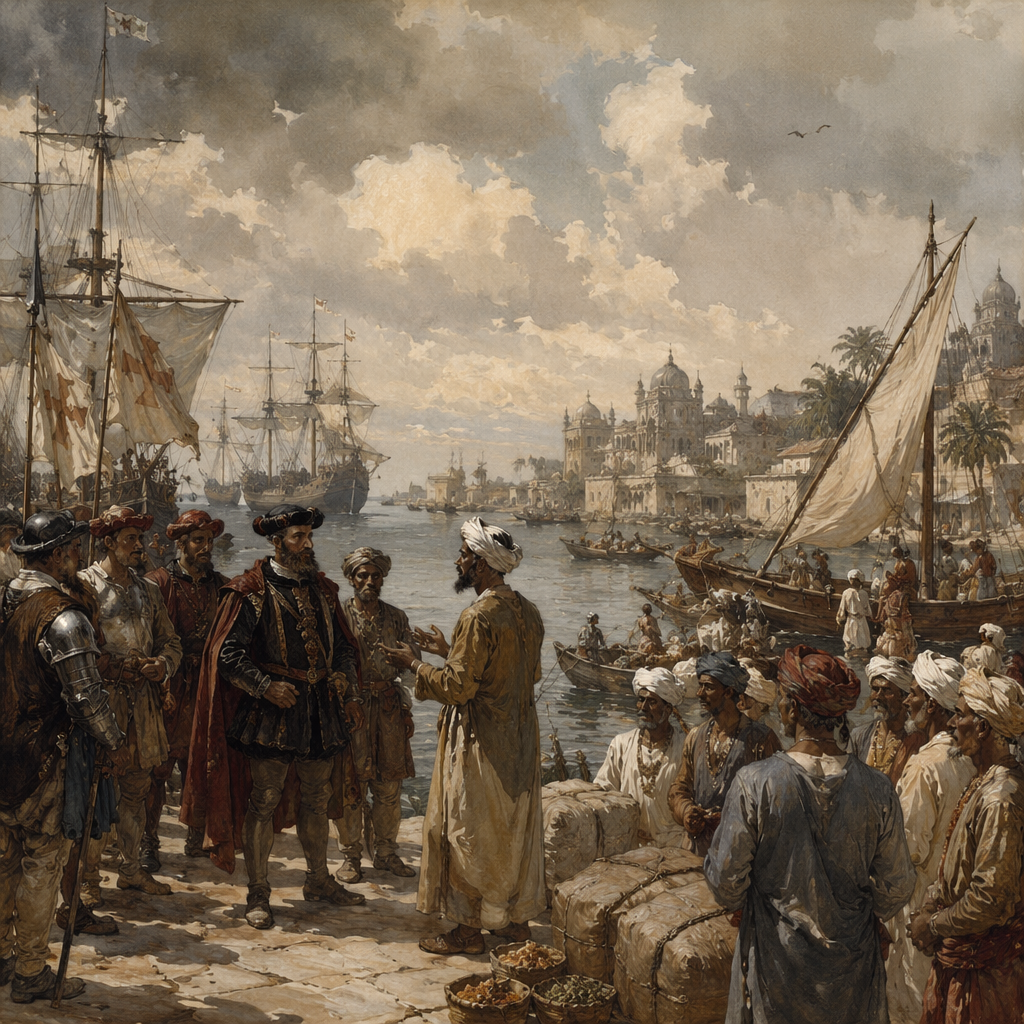
These structural pressures — technological, economic and political — set the stage, but interpretations differ on how much the Portuguese breakthrough reflects individual decision-making versus broader forces. This page keeps those ambiguities visible rather than proposing a single cause. A stronger Vasco da Gama page starts by decentering Europe. Calicut was already part of an old Indian Ocean world of monsoon sailing, port brokers, Muslim and Gujarati merchants, Swahili connections, Arab pilots, pilgrimage routes, pepper markets, and coastal politics. The Portuguese fleet entered that world late and awkwardly, with ambition greater than its local knowledge.
The voyage depended on people who are often pushed to the edge of the story: pilots, interpreters, sailors, port officials, merchants, rulers, ship carpenters, and coastal communities from East Africa to India. Their knowledge of winds, currents, gifts, languages, prices, and diplomatic customs shaped what the Portuguese could do. The page also needs to separate arrival from control. Reaching Calicut did not mean Portugal controlled Indian Ocean trade. The later story involved violence, forts, cartaz passes, attacks on rivals, alliances with some local powers, and repeated failures to fully dominate the commercial networks Portuguese rulers wanted to redirect.
The Turning Point
The change occurred when a European squadron reached a principal port of the Indian Ocean trading world by following a sea route from Europe. Vasco da Gama, as the expedition’s leader, made concrete navigational and diplomatic choices: choosing the route around Africa, engaging with local pilots and merchants when possible, and presenting Europe’s interest in direct trade. His arrival at Calicut did not instantly overturn centuries of trade practices, but it parceled a new reality into the existing map. Local rulers and traders confronted unfamiliar demands: armed foreign ships seeking commercial footholds and political recognition.
The Portuguese decision to press for state-backed presence — shifting from episodic trading voyages to permanent fortified positions and naval patrols — marks the pivotal shift. That tactical change transformed a single voyage into the opening act of a state-led maritime strategy that interacted with, and often clashed against, established Indian Ocean patterns. The turning point was not discovery of an empty route but entry into a connected commercial system by a militarized Atlantic monarchy. Da Gama's arrival made it possible for Portuguese strategy to move from coastal probing to sustained attempts at armed trade. Another turning point was diplomatic mismatch. Portuguese envoys expected royal letters, crusading confidence, and naval force to produce access.
Calicut's commercial world expected gifts, reputation, brokers, taxes, and negotiated place inside existing merchant communities.
Consequences
In the near term, the voyage provided Portugal with the practical information and legitimacy to move from exploratory voyages to a policy of maritime dominance. Portuguese leaders invested in forts, trading posts and a naval presence around key harbors, altering the balance of local maritime power. These fortified positions aimed to control chokepoints and secure direct access to commodities, but they also introduced sustained military pressure into previously commercialized spaces. Over the longer term, the arrival of a European maritime power linked European expansion more tightly to older Asian trade systems. That linkage reshaped commercial routes, credit relations and diplomatic practices across continents and contributed to new patterns of imperial competition.
Historians continue to debate the balance between the captain’s decisions and deeper structural shifts — technology, state formation and global demand — but the voyage is widely seen as a turning point that helped redirect the planet’s commercial and political currents. The immediate consequence was renewed Portuguese investment in Indian Ocean expeditions. The longer consequence was a more violent maritime politics in which ships, forts, passes, cannon, and royal monopolies tried to reshape older routes. For readers, the event links Calicut to Kilwa, Malacca, Goa, Hormuz, the VOC, and later chartered-company empires. It is a gateway into how early modern globalization combined navigation, knowledge borrowing, commerce, religion, and coercion.
Interpretation Notes
Vasco da Gama Reaches India raises a debate about scale: did the decisive change come from the visible voyage, or from older pressures around Exploration and Indian Ocean that had already narrowed what people could do?
Why Keep Reading
Follow the next pages to see how a single sea route became a network of fortified harbors and naval patrols, and to trace responses from port cities, merchants and rulers across the Indian Ocean. You can watch how local actors adapted, resisted or negotiated with Portuguese demands, and how competing European powers later entered the same waters. If you want to understand modern global commerce and empire, the immediate aftermath — the clash of trade practices, the building of forts and the emergence of naval logistics — shows how local choices and imperial strategies combined to reshape coastlines and markets. Read this page beside Indian Ocean World, Swahili Coast, Malacca, the VOC, South Asia, and Portuguese Kongo contact.
That route keeps African, Arab, South Asian, and Southeast Asian actors visible beside Portuguese expansion.
Reading Path
Follow the story without losing the thread
Before This
- Treaty of Tordesillas1494 CE
- Columbus's First Atlantic Voyage1492 CE
- Columbian Exchange Begins1492 onward
After This
- Portuguese Capture Kilwa1505 CE
- Malacca Falls to the Portuguese1511 CE
- Protestant Reformation Begins1517 CE
Same Period
Wider Timeline
Mind Map
How to think about Vasco da Gama Reaches India
Monsoon trade
Seasonal winds and established coastal routes structured centuries of Indian Ocean exchange.
Map Layer
Where this event sits geographically
Gold pins mark the approximate locations of published event pages. This is a schematic locator map, not a historical border map.
Coordinates are approximate and are used to help readers orient themselves before opening a full event page.
References
Where to Check the Facts
- Encyclopaedia Britannica: Vasco da GamaSpecific reference for Vasco da Gama's voyage to India, arrival near Calicut, and Portuguese entry into Indian Ocean trade.
- Encyclopaedia Britannica: Indian Ocean tradeContext reference for Indian Ocean geography, maritime paths, trade connections, and the wider commercial world entered by Portuguese voyages.
- Library of Congress: U.S. History Primary Source TimelinePrimary-source timeline reference for Atlantic settlement, colonial expansion, reform, and later U.S. history paths.