At a Glance
The shape of the event
- Date
- June 18, 1815
- Place
- Waterloo
- Type
- Battle
Coalition forces defeated Napoleon near Waterloo, ending his brief return to power and closing the Napoleonic Wars.
June 18, 1815; place the event in Waterloo before comparing causes or consequences.
Waterloo confirmed a new European balance negotiated at Vienna and became shorthand for decisive political defeat.
Napoleon Bonaparte / Duke of Wellington / Gebhard Leberecht von Blucher are the first names or groups to compare before widening the story.
Napoleon abdicated again and was exiled to Saint Helena.
Napoleon abdicated again and was exiled to Saint Helena.
Waterloo confirmed a new European balance negotiated at Vienna and became shorthand for decisive political defeat.
If Waterloo compelled the end of the Napoleonic Wars, its story radiates outward into several compelling threads.
Background
By June 1815 Europe had already been through a quarter century of near-constant war. Napoleon’s return from exile in 1815 interrupted a diplomatic settlement in Vienna that aimed to reorder the continent after revolutionary upheaval. The Congress at Vienna had produced a fragile balance: restored monarchies, negotiated borders, and a coalition readiness to resist renewed French expansion. That readiness mattered. Coalition armies coalesced around a single objective—remove Napoleon’s renewed threat—and commanders such as the Duke of Wellington and Gebhard Leberecht von Blücher led forces with different national traditions and priorities. At the same time, France carried the weight of one man’s ambition and the institutions that supported it.
Historians debate how much Waterloo was the result of short-term decisions—timing, reconnaissance, battlefield tactics—and how much it reflected deeper structural pressures: exhaustion after long wars, diplomatic consensus against Napoleon, and the logistical limits of early nineteenth-century armies. This account keeps those disputes visible rather than presenting a single neat cause. Waterloo is more than Napoleon's final battle. It belongs to the Hundred Days, the Congress of Vienna, coalition warfare, army logistics, muddy fields, command timing, and the fear among European rulers that revolutionary and imperial war might reopen. The battle mattered because diplomacy and battlefield risk met in one day. The battlefield needs actors, not just famous names.
Wellington's mixed allied army, Blucher's Prussians, Napoleon's commanders, infantry squares, cavalry attacks, artillery, farm positions, roads, rain, wounded soldiers, and local civilians all shaped what happened. Heroic shorthand hides how contingent the day was. Readers also need the Vienna frame. The powers had already been negotiating Europe's post-Napoleonic order. Waterloo confirmed that Napoleon's return would not overturn that settlement, but it did not create peace by itself. The battle worked because armies and diplomats were part of the same political project.
The Turning Point
The battle that day turned on a series of concrete actions and choices by commanders on both sides. Napoleon arrived on the field intent on striking the coalition before their forces could combine effectively. Wellington, commanding Anglo-allied troops, prepared to hold ground and absorb pressure until reinforcements or a change in the operational picture could be exploited. Crucially, Prussian forces under Blücher were not neutral bystanders; their decision to continue maneuvering toward the battlefield and to engage after suffering earlier setbacks altered the calculus confronting Napoleon. Command choices—when to attack, where to centralize reserves, how to protect lines of communication—shaped the day’s momentum.
Contemporary witnesses and later historians disagree about which move mattered most: the timing of assaults, the resilience of defensive positions, delays caused by weather or reconnaissance failures, or simply the exhaustion of veterans on both sides. Whatever the precise causal balance, the shift from a contested engagement to a clear coalition advantage came through a mixture of individual initiative and the pressure of pre-existing strategic alignments. The turning point was the failure of Napoleon to defeat Wellington before Prussian arrival made the coalition position decisive. Timing mattered: attacks, delays, defensive positions, communication, and battlefield exhaustion turned strategic possibility into collapse. The battle also turned Napoleon from returning emperor into captive symbol.
His exile to Saint Helena made the end visible, while the memory of Waterloo became a language for decisive defeat, British military identity, Prussian contribution, and European restoration politics.
Consequences
In immediate terms, Waterloo ended Napoleon’s brief return to power. Faced with defeat, he abdicated again and was sent into permanent exile on Saint Helena. The Napoleonic Wars, a series of conflicts that had reshaped Europe for two decades, were brought to a close. Politically, the battle confirmed the new balance the major powers had negotiated at Vienna: a diplomatic order premised on concert and containment rather than the triumph of revolutionary France. For ordinary people the consequences were mixed—soldiers returned to uncertain peacetime lives, regimes consolidated authority, and borders and alliances settled into arrangements that would last for decades. Culturally and rhetorically, Waterloo entered the language as shorthand for decisive, irreversible defeat.
Historians still debate the extent to which that outcome was inevitable. Some emphasize the decisive agency of commanders on 18 June; others point to structural forces—coalition unity, resource imbalances, the exhaustion of French power—that made Napoleon’s restoration unlikely to endure. Both lines of interpretation matter for understanding why Waterloo became a turning point rather than a single dramatic loss. The immediate consequence was Napoleon's second abdication and permanent exile. The longer consequence was the stabilization of the Vienna settlement, where the major powers tried to manage revolution, balance, legitimacy, and territorial order after more than two decades of war. Waterloo's afterlife is unusually crowded. British, French, Belgian, Prussian/German, and European memories each emphasized different parts of the day.
A strong page keeps the battle specific while showing why one battlefield became a shorthand for the end of an era.
Interpretation Notes
Battle of Waterloo raises a debate about scale: did the decisive change come from the visible battle, or from older pressures around Napoleonic Wars and Europe that had already narrowed what people could do?
Why Keep Reading
If Waterloo compelled the end of the Napoleonic Wars, its story radiates outward into several compelling threads. Read next to trace Napoleon’s return and the ‘Hundred Days’ that led to Waterloo, to follow the diplomatic architecture of the Congress of Vienna that coalition ministers fought to protect, or to read contemporary accounts from soldiers and civilians who lived through the battle. Biographies of Wellington and Blücher illuminate different national memories of the victory; studies of 1815’s logistics and communications show how operational limits shaped decisions on the ground. Each path deepens your understanding of how a single day can both reflect and reshape larger historical forces.
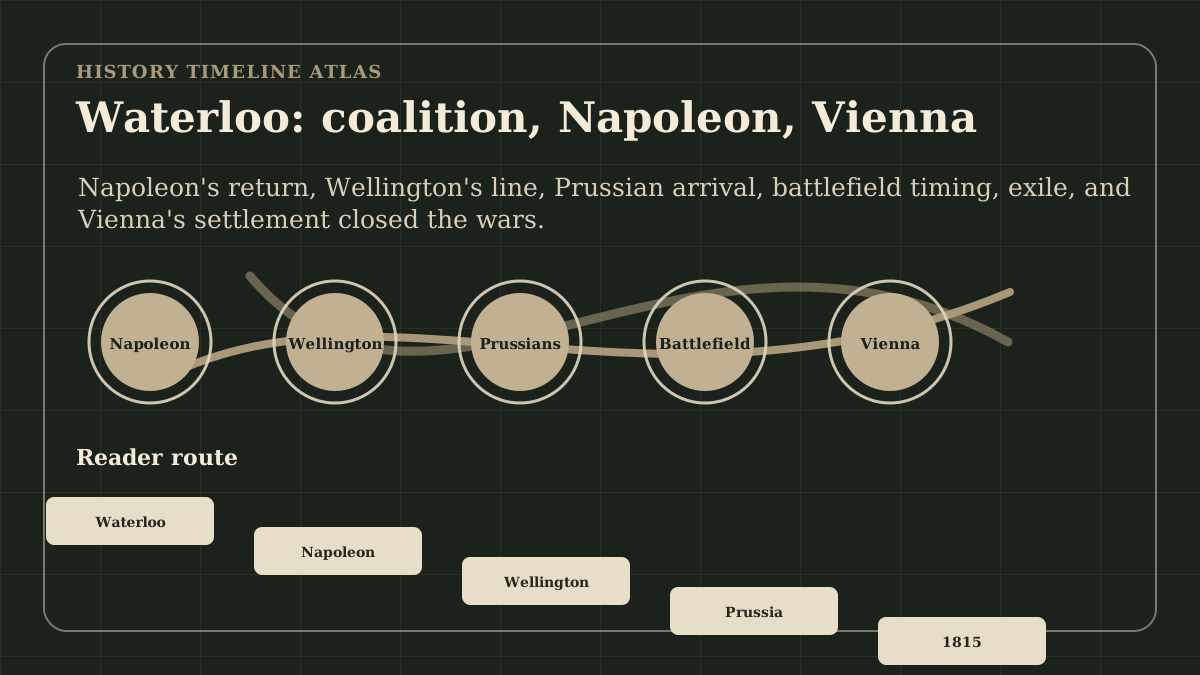
Read Waterloo after the French Revolution, Napoleon's empire, and the Congress of Vienna, then continue to 1848 and nationalism. The route shows how revolutionary war ended on the battlefield but survived as political memory.
Reading Path
Follow the story without losing the thread
Before This
- Industrial Revolution Beginsc. 1760 CE
- Second Siege of Vienna1683 CE
- Protestant Reformation Begins1517 CE
After This
- First Opium War Begins1839 CE
- Revolutions of 18481848 CE
- American Civil War BeginsApril 12, 1861
Same Period
- Industrial Revolution Beginsc. 1760 CE
- First Opium War Begins1839 CE
- Revolutions of 18481848 CE
Wider Timeline
No curated timeline yet.
Mind Map
How to think about Battle of Waterloo
Coalition unity
Concerted political and military purpose among Britain, Prussia and other allies to remove Napoleon
Map Layer
Where this event sits geographically
Gold pins mark the approximate locations of published event pages. This is a schematic locator map, not a historical border map.
Coordinates are approximate and are used to help readers orient themselves before opening a full event page.
References
Where to Check the Facts
- Encyclopaedia Britannica: Battle of WaterlooSpecific reference for the Waterloo campaign, Napoleon's defeat, coalition forces, and European consequences.
- National Army Museum: Battle of WaterlooMuseum reference for Waterloo's battlefield sequence, coalition command, Wellington, Napoleon, Prussian intervention, and aftermath.
- The Waterloo Association: The BattleSpecialist public-history reference for the battle, armies, timing, and battlefield memory.