At a Glance
The shape of the event
- Date
- April 17-20, 1961
- Place
- Bay of Pigs
- Type
- Failed Invasion
A U.S.-backed Cuban exile invasion failed at the Bay of Pigs, strengthening Castro's position and intensifying Cold War confrontation in the Caribbean.
April 17-20, 1961; place the event in Bay of Pigs before comparing causes or consequences.
The failure deepened U.S.-Cuban hostility, pushed Castro closer to the Soviet Union, and helped set the stage for the Cuban Missile Crisis.
John F. Kennedy / Fidel Castro / Cuban exile brigade are the first names or groups to compare before widening the story.
The invasion collapsed within days, and many members of the exile brigade were captured.
The invasion collapsed within days, and many members of the exile brigade were captured.
The failure deepened U.S.-Cuban hostility, pushed Castro closer to the Soviet Union, and helped set the stage for the Cuban Missile Crisis.
The next useful step is to follow the linked events, people, topic routes, and timelines.
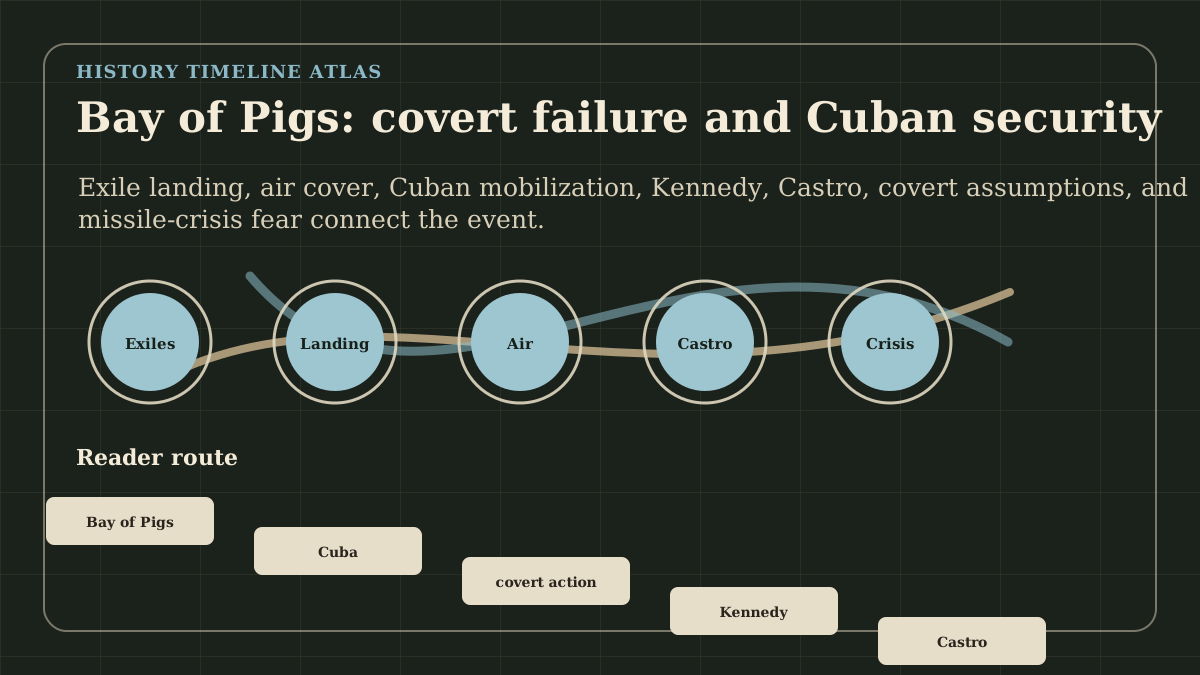
Background
The Cuban Revolution had overthrown a U. S. -backed dictatorship and moved toward a radical government close to the Soviet Union. American officials feared a revolutionary and Soviet-aligned Cuba ninety miles from Florida. Before Bay of Pigs Invasion, the surrounding world already contained unresolved tensions over authority, resources, belief, strategy, or legitimacy. Those pressures mattered because they shaped what different actors thought was possible. Single-cause explanations flatten the background, which was usually a mix of long-running structures and immediate decisions. The location in Caribbean also matters, because events there connected local choices to wider routes of diplomacy, war, trade, reform, or memory.
This context prepares the reader to see the event as part of a sequence rather than as an isolated headline. Bay of Pigs makes Cold War intervention concrete. The invasion grew from fear of a revolutionary Cuba, confidence in covert action, and assumptions about how quickly a government could be destabilized. Those assumptions failed against Cuban state control, popular mobilization, and the practical weaknesses of the operation. The event also belongs to Cuban history, not only U. S. policy. For Castro's government, the landing confirmed that invasion was not a distant possibility but an active threat.
For many Cubans, the crisis unfolded through militia mobilization, beaches, roads, radio, prisoners, revolutionary loyalty, fear of counterrevolution, and the new state's claim that sovereignty had to be defended. The planning layer matters because covert action can hide responsibility without removing consequences. Exile fighters, CIA assumptions, presidential authorization, air support limits, intelligence failures, and diplomatic denial all shaped the event. A failed operation still changed the region because it altered trust, threat perception, and the tempo of U. S. -Cuban confrontation.
The Turning Point
The invasion relied on Cuban exiles, covert planning, limited air support, and the expectation that Castro's government could be destabilized. Instead, the landing force was quickly defeated. The failure embarrassed Kennedy's administration and made Cuba a more central Cold War flashpoint. The turning point was not simply that the event occurred, but that it changed the range of options available afterward. People connected to John F. Kennedy, Fidel Castro, Cuban exile brigade acted inside constraints created by earlier conflicts, institutions, and expectations. Some choices were deliberate; others were responses to pressure, fear, opportunity, or failed compromise. The event's form as failed invasion also shaped how consequences unfolded.
It made certain outcomes easier to imagine, gave later actors new evidence or symbols to use, and forced communities to adapt to a situation that could no longer be treated as temporary. The turning point came when the landing failed to spark the internal collapse planners expected. Cuban forces contained the invasion quickly, and the exile brigade could not become the nucleus of a wider revolt. The difference between imagined local support and actual state response made the operation collapse. Kennedy's restraint around overt U. S. escalation also shaped the outcome. More direct intervention might have changed the battlefield, but it would have made the United States openly responsible for invasion.
The crisis therefore exposed a recurring Cold War problem: covert pressure promised deniability while still risking major public defeat.
Consequences
The invasion collapsed within days, and many members of the exile brigade were captured. The failure deepened U. S. -Cuban hostility, pushed Castro closer to the Soviet Union, and helped set the stage for the Cuban Missile Crisis. The immediate result mattered, but the longer effect came from how later people interpreted and reused the event. Some consequences were institutional: laws, borders, offices, alliances, or systems of rule changed. Others were social or cultural: public memory, political language, religious identity, or expectations about power shifted. Read the event on two clocks at once. One clock follows the immediate aftermath; the other follows the slower movement of influence into later crises, reforms, debates, and historical comparisons.
The failure strengthened Castro, embarrassed the Kennedy administration, and made Cuba a sharper point in U. S. -Soviet rivalry. It also made the next crisis more dangerous: Soviet missile deployment in Cuba cannot be understood without the memory of attempted invasion, U. S. hostility, and Cuban insecurity. The event's longer consequence was psychological as well as diplomatic. It narrowed room for trust, hardened revolutionary legitimacy in Cuba, pushed Washington toward other pressure campaigns, and gave Moscow a reason to treat Cuban security as a strategic issue. Bay of Pigs is therefore a doorway into the Cuban Missile Crisis, not a failed episode that can be left behind.
Interpretation Notes
Debate centers on planning, secrecy, assumptions about Cuban support, Kennedy's decisions, and the larger ethics of covert regime-change operations.
Why Keep Reading
The next useful step is to follow the linked events, people, topic routes, and timelines. Bay of Pigs Invasion becomes clearer when it is compared with what came before and after it, especially events in Cold War and related pages about Cold War and Cuba. The map helps locate the event, the mind map separates causes from effects, and the source list gives readers a way to check the factual spine. Keep reading to see whether this event was a beginning, a turning point, an ending, or a symbol that later generations kept reworking. Read Bay of Pigs between the Cuban Revolution and the Cuban Missile Crisis.
That path shows how revolution, covert action, sovereignty fears, alliance politics, and nuclear danger escalated in less than four years.
Reading Path
Follow the story without losing the thread
Before This
- Berlin Wall BuiltAugust 1961
- Congo Independence and Crisis1960 CE
- Cuban Revolution Triumphs1959
After This
- Cuban Missile CrisisOctober 1962
- March on WashingtonAugust 28, 1963
- Partial Nuclear Test Ban TreatyAugust 5, 1963
Same Period
- Cuban Missile CrisisOctober 1962
- Apollo 11 Moon LandingJuly 20, 1969
- Fall of the Berlin WallNovember 9, 1989
Wider Timeline
Mind Map
How to think about Bay of Pigs Invasion
Pressure
The Cuban Revolution had overthrown a U.S.-backed dictatorship and moved toward a radical government close to the Soviet Union. American officials feared a revolutionary and Soviet-aligned Cuba ninety miles from Florida.
Map Layer
Where this event sits geographically
Gold pins mark the approximate locations of published event pages. This is a schematic locator map, not a historical border map.
Coordinates are approximate and are used to help readers orient themselves before opening a full event page.
References
Where to Check the Facts
- John F. Kennedy Presidential Library: The Bay of PigsPresidential library reference for the April 1961 invasion and Kennedy administration context.
- CIA Reading Room: Bay of Pigs ReleaseArchive collection reference for Bay of Pigs planning and later documentation.
- U.S. National Archives: The Cold WarArchive reference hub for Cold War records, federal documentation, and research guidance.
- Office of the Historian: The Early Cold War, 1945-1952Official diplomatic history reference for early Cold War foreign-policy context.