At a Glance
The shape of the event
- Date
- 1505 CE
- Place
- Kilwa Kisiwani
- Type
- Conquest and port occupation
Portuguese forces captured Kilwa as part of a wider campaign to control Indian Ocean trade through forts, naval pressure, tribute, and strategic ports.
1505 CE; place the event in Kilwa Kisiwani before comparing causes or consequences.
The event marks a turning point when older Indian Ocean port systems faced a new militarized oceanic empire.
Francisco de Almeida / Swahili rulers are the first names or groups to compare before widening the story.
Kilwa was briefly held by Portugal, and the balance of power along the Swahili Coast shifted under armed European pressure.
Kilwa was briefly held by Portugal, and the balance of power along the Swahili Coast shifted under armed European pressure.
The event marks a turning point when older Indian Ocean port systems faced a new militarized oceanic empire.
Follow this story to see how a handful of port seizures became a maritime policy and how coastal societies adapted, resisted or accommodated.
Background
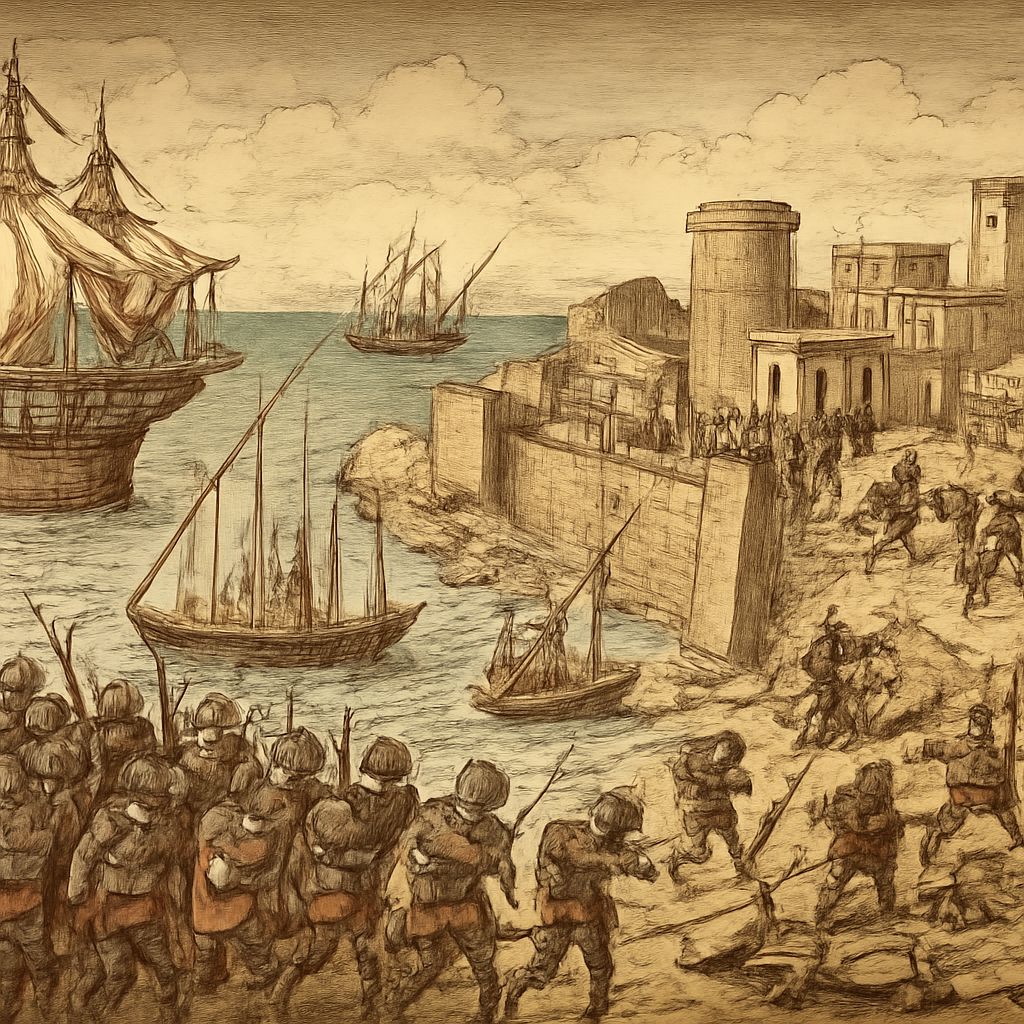
The Swahili Coast built its wealth and authority on maritime networks that linked East Africa to Arabia, India and beyond. Kilwa Kisiwani was one of those ports: a node where local rulers, coastal merchants and itinerant traders exchanged goods, credit and political favours. By the turn of the sixteenth century, Europe’s maritime states were pressing into the Indian Ocean with different intentions. Portugal’s campaign combined an appetite for direct control of lucrative routes with a strategic program: seize or neutralise key ports, erect forts, force payments of tribute and use naval presence to bend coastal politics. Francisco de Almeida led one arm of this campaign in 1505, approaching these decisions as both military operation and commercial policy.
That pressure did not act alone. Local politics, long-distance markets, reciprocal obligations between inland producers and coastal middlemen, and the logistical realities of sailing season and provisioning all shaped outcomes. Treating the Portuguese capture of Kilwa as a single, isolated incident flattens these strands. Instead, the event sits at the intersection of external expeditionary intent and complex regional practises — a collision of strategies, loyalties and economic entanglements that produced a moment of armed occupation and a longer unraveling of older port arrangements. The Portuguese capture of Kilwa belongs inside Indian Ocean history, not only European expansion.
Kilwa was a wealthy Swahili city tied to gold routes, Islam, coral-stone architecture, monsoon trade, and relationships across East Africa, Arabia, India, and beyond. Portuguese violence at Kilwa shows how cannon-armed maritime power tried to insert itself into existing trade worlds. The event mixed diplomacy, coercion, tribute demands, local politics, and the strategic desire to control routes rather than simply visit them.
The Turning Point
In the weeks and months of the 1505 operation, the capture of Kilwa crystallised choices that would reverberate across the coast. Francisco de Almeida’s forces took control of a principal port at Kilwa Kisiwani, converting a trading node into a held position within a campaign to command the sea lanes. That conversion was not merely a change of flag; it was a shift in practice. Portuguese occupation meant the application of forts, naval pressure and demands for tribute as instruments to regulate access and profit. For Swahili rulers the moment forced concrete decisions: to resist militarily, attempt diplomatic settlement, or accommodate a new overlord who could interdict ships and enforce terms.
These actors made tactical decisions under pressure — negotiating terms where possible, staging defences where necessary — but the balance had already tilted. The operation demonstrated how an oceanically mobile European power could translate maritime reach into territorial control of ports. Importantly, the capture should be read in two registers: as an immediate military act with local consequences, and as part of a deliberate Portuguese strategy that reconfigured the logic of control in the Indian Ocean. In short, Kilwa’s fall was both an isolated conquest and an emblem of a broader reorientation toward armed commercial governance.
Consequences
In the near term, Portuguese control of Kilwa was brief but consequential. Holding the port allowed Almeida’s campaign to demonstrate the effectiveness of forts, naval pressure and tribute in reshaping trade access, and it sent a clear message along the Swahili Coast: European fleets could occupy key harbours and enforce new economic terms. For coastal communities the immediate effects were practical and political — disruptions to established trading rhythms, shifts in who controlled revenues, and altered bargaining positions for Swahili rulers. Over the longer term, Kilwa’s capture signals a turning point: old systems built around relatively autonomous port cities met a militarized model of oceanic empire.
That model did not instantly erase local agency or complex coastal networks, but it changed the parameters within which merchants and rulers operated. Ports that once negotiated on the basis of reciprocal exchange now faced demands backed by guns and fortifications. The event also acquired power as memory: later administrations and movements would recall Kilwa’s fall when justifying claims or narrating decline. Historians must therefore treat the capture both as an episode of immediate occupation and as an initiating moment in a longer contest over the terms of Indian Ocean trade and sovereignty. The consequences included disruption to Swahili coast politics, fortified Portuguese presence, altered trade pressures, and later Omani and local responses.
Kilwa's story remains important because it centers African urban life before and during European intrusion.
Interpretation Notes
Portuguese Capture Kilwa is easy to flatten into one dramatic date. A stronger reading separates immediate action from deeper causes, affected communities, and the memory later states or movements built around the event.
Why Keep Reading
Follow this story to see how a handful of port seizures became a maritime policy and how coastal societies adapted, resisted or accommodated. The capture of Kilwa in 1505 is an entry point into broader patterns: Portuguese imperial tactics of fort-building and tribute; responses by other Swahili ports; and the gradual remaking of Indian Ocean political economies. Readers interested in how local agency survived under new constraints should look next at subsequent ports, the changing routes of merchants, and the ways memory of occupation shaped later claims to authority. Each thread explains a different part of how an older system met a militarised European presence and why that collision mattered for centuries.
Read Kilwa with Ibn Battuta, Vasco da Gama, Indian Ocean trade, Mombasa, and Swahili Coast routes.
Reading Path
Follow the story without losing the thread
Before This
After This
Same Period
- Oman Expels Portuguese from Mombasa1698 CE
- Malacca Falls to the Portuguese1511 CE
- Berlin Conference1884-1885
Wider Timeline
Mind Map
How to think about Portuguese Capture Kilwa
Indian Ocean trade
Kilwa as a node linking East Africa to Arabian and South Asian markets
Map Layer
Where this event sits geographically
Gold pins mark the approximate locations of published event pages. This is a schematic locator map, not a historical border map.
Coordinates are approximate and are used to help readers orient themselves before opening a full event page.
References
Where to Check the Facts
- Encyclopaedia Britannica: KilwaReference for Kilwa as a Swahili city-state, commercial center, Portuguese occupation, and later decline.
- Official UNESCO World Heritage Centre: Ruins of Kilwa Kisiwani and Songo MnaraReference for the material remains and Indian Ocean setting of Kilwa and Songo Mnara.