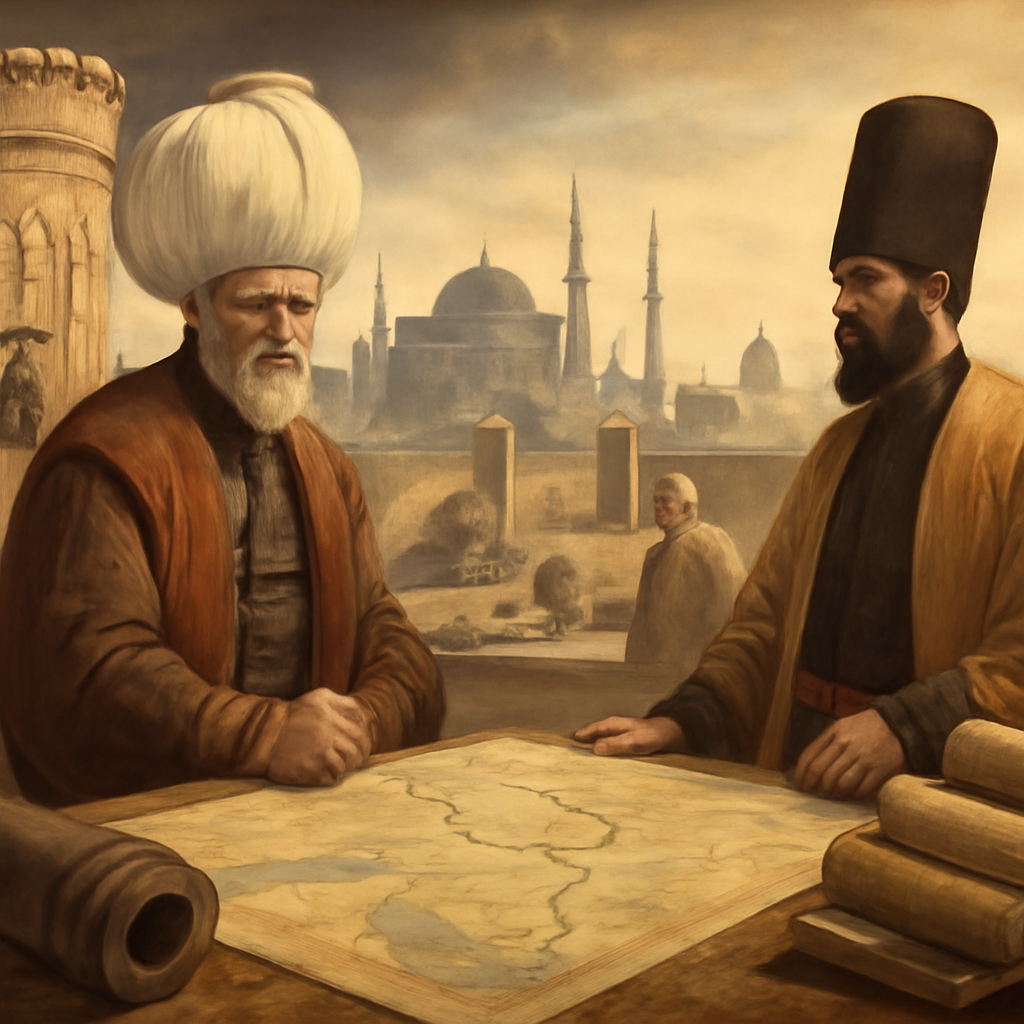
Central Question
How did gunpowder empires turn conquest, religion, reform, diplomacy, and frontier pressure into the political map of the early modern Middle East and Mediterranean?
Start With These Dates
- May 29, 1453Fall of Constantinople, 1453: Siege Timeline, Causes, Aftermath
The Fall of Constantinople happened on May 29, 1453, when Mehmed II's Ottoman forces captured the city after a 55-day siege. Read the event through a four-step sequence: Ottoman artillery and blockade pressure on the Bosporus map, Byzantine wall defense, the final assault before dawn, and the aftermath in which Constantinople became an Ottoman imperial capital.
- 1501 CESafavid Empire Founded
Ismail I founded the Safavid dynasty in Iran, creating a major early modern Islamic empire and making Twelver Shi'ism central to state identity.
- August 23, 1514Battle of Chaldiran
Ottoman forces defeated the Safavids at Chaldiran, exposing military differences, hardening an imperial frontier, and reshaping Sunni-Shi'a political rivalry.
- 1517 CEOttoman Conquest of Egypt
Ottoman conquest brought Egypt and the former Mamluk domains into the Ottoman imperial system, linking Cairo, Syria, the Red Sea, and pilgrimage routes to Istanbul.
- 1639 CETreaty of Zuhab
The Treaty of Zuhab stabilized parts of the Ottoman-Safavid frontier, making imperial rivalry visible through borders, diplomacy, and contested Iraqi and Iranian spaces.
- July 1908Young Turk Revolution
The Young Turk Revolution restored the Ottoman constitution and parliament, challenging Abdulhamid II's autocracy while intensifying debates over empire and nationalism.
- 1915 CEArmenian Genocide Begins, 1915: Deportation, Violence, and Evidence
The Armenian Genocide began in 1915 as Ottoman authorities moved from wartime suspicion to arrests, deportations, and mass violence against Armenian communities. April 24 marks one remembered start, but the destruction unfolded through a wider system of removal, killing, starvation, exile, and evidence.
Sources Used Here
- Encyclopaedia Britannica: Ottoman Empire
Reference for Ottoman imperial chronology, institutions, reform, war, and decline.
- Encyclopaedia Britannica: Tanzimat
Reference for the nineteenth-century Ottoman reform program and its administrative setting.
- Encyclopaedia Britannica: Battle of Chaldiran
Reference for the 1514 Ottoman-Safavid battle and its regional consequences.
- Encyclopaedia Britannica: Safavid dynasty
Reference for Safavid state formation, Shi'a imperial identity, and rivalry with the Ottomans.
Ottoman, Safavid, and Gunpowder Empires is designed as a route, not a folder. It gathers events that answer related reader questions about power, belief, conflict, exchange, institutions, and memory. The strongest way to read the page is to move from the earliest events toward the later ones, watching how one kind of pressure changes form across different places.
The route currently runs from May 29, 1453 to 1915 CE. That span lets readers compare immediate turning points with slower consequences: the founding of institutions, the spread of ideas, the shock of war or disease, and the way later societies reused earlier events as warnings, models, or symbols.
Start with Fall of Constantinople, 1453: Siege Timeline, Causes, Aftermath, Safavid Empire Founded, Battle of Chaldiran, Ottoman Conquest of Egypt, Siege of Vienna and then follow the internal links into people, timelines, years, maps, and source lists. The route structure stays visible when each event explains why it belongs with the others and where the next useful page is.
Compare the events by scale. Some are concentrated moments, such as a battle, proclamation, trial, or publication. Others are long processes, such as a reform movement, pandemic, trade route, or diplomatic order. Reading both types together helps prevent the page from becoming a list of dates.
A useful route keeps uncertainty visible. Historical change rarely has one cause or one clean ending, so the reader can separate background pressure, immediate trigger, turning point, result, and later memory. That pattern is what makes the atlas expandable without making the reader start over each time.
This route is also a comparison tool. After reading one event, compare it with a later event on the same page and ask what changed in scale, language, geography, technology, authority, or public memory. The comparison is often more useful than the individual summary because it reveals the pattern the topic page is built to expose. When a claim feels too neat, open the full event page and check whether the evidence supports one cause, several causes, or a contested interpretation before moving on.
This hub reads the Ottoman and Safavid worlds as a set of connected imperial problems: conquest, religious legitimacy, gunpowder warfare, frontier management, law, and reform. Constantinople, Chaldiran, Cairo, Vienna, Lepanto, and Zuhab are not isolated dramatic scenes. They show how early modern empires tried to make power travel across mountains, seas, sacred cities, administrative provinces, and contested borderlands.
The Ottoman-Safavid rivalry gives the route its sharpest ideological and geographic edge. Chaldiran and Zuhab show military technology, dynastic charisma, Sunni-Shi'a difference, Anatolian politics, Iraqi cities, Iranian plateaus, and frontier diplomacy interacting over generations. The point is not to make sectarian identity the only cause. The stronger reading asks how rulers used religion, army reform, taxation, and border claims to make imperial authority believable.
The later nodes move from expansion to pressure. Kucuk Kaynarca, Tanzimat, the Young Turk Revolution, and the Armenian Genocide show that imperial power could not survive by conquest alone. Reformers tried to strengthen the Ottoman state with law, equality claims, bureaucracy, and military modernization, while nationalist conflict, war, and mass violence exposed the human cost of imperial crisis. The route therefore connects the early modern map to modern Middle Eastern and Balkan history.
Constantinople gives the route its first capital problem. Ottoman victory in 1453 was not only a siege result; it was the capture and remaking of a Roman-Byzantine city into an imperial center. The city tied the Black Sea, Mediterranean, Balkans, Anatolia, Orthodox Christianity, Islamic authority, and court ceremony into one place. That is why the route starts with conquest but quickly becomes administration, population, architecture, law, and memory.
The Safavid founding in 1501 changes the map from a western Ottoman story into a wider Iranian and Islamic rivalry. Safavid power joined dynastic charisma, military followings, Persianate court culture, Shi'i identity, urban centers, and frontier competition. The route becomes more useful when readers treat the Safavids as empire-builders with their own institutions, not simply as Ottoman opponents.
Chaldiran in 1514 marks the point where battlefield technology and sacred legitimacy collided. Ottoman artillery and firearms mattered, but so did charisma, tribal-military organization, claims to true rule, and control over eastern Anatolia. The battle did not settle every border or identity question; it made a long rivalry more legible. Later diplomacy at Zuhab shows how repeated conflict became frontier management.
Egypt in 1517 widens Ottoman authority toward the Arab lands, the Red Sea, holy cities, Mediterranean trade, and older Mamluk institutions. This matters because empire was layered. The Ottomans had to rule through existing elites, tax systems, legal traditions, and provincial arrangements. Conquest created claims, but governing required bargains, records, troops, and religious legitimacy that worked differently from Istanbul to Cairo to Baghdad.
Vienna and Lepanto keep Europe and the Mediterranean in the frame without making Europe the whole story. Siege warfare, naval battle, Habsburg rivalry, Venetian interests, North African links, and Ottoman logistics reveal an empire operating across land and sea. The route is strongest when it compares different theaters: a Danube frontier did not function like a Mediterranean fleet or an Iraqi borderland.
Kucuk Kaynarca in 1774 reveals a later balance. Russian pressure, Black Sea access, diplomacy, Orthodox protection claims, and Ottoman vulnerability made the eighteenth century different from the age of expansion. The treaty gives readers a bridge from early modern conquest to the nineteenth-century problem of reform under pressure. The empire now had to answer military defeat, fiscal strain, and European diplomatic intervention.
Tanzimat reform and the Young Turk Revolution belong in the same route because they show imperial survival being argued through law and citizenship. Reformers used equality, bureaucracy, military modernization, schools, and constitutional language to strengthen the state. But reform also raised difficult questions: who counted as an Ottoman subject, how minorities would be protected, and whether centralization could coexist with regional identities.
The Armenian Genocide gives the route its most sensitive and necessary endpoint. It cannot be treated as a final footnote to a military story. It belongs to late imperial crisis, war, nationalism, state violence, deportation, mass death, survivor testimony, denial, and memory. The route gives readers a structured path into that catastrophe while keeping the human and evidentiary stakes visible.
This hub also helps readers connect early modern and modern Middle Eastern history. Ottoman and Safavid institutions shaped later borders, religious communities, provincial politics, legal memory, and diplomatic patterns. The route does not claim one straight line from Chaldiran to the modern region. It gives readers a map of inherited pressures: frontier zones, sectarian language, reform under pressure, imperial collapse, and the violence of remaking states.
Military change runs through the whole route, but it never acts alone. Cannon, firearms, siegecraft, naval gunnery, fortifications, logistics, and drilled armies changed the cost of war. Yet rulers still needed tax systems, religious legitimacy, commanders, provincial elites, artisans, and supply routes. The term gunpowder empire is useful only when it keeps technology tied to the institutions that made technology work.
The route also benefits from an everyday administrative lens. An imperial order reached people through courts, tax registers, land grants, military recruitment, market supervision, religious endowments, governors, judges, and local notables. Istanbul or Isfahan could announce policy, but provincial society determined how far policy traveled. That gap between command and practice is where many imperial systems became durable or fragile.
Religious difference appears throughout the route, but careful reading avoids turning it into a timeless explanation. Sunni and Shi'i identity mattered in Ottoman-Safavid rivalry, but so did dynasty, cavalry politics, trade, frontier tribes, taxation, cities, and diplomacy. Later sectarian language often borrows older memories, which makes historical precision important. The route asks when religion shaped policy and when rulers used religious language to solve political problems.
Cities give the route texture. Istanbul, Isfahan, Cairo, Baghdad, Tabriz, Vienna, and Mediterranean ports were not just dots on a map. They concentrated artisans, soldiers, scholars, merchants, diplomats, judges, minorities, and court ceremony. A city could be a capital, prize, frontier, sacred center, or treaty concern. Reading the route through cities makes imperial power less abstract.
The Black Sea and Mediterranean also make the story bigger than a land-war timeline. Naval logistics, grain, piracy, merchants, islands, canals, ports, and diplomatic access shaped Ottoman relations with Venice, Russia, North Africa, and European powers. Lepanto and Kucuk Kaynarca are different kinds of events, but both show that sea access and maritime power could reshape imperial confidence.
Reform created new promises and new dangers. Tanzimat language about equality and law tried to bind diverse subjects to the state, but it also changed expectations. Communities could use reform language to demand protection, while central officials could use reform to extend surveillance and control. The Young Turk Revolution carried constitutional hope, but it also opened questions about nationalism, army politics, and central authority under extreme pressure.
The Armenian Genocide endpoint demands evidence-aware reading. Deportation orders, survivor testimony, diplomatic reports, photographs, memoirs, legal debates, and denial all shape how the event is studied and remembered. The route includes it not for shock value but because late imperial crisis cannot be understood without confronting mass violence and the destruction of communities.
For readers arriving through modern Middle East searches, this route supplies the deeper background. It explains why Ottoman reform, Iranian state tradition, frontier memories, religious institutions, European intervention, and wartime collapse matter before oil, Cold War politics, and contemporary conflict enter the frame. The value of the hub is continuity with caution: inherited structures matter, but they never determine later events by themselves.
The best final comparison is between conquest and repair. Early nodes ask how empires won cities, provinces, sea lanes, and legitimacy. Later nodes ask how empires tried to repair military weakness, fiscal strain, legal inequality, and nationalist pressure. The route becomes compelling when readers see that expansion and reform were two answers to the same problem: how to keep a diverse empire governable across distance.
The hub also gives readers a method for comparison with Mughal, Habsburg, Qing, and Roman routes. Large empires often faced familiar problems: how to collect revenue, discipline armies, honor local elites, manage religious diversity, and explain defeat. The Ottoman-Safavid route adds a sharper focus on gunpowder warfare, Islamic legitimacy, frontier settlement, and Mediterranean diplomacy, making the comparison specific rather than generic.
A final reader path follows objects and built spaces. Cannons, manuscripts, mosques, churches, palaces, fortresses, ships, treaties, coins, and court chronicles all reveal how power became visible. Material culture keeps the topic from becoming a list of rulers. It shows how ordinary subjects encountered empire through taxes, buildings, courts, soldiers, markets, and rituals.
The route also explains why timelines alone are not enough. Chronology shows sequence, but the hub shows relationships: why a siege connects to a capital, why a treaty connects to a frontier, why reform connects to state survival, and why genocide memory belongs inside the story of imperial collapse.
That relationship layer gives readers a reason to move from event pages back to the hub. The hub is where scattered battles, reforms, treaties, cities, and atrocities become one argument about how empires endure and fail.
The strongest route into this hub starts with a map table: Istanbul, Tabriz, Baghdad, Cairo, Vienna, the Black Sea, the Mediterranean, and the Iranian plateau all pull the reader into different imperial problems. Ottoman and Safavid power was not a simple duel between two states. It was a long experiment in making conquest, religious legitimacy, provincial bargains, military technology, and frontier diplomacy work across difficult geography.
Gunpowder is useful only if it stays attached to people and institutions. Cannon, firearms, fortresses, fleets, and siegecraft changed the cost of war, but rulers still needed tax registers, land grants, judges, scholars, merchants, soldiers, artisans, and local elites. The page becomes more readable when military scenes lead into administration rather than replacing it.
The late route gives the hub emotional and political weight. Kucuk Kaynarca, Tanzimat, Young Turk constitutionalism, and the Armenian Genocide show reform under pressure, not just decline. A reader can follow how military defeat created legal promises, how legal promises created new expectations, and how wartime nationalism and state violence destroyed communities. That structure keeps the page from becoming a decorative empire overview.
Read the events in order first; the page is built to reveal change over time.
Ask which pressures existed before the visible turning point and which actors had room to choose.
Follow what changed afterward in institutions, borders, law, belief, or everyday life.
Notice which events became symbols and why later generations kept returning to them.
Ask how sultans and shahs used conquest, religion, law, genealogy, monuments, and military success to justify rule.
Follow Anatolia, Iraq, the Black Sea, the Balkans, Egypt, and the Mediterranean as zones where imperial claims met limits.
Use Tanzimat and 1908 to see reform as a survival strategy under military, fiscal, diplomatic, and nationalist pressure.
Compare Istanbul, Cairo, Baghdad, Vienna, the Black Sea, the Mediterranean, and Iranian plateau as different imperial settings.
Place Armenian Genocide memory, survivor evidence, and denial beside the late Ottoman crisis rather than outside it.
Use Chaldiran and Zuhab to compare battlefield technology, religious legitimacy, diplomacy, local elites, and the hard work of governing borderlands.
Choose a Reading Path
Start With the Timeline
Use the related timeline first when you want a chronological route through the topic.
Start with May 29, 1453: Fall of Constantinople, 1453: Siege Timeline, Causes, AftermathOpen a Person Page
Use people pages when the topic is easier to understand through leadership, resistance, reform, or memory.
Start with 1501 CE: Safavid Empire FoundedUse Year Pages
Use year pages when you need a fast answer to what changed in a specific year.
Start with August 23, 1514: Battle of ChaldiranReturn to the Map
Use the map to keep geography visible while moving between events and regions.
Start with 1517 CE: Ottoman Conquest of EgyptNeed Ottoman Rise
Start with Constantinople, Egypt, Vienna, and Lepanto to see capital-making, Arab provinces, European frontier, and naval power.
Start with 1639 CE: Treaty of ZuhabNeed Safavid Rivalry
Read Safavid founding, Chaldiran, and Zuhab to follow Shi'i kingship, military competition, and border diplomacy.
Start with July 1908: Young Turk RevolutionNeed Reform
Use Kucuk Kaynarca, Tanzimat, and 1908 to understand pressure, citizenship claims, bureaucracy, and constitutional politics.
Start with 1915 CE: Armenian Genocide Begins, 1915: Deportation, Violence, and EvidenceNeed Late Ottoman Crisis
Move to Armenian Genocide and the modern MENA route for war, nationalism, state violence, and memory.
How the Story Builds
Begin with Fall of Constantinople, 1453: Siege Timeline, Causes, Aftermath. The opening event usually shows the pressure that made the route necessary: a crisis of authority, an expanding exchange system, a new technology, a contested idea, or a conflict that older institutions could no longer contain.
Treaty of Zuhab works as a checkpoint because it lets readers ask what had become irreversible, which actors still had choices, and how the route changed scale between the opening event and the later consequences.
The later edge of the route includes Tanzimat Reforms Begin, Young Turk Revolution, and Armenian Genocide Begins, 1915: Deportation, Violence, and Evidence. These pages help readers see what survived beyond the first shock: institutions, borders, laws, memories, technologies, movements, or arguments that kept shaping later history.
The route is easier to remember through people and places. Watch figures such as Mehmed II, Constantine XI Palaiologos, Ismail I, Selim I, and Shah Ismail I move through settings such as Constantinople, Tabriz, Chaldiran, Cairo, and Vienna; that is where large structures become visible as choices, risks, costs, and memories.
Constantinople turns conquest into a claim over Roman memory, Islamic sovereignty, Mediterranean geography, and imperial ceremony.
Safavid founding and Chaldiran make Ottoman-Safavid rivalry a problem of religion, firearms, frontier elites, and dynastic legitimacy.
Egypt, Vienna, and Lepanto show imperial power moving through holy cities, fleets, armies, provinces, and European diplomacy.
Zuhab and Kucuk Kaynarca show how repeated war became border settlement, Russian pressure, and treaty language.
Tanzimat, the Young Turk Revolution, and Armenian Genocide reveal the stakes of trying to remake empire under nationalist and wartime stress.
- Which event in Ottoman, Safavid, and Gunpowder Empires feels like the true point of no return, and why might another reader choose a different event?
- What changes if the route is read from the perspective of ordinary people rather than rulers, armies, inventors, reformers, or institutions?
- Which consequence was immediate, and which consequence only became clear decades later?
- Where does the map change the interpretation by showing distance, borders, routes, ports, capitals, or frontiers?
- Why did Chaldiran matter beyond the battlefield?
- How did the Ottoman conquest of Egypt change the empire's Islamic and Mediterranean role?
- When did reform strengthen imperial rule, and when did reform expose deeper weakness?
- How can readers handle the Armenian Genocide as both a World War I event and a late Ottoman catastrophe?
- Which frontier mattered most for the route: Anatolia, Iraq, the Balkans, the Black Sea, or the Mediterranean?
- Why is Ottoman-Safavid history weaker when it is explained only as sectarian conflict?
- How did reform language both strengthen imperial government and expose the limits of imperial belonging?
Interactive Timeline
Follow Ottoman, Safavid, and Gunpowder Empires by sequence
Fall of Constantinople, 1453: Siege Timeline, Causes, Aftermath
The Fall of Constantinople happened on May 29, 1453, when Mehmed II's Ottoman forces captured the city after a 55-day siege. Read the event through a four-step sequence: Ottoman artillery and blockade pressure on the Bosporus map, Byzantine wall defense, the final assault before dawn, and the aftermath in which Constantinople became an Ottoman imperial capital.
Read the full event pageMap Layer
Ottoman, Safavid, and Gunpowder Empires geography
Gold pins mark the approximate locations of published event pages. This is a schematic locator map, not a historical border map.
Coordinates are approximate and are used to help readers orient themselves before opening a full event page.
Route Events
Events in This Topic
Fall of Constantinople, 1453: Siege Timeline, Causes, Aftermath
The Fall of Constantinople happened on May 29, 1453, when Mehmed II's Ottoman forces captured the city after a 55-day siege. Read the event through a four-step sequence: Ottoman artillery and blockade pressure on the Bosporus map, Byzantine wall defense, the final assault before dawn, and the aftermath in which Constantinople became an Ottoman imperial capital.
Safavid Empire Founded
Ismail I founded the Safavid dynasty in Iran, creating a major early modern Islamic empire and making Twelver Shi'ism central to state identity.
Battle of Chaldiran
Ottoman forces defeated the Safavids at Chaldiran, exposing military differences, hardening an imperial frontier, and reshaping Sunni-Shi'a political rivalry.
Ottoman Conquest of Egypt
Ottoman conquest brought Egypt and the former Mamluk domains into the Ottoman imperial system, linking Cairo, Syria, the Red Sea, and pilgrimage paths to Istanbul.
Siege of Vienna
The Ottoman siege of Vienna tested the empire's ability to project power deep into Central Europe and made the Habsburg-Ottoman frontier a durable strategic zone.
Battle of Lepanto
A Holy League fleet defeated Ottoman naval forces at Lepanto, one of the largest galley battles in Mediterranean history.
Treaty of Zuhab
The Treaty of Zuhab stabilized parts of the Ottoman-Safavid frontier, making imperial rivalry visible through borders, diplomacy, and contested Iraqi and Iranian spaces.
Second Siege of Vienna
The Ottoman siege of Vienna in 1683 failed after a relief force broke the siege, opening a period of Habsburg counteroffensive in Central Europe.
Treaty of Kucuk Kaynarca
The Treaty of Kucuk Kaynarca ended a Russo-Ottoman war and gave Russia new leverage around the Black Sea, Crimea, and claims involving Orthodox Christians.
Tanzimat Reforms Begin
The Tanzimat reforms began with an imperial reform program that aimed to reorganize Ottoman law, administration, taxation, military service, and subjecthood.
Young Turk Revolution
The Young Turk Revolution restored the Ottoman constitution and parliament, challenging Abdulhamid II's autocracy while intensifying debates over empire and nationalism.
Armenian Genocide Begins, 1915: Deportation, Violence, and Evidence
The Armenian Genocide began in 1915 as Ottoman authorities moved from wartime suspicion to arrests, deportations, and mass violence against Armenian communities. April 24 marks one remembered start, but the destruction unfolded through a wider system of removal, killing, starvation, exile, and evidence.
References
Where to Check the Facts
- Encyclopaedia Britannica: Ottoman EmpireReference for Ottoman imperial chronology, institutions, reform, war, and decline.
- Encyclopaedia Britannica: TanzimatReference for the nineteenth-century Ottoman reform program and its administrative setting.
- Encyclopaedia Britannica: Battle of ChaldiranReference for the 1514 Ottoman-Safavid battle and its regional consequences.
- Encyclopaedia Britannica: Safavid dynastyReference for Safavid state formation, Shi'a imperial identity, and rivalry with the Ottomans.