At a Glance
The shape of the event
- Date
- 1529 CE
- Place
- Vienna
- Type
- Siege
The Ottoman siege of Vienna tested the empire's ability to project power deep into Central Europe and made the Habsburg-Ottoman frontier a durable strategic zone.
1529 CE; place the event in Vienna before comparing causes or consequences.
The event gives readers a map-based way to understand Ottoman power as both expansive and limited by distance, supply, and coalition politics.
Suleiman the Magnificent / Ferdinand I are the first names or groups to compare before widening the story.
Vienna held, and Ottoman expansion continued to face logistical, weather, and frontier constraints in Central Europe.
Vienna held, and Ottoman expansion continued to face logistical, weather, and frontier constraints in Central Europe.
The event gives readers a map-based way to understand Ottoman power as both expansive and limited by distance, supply, and coalition politics.
Follow this episode into the surrounding maps and timelines to see how military, logistic and political systems shaped Central Europe.
Background
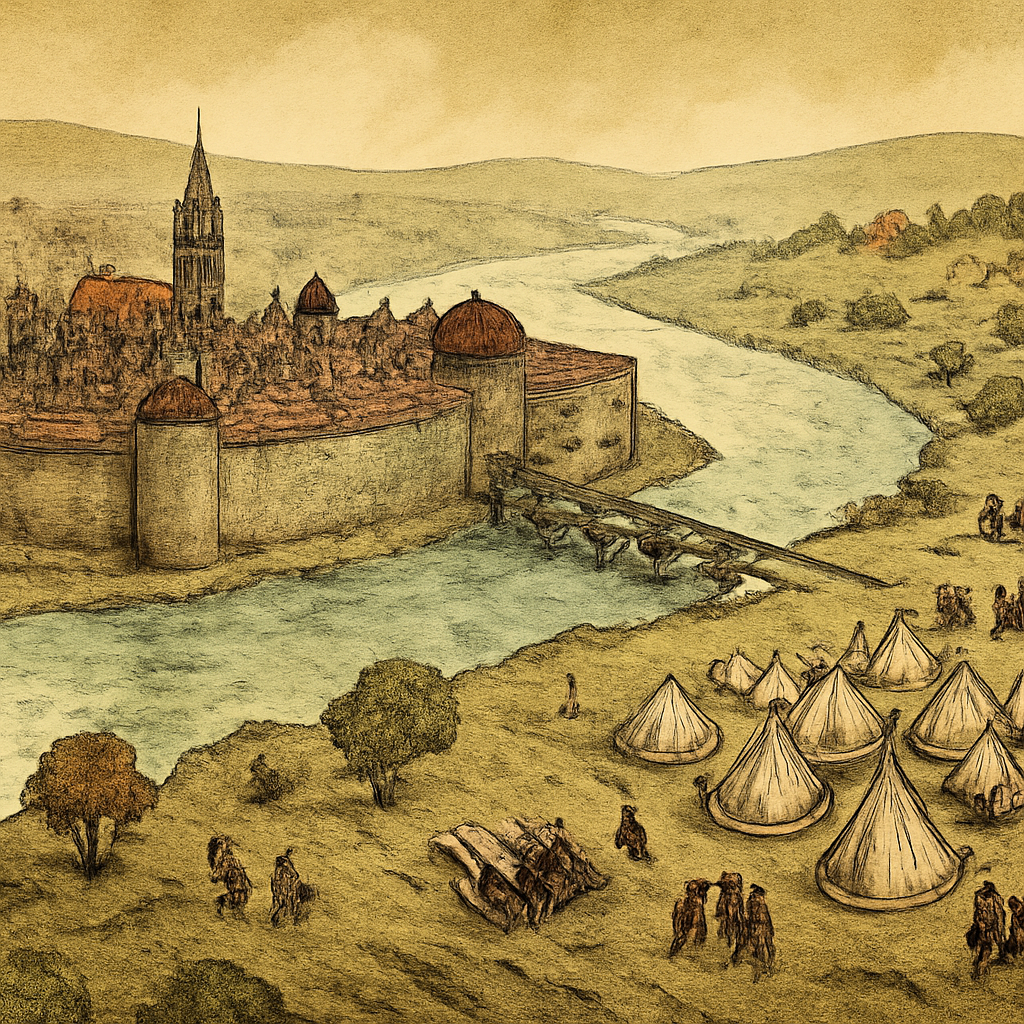
By 1529 the Ottoman Empire had become the principal military and political force to the east and southeast of Central Europe, while the Habsburgs held a patchwork of territories across the region. Those two realities set most of the pressures that led to the siege: an imperial center capable of rapid military campaigns, and a Habsburg realm that had to defend a long, porous frontier. Distance mattered. The logistics of moving men, horses, artillery and provisions over hundreds of miles across rivers and mountains tested any commander’s plans. Local conditions — roads, supply points, and the loyalties or survival strategies of towns and villages between capitals — shaped campaign possibilities as much as grand strategy.
European politics also intruded: rivalries, dynastic claims and the need to secure alliances or neutrality affected how much attention and resource either side could commit. All of this meant that the 1529 siege should be read as a meeting of ambitions and limits: a high-stakes attempt to push an imperial frontier that collided with the daily realities of supplying and sustaining war in Central Europe. The first Ottoman siege of Vienna is most readable when it is treated as a campaign shaped by weather, roads, supplies, artillery, diplomacy, and defensive preparation rather than as an inevitable clash at the edge of Europe.
Suleiman's army operated at the outer edge of long-distance logistics, while Habsburg defenders relied on walls, repair work, urban discipline, and relief expectations. The siege also belongs inside a wider struggle over Hungary after the Battle of Mohacs. Rival claims, dynastic politics, Ottoman expansion, Habsburg ambition, and Central European frontier communities all shaped why Vienna mattered. The city was a strategic and symbolic target, but the campaign was limited by season, distance, mud, disease, and the difficulty of sustaining pressure far from secure bases.
The Turning Point
The defining shift in 1529 was less a single heroic sally than the collision of strategic intent with operational constraint. Suleiman chose to press Ottoman power deep into Central Europe, committing forces to invest Vienna itself — a deliberate demonstration that the empire could threaten a principal Habsburg city. On the other side, Ferdinand I and the city’s defenders faced the immediate choice of holding the walls, organizing scarce resources, and using the urban terrain and fortifications to blunt the attackers. What changed during the siege was the balance between offensive momentum and defensive resilience: Ottoman projection encountered the cumulative effects of distance, interrupted supply, and adverse conditions that prevented the campaign from turning a threat into permanent control.
Commanders on both sides made pragmatic choices — where to press, when to conserve strength, which local positions to secure — that converted a campaign of conquest into a contest of endurance. Those choices, shaped by weather, logistics and the limits of coalition politics, determined that Vienna would hold and that the Ottoman advance, though powerful, would not immediately redraw the map of Central Europe. The turning point was the failure to convert imperial momentum into a captured capital. Vienna held long enough for weather and logistics to work against the besiegers, turning a dramatic advance into a warning about the limits of even a powerful expanding empire.
Consequences
In the near term, Vienna’s survival checked the immediate Ottoman push into Central Europe and gave the Habsburgs a political and psychological reprieve. The siege demonstrated that even a dominant empire could be constrained by the practicalities of long-distance warfare: provisioning, roads, seasonal conditions and the diplomatic calculation of allies and rivals all mattered as much as battlefield success. In the longer view, the event helped to turn the Habsburg–Ottoman frontier into a durable strategic zone rather than a transient line. Frontier towns and fortresses, supply networks, and the routines of border defence became regular features of regional policy and community life.
The siege also entered later memory as a touchstone for narratives about European resistance and Ottoman ambition — a memory that different states and movements would invoke for their own ends. Finally, as a map-based lesson, the 1529 siege clarifies how empire was both expansive and bounded: control over territory could be spectacular and temporary or incremental and logistical, and the limits of projection mattered as much as the reach of arms. The consequences were political and memorial as much as military. The Habsburg-Ottoman frontier remained central for generations, Hungary stayed contested, and Vienna became a reference point for later stories about defense, empire, and European identity.
Reading 1529 beside 1683 keeps the two sieges distinct while showing how memory reused the city.
Interpretation Notes
Siege of Vienna is easy to flatten into one dramatic date. A stronger reading separates immediate action from deeper causes, affected communities, and the memory later states or movements built around the event.
Why Keep Reading
Follow this episode into the surrounding maps and timelines to see how military, logistic and political systems shaped Central Europe. Look at routes armies used, the chain of supply points that made campaigns possible or impossible, and how towns and fortresses along the frontier adapted after 1529. Read the biographies of Suleiman and Ferdinand to understand the choices available to rulers; then read local case studies of communities caught between empires to see consequences on everyday life. Each map and chronology will show the siege not as a single dramatic date but as a hinge in a longer story about how distance, infrastructure and diplomacy define the limits of power.
Continue from 1529 to Mohacs, Suleiman, Habsburg-Ottoman rivalry, 1683 Vienna, and Kucuk Kaynarca. That route turns a famous siege into a long frontier history.
Reading Path
Follow the story without losing the thread
Before This
- Protestant Reformation Begins1517 CE
- Ottoman Conquest of Egypt1517 CE
- Battle of ChaldiranAugust 23, 1514
After This
- Battle of LepantoOctober 7, 1571
- Treaty of Zuhab1639 CE
- Second Siege of Vienna1683 CE
Same Period
- Battle of ChaldiranAugust 23, 1514
- Ottoman Conquest of Egypt1517 CE
- Treaty of Zuhab1639 CE
Wider Timeline
Mind Map
How to think about Siege of Vienna
Logistics & Distance
Long supply lines and terrain limited operational reach and affected campaign timing.
Map Layer
Where this event sits geographically
Gold pins mark the approximate locations of published event pages. This is a schematic locator map, not a historical border map.
Coordinates are approximate and are used to help readers orient themselves before opening a full event page.
References
Where to Check the Facts
- Encyclopaedia Britannica: Siege of Vienna 1529Reference for the 1529 Ottoman siege and its significance.
- Encyclopaedia Britannica: Ottoman EmpireReference for Ottoman imperial chronology, institutions, reform, war, and decline.
- Encyclopaedia Britannica: TanzimatReference for the nineteenth-century Ottoman reform program and its administrative setting.