At a Glance
The shape of the event
- Date
- 1683 CE
- Place
- Vienna
- Type
- Siege
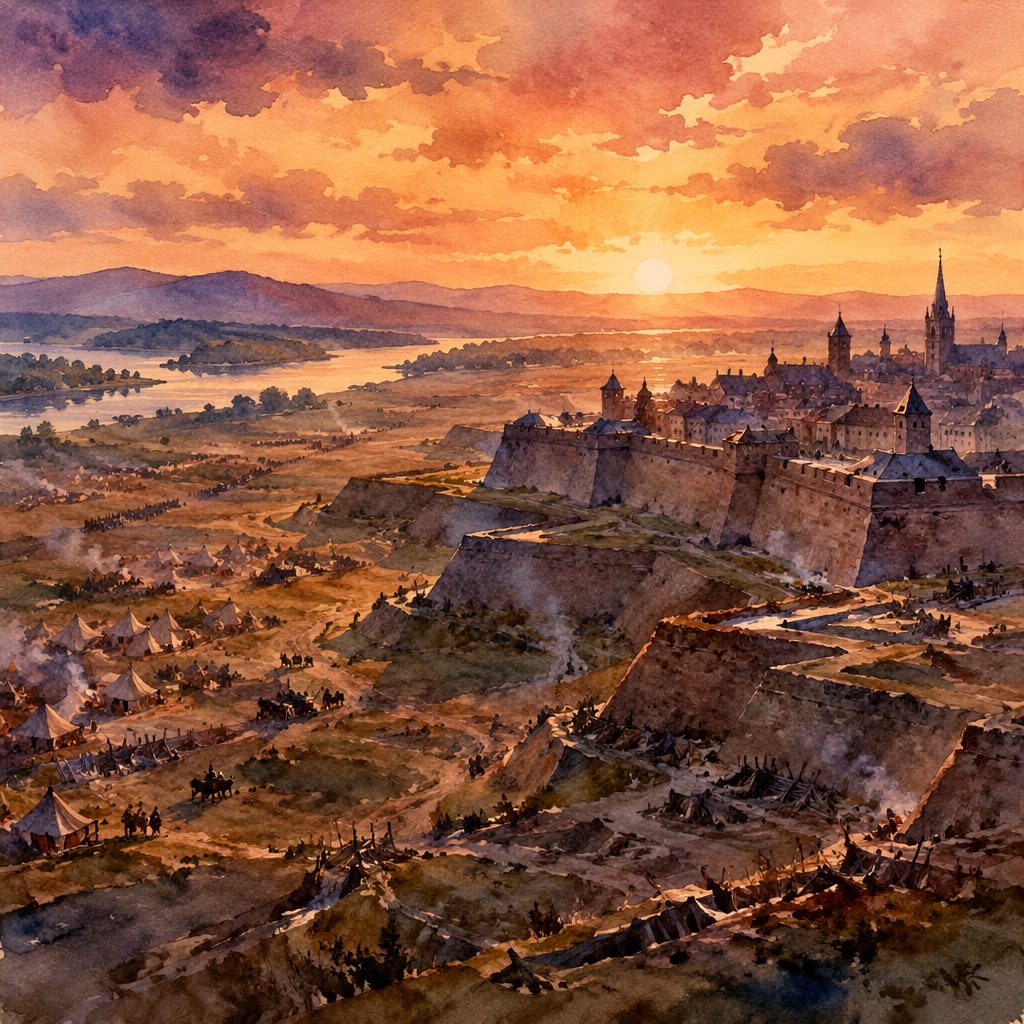
The Ottoman siege of Vienna in 1683 failed after a relief force broke the siege, opening a period of Habsburg counteroffensive in Central Europe.
1683 CE; place the event in Vienna before comparing causes or consequences.
The event became a major memory point in European-Ottoman history, though its causes and consequences were more political and logistical than mythic.
Kara Mustafa Pasha / John III Sobieski are the first names or groups to compare before widening the story.
Ottoman power in Central Europe began to retreat as Habsburg and allied forces gained momentum.
Ottoman power in Central Europe began to retreat as Habsburg and allied forces gained momentum.
The event became a major memory point in European-Ottoman history, though its causes and consequences were more political and logistical than mythic.
If this episode draws you in, follow the unfolding military and political campaigns that converted a successful relief into sustained Habsburg gains across Central Europe.
Background
By 1683 Central Europe was a contested space where long-running rivalry between the Ottoman Empire and the Habsburg Monarchy intersected with local politics, shifting alliances, and the practical limits of early modern warfare. The Ottoman state continued to field large, professional forces and pursued campaigns westward for political, strategic, and dynastic reasons. The Habsburgs held a multiethnic frontier, dependent on both imperial resources and the cooperation of neighboring states. Neither side acted from a single motive: diplomatic calculations, supply lines, seasonal campaigning, and the condition of urban populations all mattered. Coalition warfare was becoming a decisive factor; ad hoc alliances, particularly among Habsburg partners and regional princes, could multiply military capacity but required timing and political will.
Vienna itself was a focal point where military pressure met civilian endurance. The siege was not an isolated act of aggression so much as the product of those accumulated pressures — a moment when broader trends in Central European politics, Ottoman strategy, and the practical limits of sustaining operations in enemy territory converged. The Second Siege of Vienna is more compelling when the campaign is read through coalition, logistics, and memory. Ottoman planning, Habsburg defense, Polish-Lithuanian relief, German princes, papal diplomacy, fortifications, disease, weather, supply lines, and civilian fear all shaped the outcome. The event also needs protection from later myth.
1683 was a major strategic defeat for the Ottoman army and opened a Habsburg counteroffensive, but it did not end Ottoman history. The campaign matters precisely because change and continuity sit together.
The Turning Point
The siege’s decisive rupture came when outside forces arrived and broke the encirclement around Vienna. On one side stood Ottoman commanders, including Kara Mustafa Pasha, who had invested considerable resources in forcing the city. On the other stood a relief coalition that included John III Sobieski and allied contingents who had negotiated to act together. The crucial change was not a mythical last-minute miracle but a set of concrete decisions: the coalition’s choice to move in with coordinated timing, commanders’ judgments about when and how to attack, and the cumulative effects of supply shortages and fatigue inside the besieging army.
Breaking a siege requires not only battlefield success but also the prior political work of assembling allies and the logistical work of marching and provisioning relief forces. Once the relief broke the siege, momentum shifted. The Ottomans, facing the prospect of protracted campaigning far from secure supply bases and confronted with renewed Habsburg and allied resistance, could no longer maintain their position around Vienna. That tactical reversal translated quickly into strategic advantage for the defenders and their partners, opening space for counteroffensive operations. The turning point was the failure of the siege and the arrival of the relief coalition. Battlefield drama mattered, but the deeper change was a frontier balance that became less favorable to Ottoman expansion in Central Europe.
Consequences
In the immediate aftermath the failed siege deprived the Ottoman Empire of the initiative in Central Europe and allowed the Habsburgs and their allies to move from defense to sustained counteroffensive. Forces that had been occupied with the siege were no longer in a position to press westward, and Habsburg commanders could capitalize on the respite to reassert control in threatened borderlands. Over the longer term the event became a reference point: it entered diplomatic calculations, military doctrine about coalition operations, and popular memory across Europe. Yet the longer arc should be described with care.
The siege’s failure did not end Ottoman power overnight; rather, it marked the beginning of a period in which Habsburg and allied momentum grew and Ottoman influence in parts of Central Europe receded. The causes of that shift were as much political, logistical, and institutional as they were military. Local communities that had endured sieges, forced marches, and shifting sovereignties continued to shape outcomes through their loyalties and obligations. Memory would later amplify the moment into national narratives and symbols, but historians should separate commemorative meaning from the practical mechanisms — supply, alliance-making, command decisions — that produced change on the ground.
The consequences include the Great Turkish War, Habsburg advances, Polish and Austrian memory, Ottoman political fallout, and later stories that turned the siege into a symbol of Europe, Christianity, or decline. A careful route separates the campaign from the uses made of it.
Interpretation Notes
Second Siege of Vienna is easy to flatten into one dramatic date. A stronger reading separates immediate action from deeper causes, affected communities, and the memory later states or movements built around the event.
Why Keep Reading
If this episode draws you in, follow the unfolding military and political campaigns that converted a successful relief into sustained Habsburg gains across Central Europe. Look next at how coalition politics worked in practice: which states contributed troops, how commanders negotiated command, and how logistics constrained operations. Equally valuable is tracing the social aftermath in towns and borderlands — how communities rebuilt, how property and jurisdiction shifted, and how the siege entered public memory. These strands explain why a single military episode could reshape a region without being the sole cause of long-term change. Read this event with 1529 Vienna, Kucuk Kaynarca, Ottoman reform, Poland-Lithuania, and the World War I Ottoman route.
That sequence keeps a famous siege inside a long imperial history.
Reading Path
Follow the story without losing the thread
Before This
- Treaty of Zuhab1639 CE
- Battle of LepantoOctober 7, 1571
- Siege of Vienna1529 CE
After This
- Treaty of Kucuk Kaynarca1774 CE
- Battle of WaterlooJune 18, 1815
- Tanzimat Reforms Begin1839 CE
Same Period
- Fall of Constantinople, 1453: Siege Timeline, Causes, AftermathMay 29, 1453
- Protestant Reformation Begins1517 CE
- Battle of LepantoOctober 7, 1571
Wider Timeline
Mind Map
How to think about Second Siege of Vienna
Ottoman strategy
The campaign reflected Ottoman political aims and the limits of maintaining forces far from core supply bases.
Map Layer
Where this event sits geographically
Gold pins mark the approximate locations of published event pages. This is a schematic locator map, not a historical border map.
Coordinates are approximate and are used to help readers orient themselves before opening a full event page.
References
Where to Check the Facts
- Encyclopaedia Britannica: Siege of Vienna 1683Reference for the 1683 siege, relief force, and Ottoman defeat.
- Encyclopaedia Britannica: Ottoman EmpireReference for Ottoman imperial chronology, institutions, reform, war, and decline.
- Encyclopaedia Britannica: TanzimatReference for the nineteenth-century Ottoman reform program and its administrative setting.