At a Glance
The shape of the event
- Date
- March 11, 2020
- Place
- Global
- Type
- Pandemic
The World Health Organization characterized COVID-19 as a pandemic after the virus spread across continents and strained public-health systems.
March 11, 2020; place the event in Global before comparing causes or consequences.
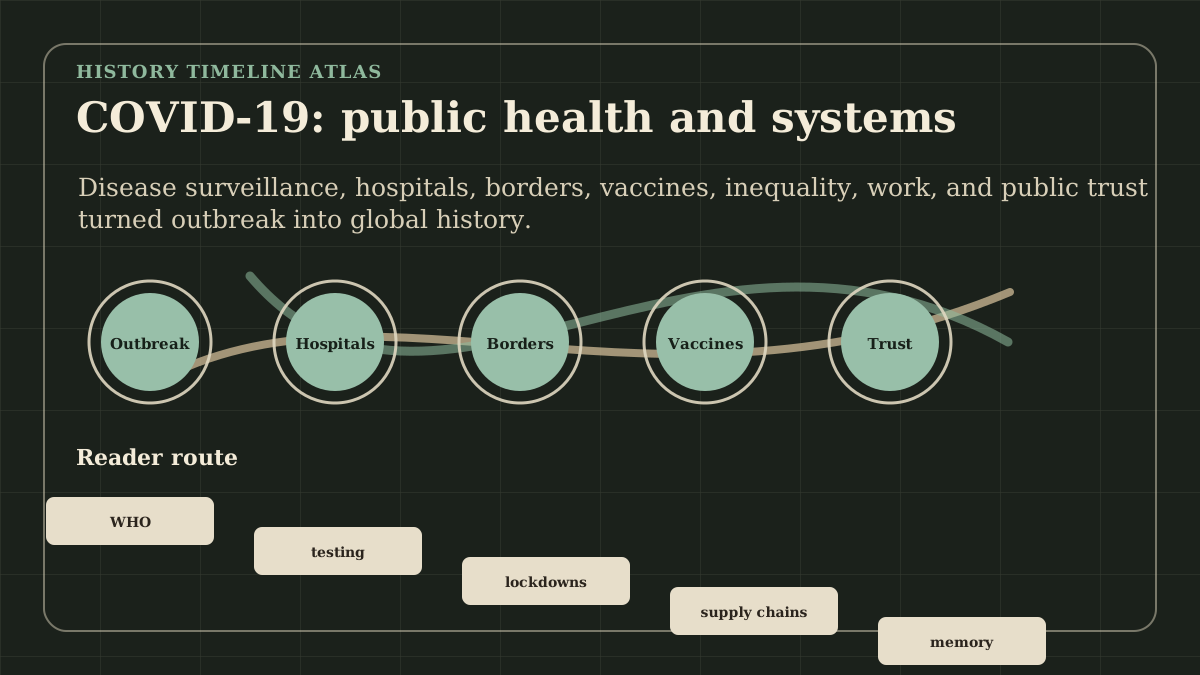
The pandemic changed health policy, work routines, education, supply chains, and debates over state power and public trust.
World Health Organization are the first names or groups to compare before widening the story.
Governments adopted emergency measures, travel restrictions, vaccination campaigns, and economic support programs.
Governments adopted emergency measures, travel restrictions, vaccination campaigns, and economic support programs.
The pandemic changed health policy, work routines, education, supply chains, and debates over state power and public trust.
Follow this thread to trace how the pandemic unfolded in policy, science and everyday life: read timelines of national responses to see how emergency measures were adopted and lifted; explore the development and deplo...
Background
The path to March 11 ran through years of deeper trends and immediate alerts. International travel and dense cities accelerated the pathogen’s reach; surveillance systems and public-health resources varied sharply between and within countries. Laboratories worked to identify the virus and public-health officials tracked clusters and chains of transmission, but these technical efforts unfolded against political calendars, supply constraints and differing national thresholds for declaring an emergency. The World Health Organization sits at the heart of global coordination: it gathers evidence, issues guidance and offers a shared language for action. Yet its assessments must be translated into law, budgets and logistics by national and local actors.
Interpretations of why the virus spread as it did—how much to attribute to individual choices versus structural realities such as healthcare investment, labour markets or global networks—remain contested. This page aims to make those disputes visible while tracing the immediate pressures that pushed the crisis from local outbreaks to a global emergency. COVID-19 belongs in a history atlas because it exposed how connected systems behave under stress. A respiratory outbreak became global through travel, cities, workplaces, hospitals, supply chains, households, media, and political decisions. The World Health Organization's pandemic declaration did not create the crisis; it publicly named a scale of risk that many communities were already beginning to experience. The page should keep ordinary life in view.
School closures, remote work, essential labor, isolation, mourning, overloaded hospitals, border controls, masks, testing, vaccine distribution, and misinformation changed how people understood government, expertise, risk, and obligation to strangers. Pandemic history is not only medical history. It is also a story of trust, inequality, labor, and public communication. The evidence layer is still important even without using unstable daily statistics. Case counts, death records, excess mortality estimates, genomic surveillance, hospital data, and public-health guidance all came from systems with different delays and blind spots. Readers need to understand why numbers were necessary and contested at the same time.
The Turning Point
The WHO’s characterization on March 11 was a turning point because it reframed the crisis from a series of national incidents into a global public-health emergency requiring coordinated, large-scale responses. That statement signalled to governments that containment would no longer be sufficient on its own and that mitigation across borders and sectors would be necessary. In the days and weeks that followed, national authorities activated emergency legal powers, imposed travel restrictions, closed schools and altered work rules; public-health agencies prioritized testing, contact tracing and hospital surge capacity; research institutions accelerated vaccine and therapeutic programmes; and supply chains for personal protective equipment and medical devices were scrutinized and rerouted. Individual choices—whether to isolate, mask or seek testing—interacted with these institutional shifts.
Some actors moved quickly to centralize decision-making, others retained decentralized approaches. The WHO’s declaration did not prescribe a single policy path; it changed expectations, resource allocations and political calculations worldwide, producing a patchwork of responses shaped by capacity, ideology and public trust. The turning point was the move from local outbreak response to global pandemic coordination. Once transmission, travel disruption, and health-system pressure crossed borders, governments faced choices about restrictions, testing, communication, economic support, and hospital capacity. The declaration gave a common language to a crisis that remained locally uneven. A second turning point came with vaccines and the politics of distribution.
Scientific speed was remarkable, but access, hesitancy, patents, logistics, cold chains, and public trust shaped who benefited and when. The pandemic made clear that discovery and delivery are different historical problems.
Consequences
In the near term the declaration prompted emergency budgets, travel bans, quarantine rules and wide-ranging social restrictions intended to slow transmission and protect health systems. Governments rolled out economic support measures to stabilize businesses and households, while health agencies mobilized testing, treatment and later vaccination efforts. Those immediate steps revealed strengths and weaknesses in preparedness: some systems adapted rapidly, others faltered under sustained pressure. Over the longer term the pandemic reshaped multiple domains. Health policy debates moved toward questions of surge capacity, pandemic preparedness and supply-chain resilience. Work routines shifted as remote work and hybrid models became routine for many occupations; education systems adopted remote and blended learning with uneven outcomes; global trade and logistics were reconfigured to manage interruptions.
The crisis also intensified public debates about state power, civil liberties and institutional trust. Societies confronted trade-offs between collective protection and individual freedoms, and historians and policymakers continue to weigh how personal behaviour, structural design and governance choices combined to produce outcomes. These consequences are still unfolding and will be interpreted differently depending on which evidence and values observers prioritize. The immediate consequences included illness, death, emergency policy, economic shock, school disruption, intensified inequality, and new expectations around remote work and digital services. The longer consequences include debates over public-health authority, preparedness, supply-chain resilience, scientific trust, and how societies remember collective loss. COVID-19 also changed historical comparison.
Readers often reach for the Black Death, smallpox, influenza, cholera, or HIV/AIDS, but each comparison has limits. A good page uses comparison to ask better questions about disease, state capacity, global connection, and social trust, not to flatten very different pandemics into one pattern.
Interpretation Notes
The memory of COVID-19 Pandemic Declared often depends on who tells the story. A court, army, religious community, merchant network, or later nation can emphasize different causes and make Global stand for different lessons.
Why Keep Reading
Follow this thread to trace how the pandemic unfolded in policy, science and everyday life: read timelines of national responses to see how emergency measures were adopted and lifted; explore the development and deployment of vaccines and how vaccination campaigns were organised; examine case studies of hospitals, workplaces and schools that adapted or failed to adapt; and follow debates about the balance between public health and civil liberties. Each linked topic reveals a different angle on the same global shock—how institutions acted, how people coped, and what choices shaped the road ahead. Read COVID-19 beside the Black Death, smallpox vaccination, Spanish flu, globalization, and public-health technology routes.
That path turns the page from a recent crisis into a longer question about how disease travels through trade, trust, science, inequality, and state capacity.
Reading Path
Follow the story without losing the thread
Before This
- Arab Spring BeginsDecember 2010
- Human Genome Project Completed2003 CE
- Iraq War BeginsMarch 2003
After This
No direct path yet.
Same Period
- September 11 AttacksSeptember 11, 2001
- Arab Spring BeginsDecember 2010
- Human Genome Project Completed2003 CE
Wider Timeline
Mind Map
How to think about COVID-19 Pandemic Declared
Global travel
Rapid international movement helped the virus reach multiple continents, increasing the chance of synchronous outbreaks.
Map Layer
Where this event sits geographically
Gold pins mark the approximate locations of published event pages. This is a schematic locator map, not a historical border map.
Coordinates are approximate and are used to help readers orient themselves before opening a full event page.
References
Where to Check the Facts
- Encyclopaedia Britannica: Black DeathReference for plague chronology, transmission debates, mortality, and social consequences.
- CDC: 1918 Pandemic H1N1 VirusPublic-health reference for the 1918 influenza pandemic and modern pandemic framing.