At a Glance
The shape of the event
- Date
- 1565 CE
- Place
- Cebu
- Type
- Colonial settlement
Spanish colonization began to create a durable imperial presence in the Philippines, linking local societies to Manila, Mexico, Christianity, and Pacific trade.
1565 CE; place the event in Cebu before comparing causes or consequences.
The event connects Southeast Asia to the Pacific and Americas, showing that colonial routes crossed oceans in more than one direction.
Miguel Lopez de Legazpi / Filipino communities are the first names or groups to compare before widening the story.
Spanish rule expanded across parts of the archipelago and made Manila a key node in the galleon trade.
Spanish rule expanded across parts of the archipelago and made Manila a key node in the galleon trade.
The event connects Southeast Asia to the Pacific and Americas, showing that colonial routes crossed oceans in more than one direction.
Keep reading to follow how a single settlement unfolded into a web of cross-ocean connections.
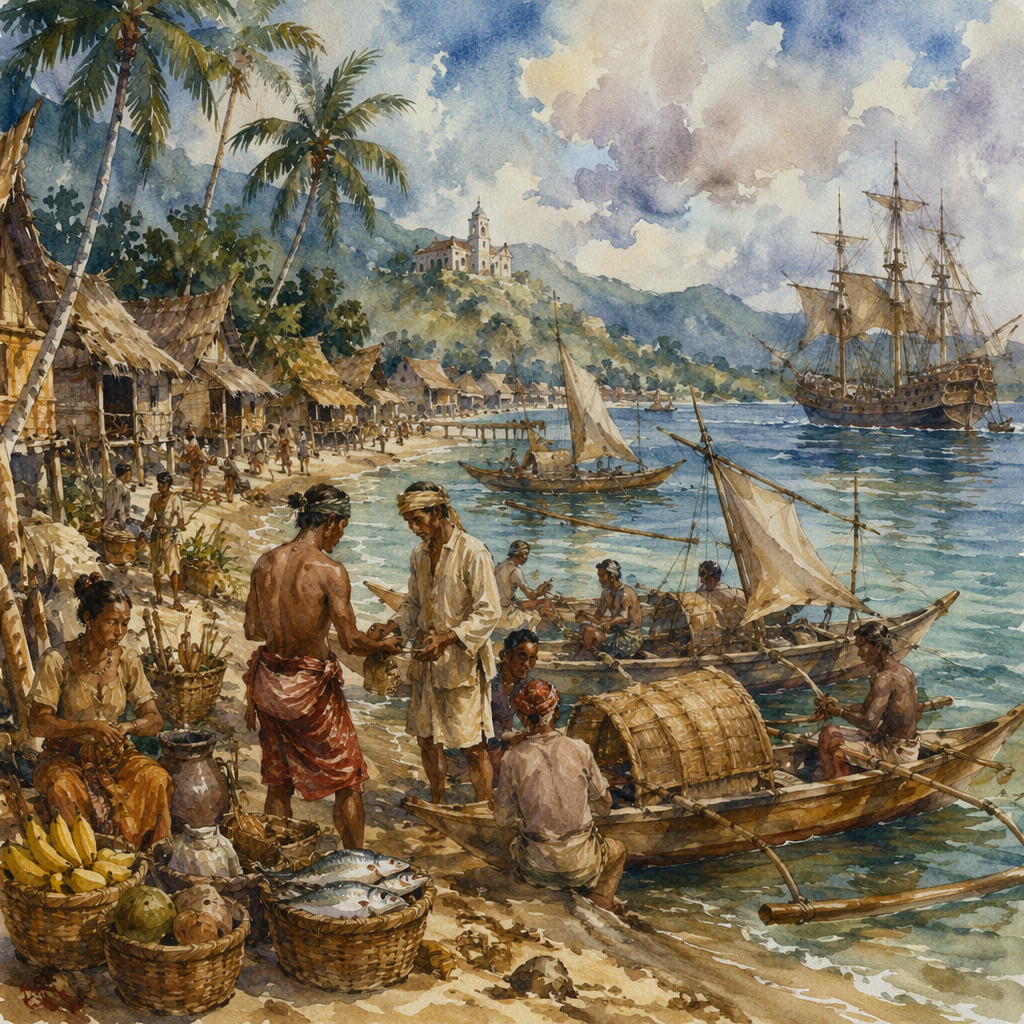
Background
By the mid-sixteenth century European states were expanding outward and testing maritime routes that linked distant shores. For the Spanish crown, the islands that now form the Philippines offered a possible base in the Pacific—a place from which to extend commercial and religious ambitions and to connect with other Iberian holdings across the ocean. The Pacific was already a space of movement and exchange among island and coastal societies, but Iberian voyages were beginning to alter the scale and direction of those movements. At the same time, Filipino communities were not uniform: coastal polities, port towns, and inland settlements each had their own politics, trade ties, and ritual lives.
Economic motives, strategic calculation, and missionary aims all converged, but none alone explains what happened. The settlement at Cebu emerged where imperial impetus met local conditions: a Spanish force led by Miguel López de Legazpi encountered communities whose responses ranged from negotiation and accommodation to resistance. Those immediate encounters would be refracted through ongoing choices, shaping an extended process rather than a single, self-contained act. Spanish colonization of the Philippines should be read as a Pacific and Asian story, not only an extension of American conquest. Legazpi's settlement linked Mexico, Manila, Cebu, local polities, galleon routes, missionary work, tribute, and regional trade. The Spanish empire became transpacific because American silver and Asian commerce could be joined through Manila.
Local agency belongs in the center. Filipino communities, datu leaders, Chinese merchants, Muslim polities, missionaries, soldiers, and colonial officials negotiated, resisted, converted, traded, and adapted in uneven ways. Colonization did not arrive as a single uniform experience across the archipelago.
The Turning Point
1565 is a turning point because choices made on the ground turned possibility into an incipient institution. Miguel López de Legazpi and his commanders chose to establish a settlement at Cebu rather than limit themselves to occasional calls or purely mercantile visits. That decision shifted Spanish activity from episodic contact to a sustained presence capable of receiving ships, supporting personnel, and anchoring further operations nearby. In practical terms, Spanish representatives entered into negotiations and encounters with local leaders, secured landing sites, and began to lay the groundwork for administration and religious work. Filipino communities responded variably: some formed new alliances, some adjusted trade and social arrangements to include Europeans, and others resisted incursions.
Missionaries accompanied the settlement and began processes of conversion that would accumulate over decades. Politically and economically, the Cebu foundation oriented Spanish attention toward other centers—most notably Manila—and toward trans-Pacific linkages with New Spain, setting patterns of governance and exchange that unfolded in choices, alliances, and conflicts over time. The turning point was the establishment of a durable Spanish base in the islands. That base made Manila a hinge between the Americas and Asia while creating new institutions of tribute, evangelization, urban rule, and maritime defense.
Consequences
In the near term, the Cebu settlement created a focal point from which Spanish influence spread unevenly across the archipelago. Officials, merchants, and missionaries who followed the 1565 pattern extended Spanish rule into some islands while encountering persistent limits and local refusals in others. Over time, and through additional settlements and administrative decisions, Manila emerged as a central node in a Pacific system that linked the Philippines to wider Asian markets and to New Spain; the galleon connections that followed would come to symbolize those interoceanic ties. For many Filipino communities, the processes begun at Cebu drew them into new networks of trade, religion, and governance—transformations that generated both accommodation and new forms of contestation.
Long-term consequences include altered economic routes, the spread of Christianity in many areas, and the embedding of colonial institutions that reshaped social hierarchies. The event also reframes regional history by showing that Southeast Asia became tied into Pacific–American circuits, and it left a contested legacy in memory and politics: 1565 is commemorated as a founding in some narratives and critiqued in others as the start of prolonged colonial imposition. The afterlife includes the Manila galleon, Catholic institutions, Chinese-Filipino commerce, Moro-Spanish conflict, colonial labor systems, and later nationalist memory. The page should make the Pacific route visible because it explains why the Philippines became central to global exchange.
Interpretation Notes
Spanish Colonization of the Philippines Begins is easy to flatten into one dramatic date. A stronger reading separates immediate action from deeper causes, affected communities, and the memory later states or movements built around the event.
Why Keep Reading
Keep reading to follow how a single settlement unfolded into a web of cross-ocean connections. Subsequent chapters trace Manila’s rise as a hub, the rhythms of the galleon links across the Pacific, and how Filipino communities navigated new pressures through adaptation, alliance, and resistance. Attention to linked timelines—political decisions, commercial flows, and religious missions—reveals colonization as a drawn-out process of choices rather than an instant conquest. Exploring those threads will show how oceans carried influence both ways and how the meaning of 1565 was shaped anew by later states and local memories. Read this page with the Manila galleon, Malacca, Zheng He, Mexican silver, and Pacific timelines to see how empire crossed oceans in both directions.
Reading Path
Follow the story without losing the thread
Before This
After This
- Batavia Founded1619 CE
- Pueblo Revolt1680
- Asiento System Expands1713
Same Period
- Batavia Founded1619 CE
- Columbus's First Atlantic Voyage1492 CE
- Fall of the Aztec Empire1521 CE
Wider Timeline
Mind Map
How to think about Spanish Colonization of the Philippines Begins
maritime motives
Spanish interest in securing bases and trade routes across the Pacific to link with New Spain
Map Layer
Where this event sits geographically
Gold pins mark the approximate locations of published event pages. This is a schematic locator map, not a historical border map.
Coordinates are approximate and are used to help readers orient themselves before opening a full event page.
References
Where to Check the Facts
- Encyclopaedia Britannica: History of the PhilippinesReference for Spanish colonization and Philippine history.
- Encyclopaedia Britannica: Southeast Asian historyReference for regional chronology, maritime exchange, colonial rule, nationalism, and modern state formation.
- Library of Congress: U.S. History Primary Source TimelinePrimary-source timeline reference for Atlantic settlement, colonial expansion, reform, and later U.S. history paths.