At a Glance
The shape of the event
- Date
- 1770
- Place
- Eastern Australia
- Type
- Imperial Claim
James Cook mapped parts of Australia's eastern coast and claimed territory for Britain despite Indigenous presence and sovereignty.
1770; place the event in Eastern Australia before comparing causes or consequences.
The event forces the Pacific route to pair exploration with dispossession and Indigenous law.
James Cook / Aboriginal communities are the first names or groups to compare before widening the story.
The claim became part of Britain's later colonization of Australia.
The claim became part of Britain's later colonization of Australia.
The event forces the Pacific route to pair exploration with dispossession and Indigenous law.
Follow the paths that lead from this moment: the maps and charts that made territory legible; the early colonial administrations that transformed claims into settlement; and the Indigenous records—oral, material and l...
Background
By 1770 the Pacific had become a corridor for exploration, commerce and imperial rivalry. Naval voyaging, charting and the desire for new stations and resources drew European ships into waters where people had long histories of occupation, trade and ceremony. On the eastern coast of Australia those histories were active. Aboriginal communities maintained laws, places of meaning and systems of movement; their evidence survives in oral memory, material traces and continuing presence. James Cook’s voyage combined seamanship, surveying and the power of a commissioned crown to turn observed geography into a legal claim. That action did not occur in isolation: it reflected imperial logics that treated mapped coastlines as potential possessions.
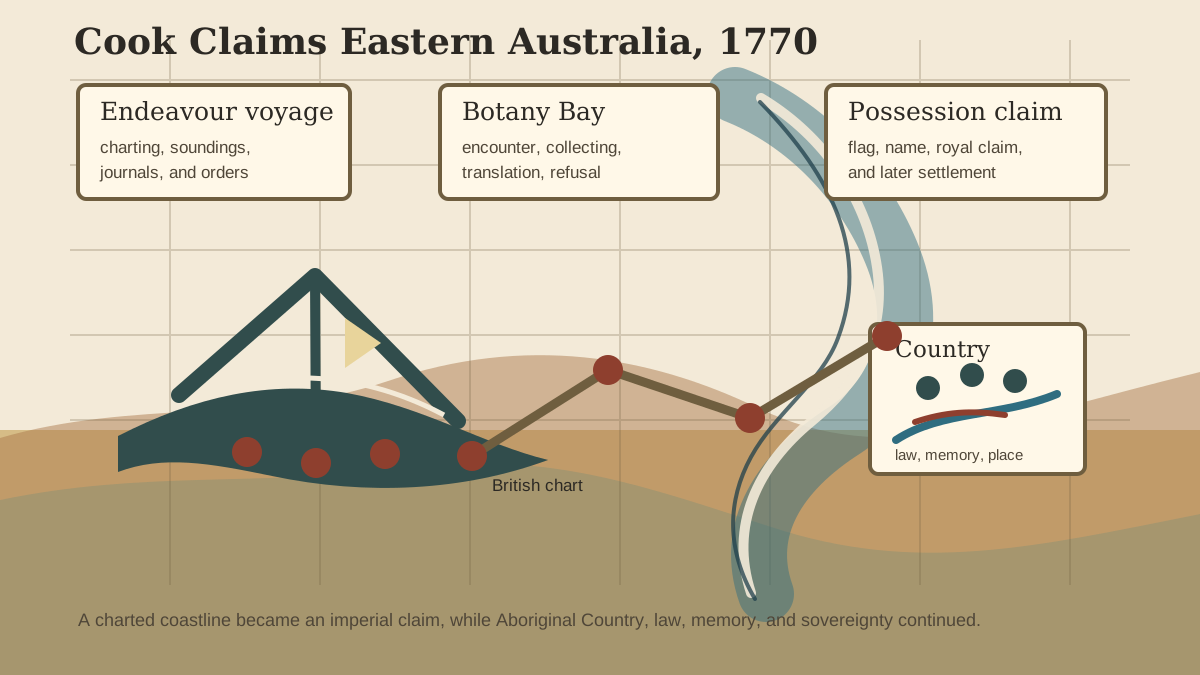
Yet the outcome of such a claim depended on further choices—by administrators, settlers and Indigenous people—over decades. Histories of the moment diverge depending on which evidence is centered: official logs and charts tell one story, while Aboriginal memory, archaeology, law and diplomacy tell others. A richer Cook page has to keep two maps visible at once. One map is the British chart: coastlines, soundings, names, anchorages, and a route that made eastern Australia legible to imperial offices. The other map is Country: Aboriginal law, story, kinship, custodianship, food systems, fire, ceremony, and responsibilities to place that did not require British recognition to exist. The Endeavour's time at what became Botany Bay is central because encounter was not abstract.
Gweagal and other Aboriginal people saw strangers arrive, watched them move through shorelines and resources, and responded within their own systems of authority. British journals often recorded misunderstanding as absence or refusal, which later fed the fiction that land could be claimed without negotiating sovereignty. Science also sat beside empire. Joseph Banks, Daniel Solander, botanical collecting, mapping, specimen naming, and Enlightenment curiosity helped make the voyage look like knowledge-gathering. But scientific collection and imperial claim were not separate lanes. Both translated living places into objects, names, records, and potential possession.
The Turning Point
The critical change in 1770 was not simply that a line was drawn on a chart, but that mapping was translated into an assertion of sovereignty. James Cook and his officers recorded coasts, bearings and place-names; in doing so they made the eastern shoreline legible to the British imperial system. That legibility mattered because empire judged territory in maps, proclamations and legal terms. Aboriginal communities continued to live and exercise authority over Country, yet their systems were not acknowledged in Cook’s act of possession. On board the Endeavour the practical choices—where to anchor, which features to name, whose presence to record—were made by a small group with naval orders.
Those choices carried a particular weight because imperial institutions could convert a charted claim into administrative policy. The result was a turning point: an encounter in which European cartography and a royal claim set the conditions for later colonial settlement, while Indigenous laws and memories persisted and contested that imposition. The turning point was the conversion of observation into possession. Cook's charts and journal entries did not physically occupy the continent, but they created documentary material later officials could cite. That is why the claim mattered even before permanent settlement: it gave empire a paper route into future policy. The act at Possession Island carried an imperial grammar that ignored Aboriginal sovereignty.
A flag, a name, and a royal claim could make sense inside British law and naval ritual while failing completely as a legitimate agreement with people already responsible for the land. That clash of legal worlds gives the event its long afterlife.
Consequences
In the near term Cook’s claim provided a documentary basis that later British authorities could point to when planning and justifying settlement. Over the longer term the act became one element in a sequence that led to colonization of Australia under British authority. This process unfolded unevenly: officials, settlers and colonists made choices about land use, governance and labour that altered the shape of Indigenous life and jurisdiction. Equally important, the event reframed the Pacific route itself. Exploration was no longer only about geographic knowledge and navigation; it was bound up with claims that displaced other sovereignties. The consequence is enduring: legal debates, diplomatic exchanges, oral histories, archaeology and public memory continue to debate what possession meant and for whom.
Some histories foreground the legal paperwork of empire; others centre Indigenous testimony about ongoing occupation and law. Recognising those divergent strands complicates any single narrative of discovery and shows how a maritime act of claiming reached into law, economy and daily life for generations. The immediate consequence was documentary rather than demographic. The claim did not instantly create a colony, but it helped prepare the archive, vocabulary, and map logic that later underwrote British settlement. In 1788, colonization turned earlier claiming into dispossession, violence, disease, legal denial, and survival struggles across many Aboriginal nations. The long consequence is still political.
Native title, public memory, museum collections, place names, Australia Day debates, treaty discussions, and repatriation campaigns all return to the problem exposed in 1770: who had authority to name, claim, collect, and govern? A careful page does not make Cook the whole story. It treats him as an actor in a larger process of British imperial expansion while keeping Aboriginal presence, refusal, adaptation, and continuing sovereignty at the center.
Interpretation Notes
Interpretations of Cook Claims Eastern Australia depend on whose evidence is centered: rulers and official records, affected communities, oral memory, archaeology, law, diplomacy, labor, and later public memory do not always tell the same story.
Why Keep Reading
Follow the paths that lead from this moment: the maps and charts that made territory legible; the early colonial administrations that transformed claims into settlement; and the Indigenous records—oral, material and legal—that offer alternative reckonings. Reading what came next reveals how particular legal doctrines, economic choices and acts of resistance shaped modern Australia. If you want to understand how a flagged coastline in 1770 connects to debates over sovereignty, memory and justice today, the subsequent timelines of settlement, Indigenous response and legal contestation are the next places to look. Read this page beside First Peoples in Australia, Pacific voyaging, Botany Bay, British settlement in 1788, native title, and Pacific empire routes.
That path keeps navigation, science, colonization, and Indigenous sovereignty in one frame.
Reading Path
Follow the story without losing the thread
Before This
- Battle of Plassey1757 CE
- Maori Settlement of Aotearoac. 1250 CE
- Eastern Polynesia Settlement Expandsc. 1000 CE
After This
Same Period
- First Opium War Begins1839 CE
- Attack on Pearl HarborDecember 7, 1941
- Eastern Polynesia Settlement Expandsc. 1000 CE
Wider Timeline
Mind Map
How to think about Cook Claims Eastern Australia
Imperial pressure
European naval expansion and rivalry made new claims strategically valuable to Britain
Map Layer
Where this event sits geographically
Gold pins mark the approximate locations of published event pages. This is a schematic locator map, not a historical border map.
Coordinates are approximate and are used to help readers orient themselves before opening a full event page.
References
Where to Check the Facts
- Te Ara: Pacific migrationsReference for Pacific voyaging, settlement paths, Polynesian migration, and Aotearoa context.
- Te Ara: TupaiaPacific-based biographical reference for Tupaia's navigation, mediation, and role during Cook's voyage.
- University of Hawaii ScholarSpace: Epeli Hau'ofa, Our Sea of IslandsPacific scholar's argument for reading Oceania as a connected sea of islands rather than scattered small places.
- Waitangi Tribunal: Treaty claims and Te TiritiPacific-based institutional reference for Te Tiriti, Maori claims, Crown obligations, and treaty interpretation.
- Encyclopaedia Britannica: Hawaii historyReference for Hawaiian settlement, kingdom history, and later United States annexation.
- Encyclopaedia Britannica: Te Tiriti o WaitangiReference for the Treaty of Waitangi and British annexation of New Zealand.
- Official UNESCO World Heritage Centre: TaputapuateaInstitutional reference for a Polynesian cultural landscape connected to voyaging, ritual, genealogy, and ocean paths.
- The Metropolitan Museum of Art: TenochtitlanMuseum reference for Mexica urban power, Tenochtitlan, and pre-Columbian imperial context.
- Encyclopaedia Britannica: The Spanish Conquest of the AztecsReference for the Spanish conquest, alliances, Tenochtitlan siege, and Indigenous context.