At a Glance
The shape of the event
- Date
- 2015
- Place
- Paris
- Type
- Climate Diplomacy
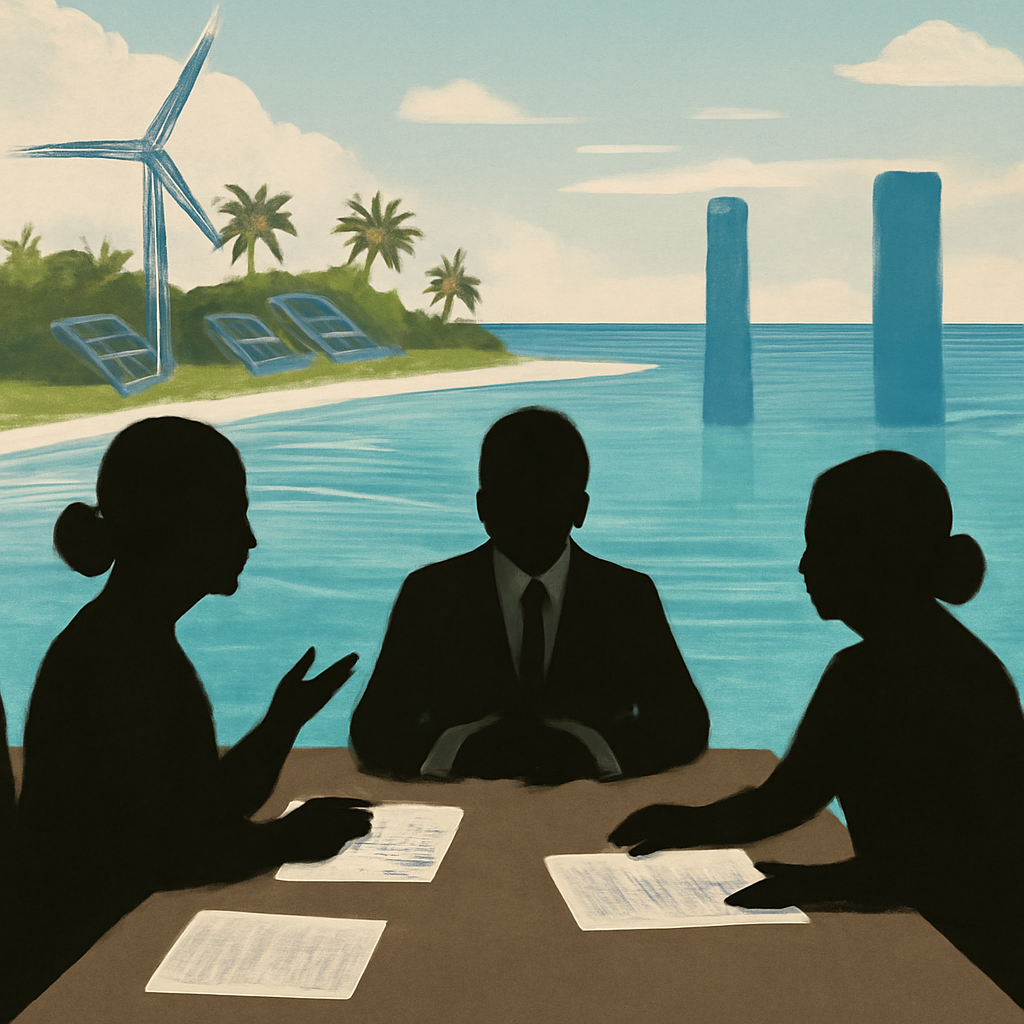
Small island states, including Pacific voices, pushed climate diplomacy toward recognizing survival, sea-level rise, and the 1.5 degree goal.
2015; place the event in Paris before comparing causes or consequences.
The event connects Pacific history to climate justice, sovereignty, migration, and contemporary global governance.
Pacific diplomats / Small island negotiators are the first names or groups to compare before widening the story.
The Paris Agreement made climate targets part of global diplomatic architecture.
The Paris Agreement made climate targets part of global diplomatic architecture.
The event connects Pacific history to climate justice, sovereignty, migration, and contemporary global governance.
Follow this thread to see how the Paris moment rippled into legal claims, adaptation funding debates, regional Pacific diplomacy, and stories of migration and cultural survival.
Background
For decades before 2015, scientists, activists and affected communities warned that rising temperatures and sea levels posed singular risks to low-lying islands. Those warnings moved unevenly through international institutions where richer, high-emission states and poorer, vulnerable states brought different priorities to the table. Small island states entered climate diplomacy with limited material leverage but with concentrated moral and political claims: survival, loss of territory, cultural continuity, and migration pressures. Pacific diplomats and negotiators drew on long-standing regional networks and on legal and moral arguments about responsibility and vulnerability. Yet their efforts unfolded inside a diplomatic architecture shaped by historical inequalities in emissions, by competing economic interests, and by procedural rules that privilege states with resources for sustained negotiation.
The story of 2015 is therefore the result of many pressures—scientific, political, legal and human—that converged in Paris but cannot be reduced to any single cause. A stronger Paris page has to keep two rooms visible at once: the formal negotiation hall and the island communities whose future gave the talks urgency. Small island states did not ask the world to notice climate change in the abstract. They connected temperature targets to homes, burial grounds, fresh water, reefs, schools, migration, debt, and the legal meaning of sovereignty. The 1. 5 degree language matters because it turned a technical threshold into a political claim. For many low-lying states, the difference between targets was not rhetorical.
It shaped arguments about adaptation finance, loss and damage, relocation, and whether a state can remain a state if land becomes uninhabitable. The diplomacy also reveals unequal power. High-emitting states controlled more money, legal staff, media attention, and negotiating capacity, while vulnerable states often relied on coalition discipline, moral clarity, scientific evidence, and public pressure. That imbalance makes the achievement more impressive and the unresolved gaps more important.
The Turning Point
By the time negotiators closed on the Paris Agreement, small island states had changed the terms of the conversation. Pacific diplomats and small island negotiators refused to let technical metrics eclipse questions of human survival and sovereignty. They pressed for an explicit reference to a 1. 5 degree goal and for language that acknowledged sea-level rise and its implications for livelihoods and migration. Their strategy combined persistent coalition-building with public statements that made the human consequences visible to other delegations and to global audiences. Those choices shifted bargaining dynamics: what began as a contest over mitigation targets and national commitments became a negotiation in which limits to warming and the protection of vulnerable peoples were central bargaining chips.
The result was not a unilateral victory but a reconfiguration of priorities inside the treaty text — climate targets and a recognition of existential risk were folded into the diplomatic architecture that emerged from Paris. The turning point was the successful insertion of survival language into the core diplomatic frame. Small island states and allied coalitions made it harder for negotiators to treat climate targets as a compromise among economies only; the text also had to speak to existential risk. Another turning point was the link between climate and sovereignty. The Paris process helped normalize the idea that sea-level rise, migration, and loss and damage are not side issues.
They are central questions about territory, rights, responsibility, and the future of international order.
Consequences
In the immediate aftermath, the Paris Agreement placed climate targets and limits on global warming at the heart of multilateral diplomacy. For small island states, that formal recognition provided a platform to press for finance, adaptation measures and legal protections tied to sea-level rise and displacement. Over the longer term, Paris has functioned as a reference point linking Pacific histories of colonial encounter, land and sovereignty to contemporary debates about climate justice and migration. The diplomatic success in Paris did not by itself secure every policy outcome island communities need; adaptation funding, legal remedies for loss and damage, and pathways for migration have remained contested and incomplete.
Interpretations of Small Island States Push the Paris Agreement depend on whose evidence is centred: rulers and official records, affected communities, oral memory, archaeology, law, diplomacy, labor, and later public memory do not always tell the same story. That divergence matters for how historians, policymakers and communities assess what Paris achieved and what remains to be done. The immediate consequence was a treaty framework that gave small island states a reference point for future pressure. The Paris Agreement did not deliver enough finance or enforcement by itself, but it created language that later campaigns could use. The longer consequence is an unfinished politics of repair.
Adaptation funding, emissions cuts, relocation pathways, legal personhood for states under climate threat, and compensation for loss and damage remain contested. Paris matters because it made those unfinished questions harder to ignore.
Interpretation Notes
Interpretations of Small Island States Push the Paris Agreement depend on whose evidence is centered: rulers and official records, affected communities, oral memory, archaeology, law, diplomacy, labor, and later public memory do not always tell the same story.
Why Keep Reading
Follow this thread to see how the Paris moment rippled into legal claims, adaptation funding debates, regional Pacific diplomacy, and stories of migration and cultural survival. Readers who begin with the 2015 negotiating table will find threads reaching back into colonial land histories and forward into contemporary campaigns over loss and damage, climate migration policy, and the practical limits of global commitments. Tracking those threads helps explain why Paris mattered, what it left unresolved, and how Pacific voices continue to shape the global politics of climate risk. Read this page beside Pacific voyaging, nuclear testing, Waitangi, Hawaiian sovereignty, and contemporary climate pages.
That route prevents island history from appearing only as vulnerability and shows Pacific actors as navigators, diplomats, protesters, and legal strategists.
Reading Path
Follow the story without losing the thread
Before This
After This
No direct path yet.
Same Period
- Lapita Expansion Beginsc. 1600 BCE
- James Cook Arrives at Tahiti1769 CE
- Spanish Colonization of the Philippines Begins1565 CE
Wider Timeline
Mind Map
How to think about Small Island States Push the Paris Agreement
sea-level threat
Rising seas framed survival and displacement as central diplomatic issues for island states
Map Layer
Where this event sits geographically
Gold pins mark the approximate locations of published event pages. This is a schematic locator map, not a historical border map.
Coordinates are approximate and are used to help readers orient themselves before opening a full event page.
References
Where to Check the Facts
- Official NZ History: Nuclear testing in the PacificReference for French nuclear testing in the Pacific and regional protest.
- Moruroa Files: Investigation into French nuclear tests in the PacificInvestigative reference for declassified-record analysis and contested health-impact claims around French Polynesian nuclear testing.
- Bougainville Referendum Commission: PublicationsOfficial reference for Bougainville referendum materials, voter information, observers, and public communication.
- PaCSIA: Bougainville Referendum DialoguesCivil-society reference for Bougainville dialogue work, referendum education, and local peace-process participation.
- Pacific Islands Forum: 2050 Strategy for the Blue Pacific ContinentPacific regional institutional reference for climate diplomacy, ocean governance, security, and shared Blue Pacific strategy.
- Encyclopaedia Britannica: Papua New GuineaReference for Papua New Guinea's independence and modern state formation.