At a Glance
The shape of the event
- Date
- c. 1200 CE
- Place
- Tonga
- Type
- Maritime Political Expansion
Tongan chiefly power expanded through voyaging, tribute, kinship, and maritime connections across parts of the central Pacific.
c. 1200 CE; place the event in Tonga before comparing causes or consequences.
The event shows that Pacific history includes regional power systems, not only isolated islands.
Tongan chiefs / Pacific voyagers are the first names or groups to compare before widening the story.
Tonga became a major Pacific political and cultural center.
Tonga became a major Pacific political and cultural center.
The event shows that Pacific history includes regional power systems, not only isolated islands.
If this episode reorients how you think about islands — not as sealed units but as nodes in networks of obligation and authority — follow the next timelines and entries that trace the spread of voyaging technologies,...
Background
The central Pacific of the twelfth and thirteenth centuries was a place of dense movement. Canoes crossed vast distances on seasonal winds; families and lineages kept track of distant kin; leaders sought prestige through gifts, alliances, and visible control. In Tonga, chiefs presided over networks that linked local obligations to wider reach. Pressure to secure resources, assert rank, and create durable alliances pushed leaders toward sustained maritime engagement. These were not simple military conquests but systems of exchange: tribute could acknowledge authority without displacing local rule; marriage and kinship could bind distant chiefs to one another; voyaging itself demonstrated capacity and reputation.
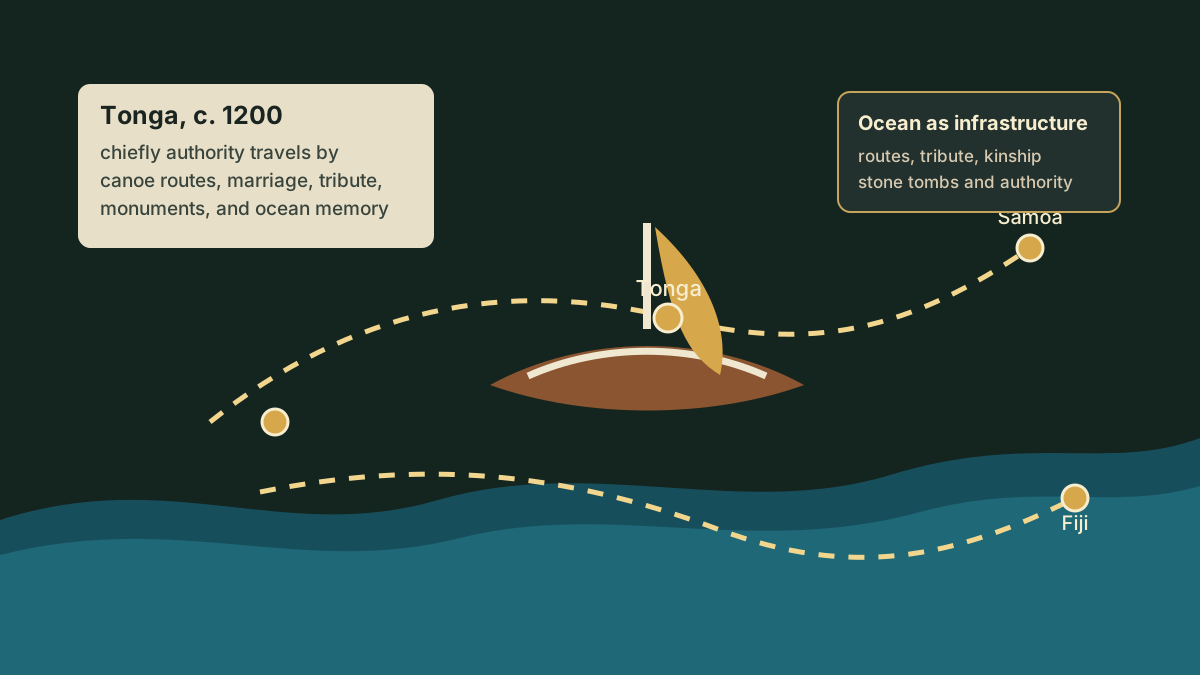
Archaeology, oral memory, later legal records, and the stories of voyagers each preserve parts of this past — but they do not always agree. No single explanation captures everything. Technology, environment, ambition, and long-standing social practices combined in ways that varied from place to place, producing a pattern of expansion that was strategic, pragmatic, and often contested. Tongan maritime expansion becomes clearer when the ocean is treated as infrastructure. Canoe routes, navigational knowledge, kinship, tribute, marriage alliances, chiefly titles, and ritual exchange linked islands rather than separating them. Tonga's influence reached across parts of the central Pacific through relationships that were political, ceremonial, and economic at once.
Authority moved through voyaging and return, not through land borders drawn on a map.
The Turning Point
What changed around c. 1200 was the scale and regularity of Tongan chiefs’ maritime engagement. Chiefs moved from occasional long-distance contacts to sustained patterns of voyaging and diplomatic exchange. They dispatched and received voyagers who carried not only goods but obligations: tribute that recognized a chief’s status, ceremonial exchanges that reinforced rank, and kinship ties that created obligations of hospitality and reciprocity across islands. These were conscious choices by named players in local politics — chiefly households that invested in canoes, navigational knowledge, and the personnel to carry out distant missions. Pacific voyagers — skilled navigators, sailors, and traders — acted as the practical agents of expansion, ferrying people, wealth, and law between places.
The result was a marine political landscape in which authority radiated along sea routes instead of being limited to a single island. Importantly, different witnesses leave different traces: a ruler’s list of allies may emphasize tribute and ceremony; oral memories may emphasize migration or alliance; archaeology records material exchange; and local law and labor practices show how that authority was exercised on the ground. Those multiple perspectives remind us that the expansion was not a single, uncontested act but a series of negotiated relationships enforced by diplomacy, obligation, and the reality of maritime power. Around 1200, chiefly power became more visible through monuments, exchange networks, and claims over people and routes.
Stone tombs and ceremonial centers gave authority a durable form, while maritime links made distant relationships practical. Expansion did not require uniform direct control everywhere. It could operate through tribute, prestige, remembered genealogy, and the ability to mobilize canoes, labor, and gifts across water.
Consequences
In the near term, Tongan chiefly networks consolidated enough authority and prestige that Tonga came to function as a major political and cultural center in the central Pacific. That center drew in tribute, hosted ceremonial exchanges, and became a focal point for certain religious and social practices as they spread or were reshaped across voyaging routes. For communities on the receiving end, relationships with Tonga could mean new obligations, new alliances, and altered local politics; for voyagers and intermediaries, it meant more regular employment and the growth of navigational expertise. Over the longer term, this pattern challenges simplistic portraits of the Pacific as only isolated island communities.
It shows regional systems of power that operated across ocean distances, mediated by kinship, ceremony, labor, and law. Those systems left uneven records: some islands preserve oral traditions that remember Tongan ties fondly or painfully; archaeological assemblages show material connections; later diplomatic encounters and colonial records interpreted these histories through other lenses. The mixed evidence underlines how historical power can be simultaneously influential and contested, forming a legacy that later writers, lawyers, and communities would remember, adapt, or resist in different ways. The consequences shaped Pacific political memory. Tonga became one of the region's most important centers of maritime authority, connected to Samoa, Fiji, and wider ocean routes. The story resists any picture of islands as isolated or small.
It shows a political world where distance could be mastered through expertise, and where ocean movement created hierarchy, obligation, and cultural exchange. Archaeology, oral traditions, and later chiefly genealogies each preserve different evidence, so the history works best when material traces and memory are read together.
Interpretation Notes
Interpretations of Tongan Maritime Chiefdom Expands depend on whose evidence is centered: rulers and official records, affected communities, oral memory, archaeology, law, diplomacy, labor, and later public memory do not always tell the same story.
Why Keep Reading
If this episode reorients how you think about islands — not as sealed units but as nodes in networks of obligation and authority — follow the next timelines and entries that trace the spread of voyaging technologies, the making of regional alliances, and the local responses to external influence. Read on to see how the practices of tribute, kinship, and maritime diplomacy evolved, how they left material traces archaeologists can test, and how oral traditions from multiple islands preserve alternative memories. That next layer will show how local choices and ocean routes together shaped centuries of Pacific history. Read next into Lapita expansion, Polynesian settlement, Pacific sovereignty, and later Tongan state history.
This route makes the Pacific visible as a connected historical field. The same trail also helps compare Pacific authority with land empires without forcing oceanic politics into continental categories. It is a route built around movement, obligation, and return.
Reading Path
Follow the story without losing the thread
Before This
- Eastern Polynesia Settlement Expandsc. 1000 CE
- Lapita Expansion Beginsc. 1600 BCE
After This
- Maori Settlement of Aotearoac. 1250 CE
- Rapa Nui Moai Building Peaksc. 1250 CE
- Spanish Colonization of the Philippines Begins1565 CE
Same Period
- Attack on Pearl HarborDecember 7, 1941
- Lapita Expansion Beginsc. 1600 BCE
- Eastern Polynesia Settlement Expandsc. 1000 CE
Wider Timeline
Mind Map
How to think about Tongan Maritime Chiefdom Expands
voyaging
Regular long-distance canoe voyages carried tribute, people, and obligations between Tonga and other islands.
Map Layer
Where this event sits geographically
Gold pins mark the approximate locations of published event pages. This is a schematic locator map, not a historical border map.
Coordinates are approximate and are used to help readers orient themselves before opening a full event page.
References
Where to Check the Facts
- Te Ara: Pacific migrationsReference for Pacific voyaging, settlement paths, Polynesian migration, and Aotearoa context.
- Te Ara: TupaiaPacific-based biographical reference for Tupaia's navigation, mediation, and role during Cook's voyage.
- University of Hawaii ScholarSpace: Epeli Hau'ofa, Our Sea of IslandsPacific scholar's argument for reading Oceania as a connected sea of islands rather than scattered small places.
- Waitangi Tribunal: Treaty claims and Te TiritiPacific-based institutional reference for Te Tiriti, Maori claims, Crown obligations, and treaty interpretation.
- Encyclopaedia Britannica: Hawaii historyReference for Hawaiian settlement, kingdom history, and later United States annexation.
- Encyclopaedia Britannica: Te Tiriti o WaitangiReference for the Treaty of Waitangi and British annexation of New Zealand.
- Official UNESCO World Heritage Centre: TaputapuateaInstitutional reference for a Polynesian cultural landscape connected to voyaging, ritual, genealogy, and ocean paths.