Historical Role
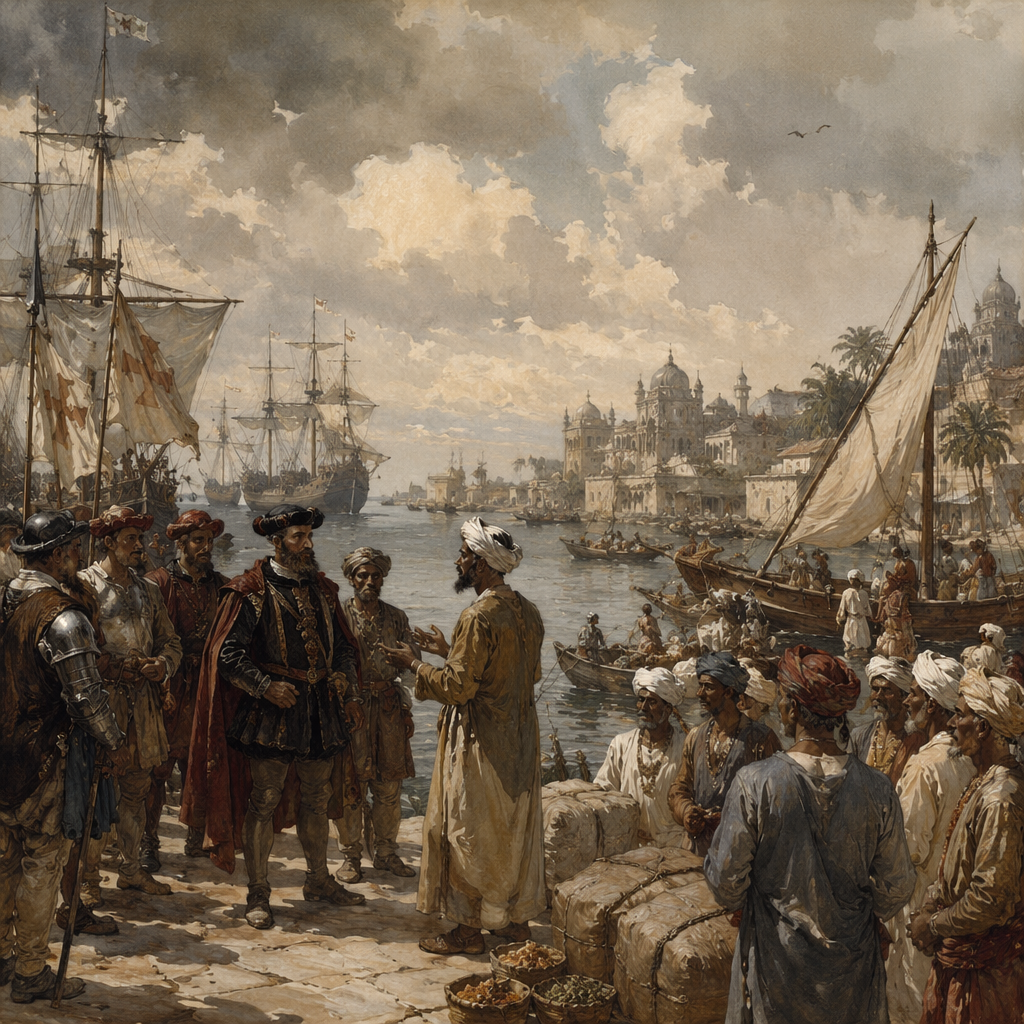
Vasco da Gama is best read through ocean systems, not through discovery language alone. His 1497-1499 voyage connected Portuguese royal strategy to an Indian Ocean world that already had pilots, ports, Muslim merchants, Gujarati traders, Arab and Swahili routes, South Asian rulers, monsoon knowledge, and commercial law. The biography becomes richer when Calicut is treated as an existing political and trading center rather than a blank endpoint for Europe.
The voyage mattered because it made armed Atlantic entry into the Indian Ocean repeatable. Ships, cannon, royal finance, route knowledge, diplomacy, coercion, and commercial ambition all moved together. Da Gama's arrival did not instantly give Portugal control over Asian trade, but it opened a violent route through which forts, cartaz passes, naval patrols, and pressure on port cities became tools of Portuguese power.
A careful reading keeps local people visible: pilots, interpreters, merchants, rulers, sailors, port officials, and coastal communities made the encounter work or fail. A navigator's name is useful as an entry point, but Indian Ocean history cannot be reduced to the perspective of the fleet.
The first voyage also depended on African and Indian Ocean coastlines before it reached India. Cape currents, East African ports, local rulers, Muslim trading communities, pilots, gifts, suspicion, and misunderstanding all shaped the route. The fleet's progress was not a simple line on a map; it was a chain of negotiations and conflicts inside port worlds that already knew how to evaluate strangers.
The later da Gama career gives the biography a sharper edge. Return voyages and Portuguese expansion brought intimidation, seizure, bombardment, and efforts to force trade through royal power. That makes him important for early modern history, but not as a harmless explorer. He marks a transition in which navigation, commerce, and violence became mutually reinforcing tools of empire.
The biography also helps readers compare ocean histories. Zheng He's fleets, Ibn Battuta's travel, Swahili commerce, Gujarati merchants, and Portuguese armed trade all moved through the same ocean with different institutions behind them. Da Gama's importance is clearer when he is placed inside that crowded world.
Vasco da Gama helps connect individual action with wider historical change in Portugal. The biography works best when it keeps the surrounding world visible: authority, conflict, belief, reform, or discovery moved through decisions made under pressure.
The related events show how roles such as Navigator, Explorer can be read through dates, places, institutions, and consequences rather than through reputation alone. The biography explains why this person matters, while the linked events explain what changed around them.
A richer reading starts with the limits around the person. Some figures acted through offices, armies, courts, laboratories, churches, parties, ships, trade networks, or protest movements; others became important because later communities turned their lives into symbols. The page therefore asks what this person could actually change, what was already moving before them, and which consequences later readers attached to the name.
Read the biography against absence as well. Many lives around Vasco da Gama are less visible in the record: opponents, collaborators, family members, workers, soldiers, students, subjects, victims, translators, scribes, or local communities. Keeping those surrounding people in view makes the page less like a name card and more like an entry point into historical systems.
Vasco da Gama also works as a navigation point. Open the linked event pages to see where the biography becomes chronology, then use the topic routes to test whether the same pattern appears beyond one life. That extra step matters because historical importance is rarely contained inside a single decision; it usually spreads through institutions, witnesses, opponents, imitators, and later arguments over memory.
Sources and Method
Source method: read Vasco da Gama through the 1498 Calicut event and Indian Ocean routes. The page treats biography as a route into maritime systems, not as a heroic discovery profile.
Evidence Notes
How Sensitive Claims Are Sourced
- 1
Indian Ocean before Portuguese arrival
The biography frames Calicut and the western Indian Ocean as already connected by merchant communities, monsoon sailing, port diplomacy, and commercial practice before da Gama arrived.
- 2
From voyage to armed maritime route
The page links da Gama's voyage to later Portuguese use of forts, cannon, passes, and naval pressure while avoiding the false claim that one voyage created instant control.
Why This Person Matters
Vasco da Gama matters because the connected events make a larger historical pattern easier to follow. The page links biography to consequences so readers can move from a life story into the wider atlas, compare the person with contemporaries, and understand why later memory kept returning to this figure. Vasco da Gama matters because his voyage helps readers see the early modern ocean as a contested system. The page connects Portuguese expansion, Calicut, Indian Ocean merchants, navigation, violence, route knowledge, and the limits of European power in Asia.
What changes when da Gama is read as an armed entrant into an existing Indian Ocean world rather than as the discoverer of a route to nowhere?
How to Read This Life
Vasco da Gama is easiest to understand when the biography is read beside Vasco da Gama Reaches India. Those events show the historical setting in motion: dates, places, institutions, conflict, and consequences give the life a structure that a short biography alone cannot provide.
The surrounding route crosses Early Modern World and locations such as Calicut. That matters because influence rarely stays inside one person. It moves through offices, armies, movements, laws, texts, speeches, institutions, and later memory.
A useful reading path starts with the role labels, then opens the event pages to see what changed, and finally compares this person with other actors facing similar pressures.
For readers who arrive on a biography first, this page is meant to become a doorway rather than a stop. Read one paragraph for the answer, then use the turning points, topic routes, and event links to test whether the person's reputation matches the wider evidence.
Read Vasco da Gama beside Calicut 1498, Malacca 1511, Kilwa 1505, Mombasa 1698, the Indian Ocean route, and exploration/colonialism pages. That path keeps Asian and African port worlds visible.
Then compare him with Zheng He, Ibn Battuta, James Cook, Columbus, and the VOC where available. The comparison asks how travel, state backing, trade, violence, and local knowledge differed across ocean histories.
Read Vasco da Gama through the roles of Navigator, Explorer rather than as reputation alone.
Place the biography inside Portugal and the wider events linked below.
Ask which choices were personal and which were constrained by institutions or crisis.
Follow how later memory simplified, contested, or reused this person's role.
Keep Calicut, pilots, merchants, rulers, interpreters, and harbor politics in view.
Track cannon, forts, passes, naval pressure, and coercive diplomacy as part of maritime expansion.
Ask why reaching India did not mean controlling Asian trade.
Legacy, Limits, and Memory
A useful biography keeps scale in view. Vasco da Gama mattered because individual choices met a wider structure: institutions, enemies, allies, audiences, technologies, beliefs, and inherited conflicts. The related event pages help separate personal agency from conditions that no single person controlled.
Memory is part of the biography too. Later readers often simplify a figure into a hero, villain, founder, reformer, conqueror, prophet, scientist, or symbol. Those labels can be helpful, but they become misleading when they hide conflict, compromise, exclusion, uncertainty, or the experiences of people outside the main biography.
For the next step, compare this life with a topic route rather than stopping at the name. If the same pattern appears across several figures, the reader has found a historical structure; if this person breaks the pattern, the contrast is usually where the most interesting question begins.
The main risk is discovery vocabulary. Da Gama did not discover India for the people already trading there. He opened a Portuguese sea route into an existing Afro-Eurasian commercial world.
A second risk is making technology alone explain the story. Cannon and ships mattered, but so did pilots, monsoon timing, diplomacy, port politics, merchant resistance, and royal finance.
Turning Points to Read Next
Vasco da Gama Reaches India
Vasco da Gama reached India by sea from Europe, opening a Portuguese route into established Indian Ocean trade networks.
Related Timeline
- 1498 CEVasco da Gama Reaches India
Vasco da Gama reached India by sea from Europe, opening a Portuguese path into established Indian Ocean trade networks.
References
Where to Check the Facts
- Encyclopaedia Britannica: Vasco da GamaBiographical reference for Vasco da Gama's life dates, roles, institutions, and historical setting.
- Encyclopaedia BritannicaBackground reference for chronology, names, and historical context.
- WikidataStructured reference for dates, places, alternate names, and entity links.