At a Glance
The shape of the event
- Date
- 1644
- Place
- Beijing
- Type
- Conquest
Manchu forces entered Beijing and began Qing rule over China after Ming collapse and civil war.
1644; place the event in Beijing before comparing causes or consequences.
The event helps readers understand China as an imperial formation involving Manchu, Mongol, Tibetan, Uyghur, and Han worlds.
Manchu rulers / Ming loyalists are the first names or groups to compare before widening the story.
The Qing built a multiethnic empire that expanded across Inner Asia and governed China for more than two centuries.
The Qing built a multiethnic empire that expanded across Inner Asia and governed China for more than two centuries.
The event helps readers understand China as an imperial formation involving Manchu, Mongol, Tibetan, Uyghur, and Han worlds.
Continue to Kangxi, Qing expansion, treaty-port crises, and the 1911 revolution to see how a conquest dynasty became a long imperial order and then faced new pressures.
Background
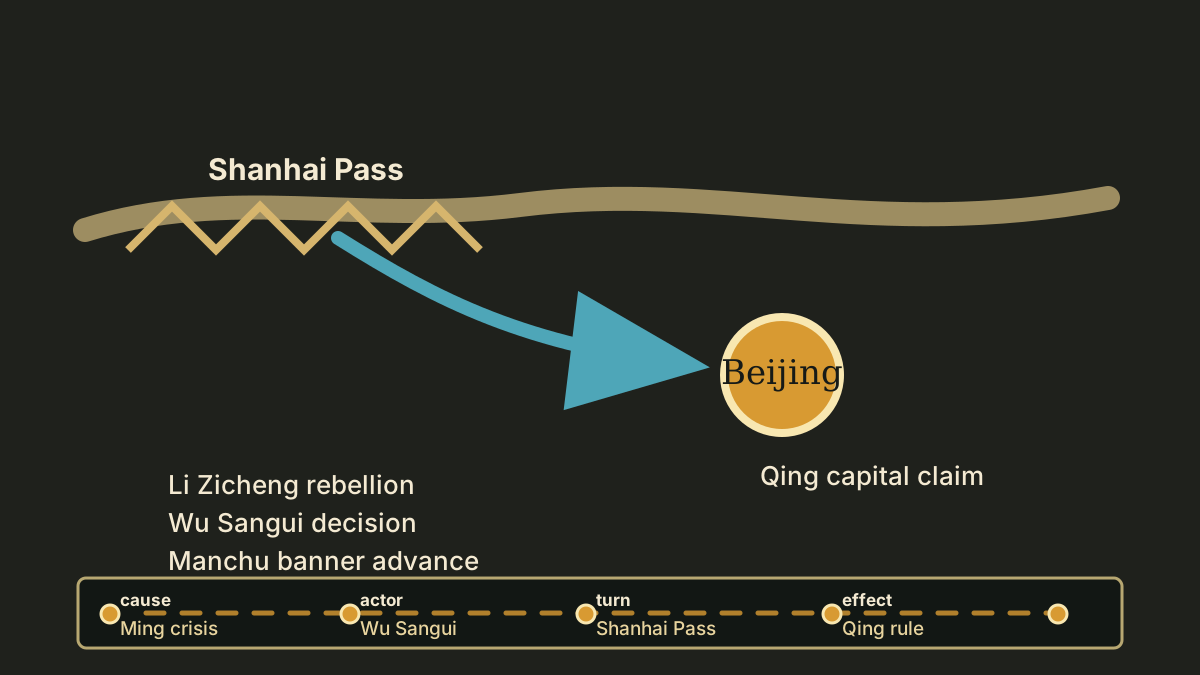
Late Ming China faced overlapping strains: silver shortages, tax burdens, climate stress, military expenses, court factionalism, and widespread rebellion. Beyond the Great Wall, the Manchu state had already built a formidable military and administrative system through the banner armies, alliances with Mongol groups, and the absorption of Chinese officials and soldiers. When Li Zicheng's rebel forces captured Beijing, Ming legitimacy cracked dramatically, but the result was not predetermined. Wu Sangui, commander at the Shanhai Pass, had to choose between rebel rule, impossible loyalty to a fallen court, and cooperation with the Manchus. His decision opened a route for Dorgon and Qing forces into north China. The Ming crisis had roots deeper than the fall of Beijing.
Fiscal administration depended heavily on silver, and disruptions in silver flows made taxation and military payment harder. Climatic stress and famine intensified rural misery, while banditry and rebellion spread across regions already strained by local inequality. On the frontier, the Manchu state was not a loose tribal force. It had built banner institutions, adopted Chinese bureaucratic practices, incorporated surrendered Ming officers, and developed a political language that could appeal beyond Manchu identity. By 1644, then, north China was not facing a simple outside attack. It was facing a prepared frontier state entering a collapsing imperial center.
The Turning Point
The turning point was the linkage of internal Ming collapse with Manchu military opportunity. The Shanhai Pass mattered because it connected frontier defense to the road toward Beijing. Once Wu Sangui aligned with Qing forces, the Manchus could present themselves not only as conquerors but as restorers of order against rebellion. That claim helped recruit officials and local elites who feared disorder more than dynastic change. The Qing advance still required decades of campaigning against Ming loyalists and regional resistance, but 1644 gave the new dynasty the symbolic capital of Beijing and the administrative machinery of north China. The conquest combined cavalry power, banner organization, Chinese collaborators, political messaging, and ruthless coercion.
Wu Sangui's choice at Shanhai Pass is often treated as a single hinge, but it mattered because of the systems behind it. The pass controlled a military corridor between the northeast and the North China plain. Wu's forces, Li Zicheng's rebels, and Dorgon's Qing armies each represented a different future. Once Qing forces entered Beijing, they used the capital's symbolic weight to claim the Mandate of Heaven and to recruit Chinese officials who could keep administration functioning. The conquest still required brutal campaigns in the south and west, but Beijing gave the Qing a language of legitimacy and a practical bureaucracy from which to govern.
Consequences
In the short term, Qing rule replaced Ming authority in Beijing and began the long process of conquering the rest of China. Policies such as the queue order made submission visible and provoked resistance, especially in places where hairstyle, ritual, and loyalty carried political meaning. Over time the Qing built one of the largest and most durable empires in world history, governing Han Chinese, Manchus, Mongols, Tibetans, Uyghurs, and many frontier peoples through layered institutions. The conquest also left contested memories: for some it restored order after chaos; for others it marked violent occupation and the betrayal of Ming loyalism. Reading the event well means holding both the administrative success and the human cost in view.
The conquest created new hierarchies and new compromises. Manchu rulers preserved distinct banner privileges and court rituals while relying heavily on Chinese literati, tax systems, and local administration. Policies such as the queue order made loyalty visible on the body, which is why they became flashpoints of resistance. Ming loyalism survived in writing, ritual, exile, and armed struggle, especially in the south. Over the long run, Qing success depended on making conquest look like order to enough local elites, while maintaining coercive force where persuasion failed. This combination of adaptation and violence is central to understanding the dynasty's durability. Another important layer is regional variation.
Beijing's fall did not mean that everyone from the northeast to the southeast accepted Qing rule in the same way or at the same speed. Some officials surrendered quickly to preserve office and order; others chose loyalist resistance, martyrdom, or withdrawal. Coastal and southern campaigns had their own violence, diplomacy, and memories. That unevenness matters for SEO readers searching for a simple timeline, because the answer is not one day equals one conquest. The 1644 entry marks the seizure of the capital and the beginning of a much longer consolidation.
Interpretation Notes
Interpretations of Qing Conquest of China depend on whose evidence is centered: rulers and official records, affected communities, oral memory, archaeology, law, diplomacy, labor, and later public memory do not always tell the same story.
Why Keep Reading
Continue to Kangxi, Qing expansion, treaty-port crises, and the 1911 revolution to see how a conquest dynasty became a long imperial order and then faced new pressures. This page also helps compare dynastic transitions across world history: moments when internal breakdown creates openings for outside or frontier powers to claim legitimacy. Read this with the Ming collapse, Kangxi consolidation, Qing expansion, Opium War, and Xinhai Revolution. The sequence shows how a conquest dynasty first gained legitimacy, then built a vast empire, then faced the modern crises that made its Manchu origins politically charged again. Evidence note: readers should be reminded that conquest is reconstructed through court records, loyalist writings, Qing proclamations, local gazetteers, military accounts, and later memory.
Each source has a position. Qing documents often stress order and legitimacy; loyalist texts stress betrayal and moral loss; local records may reveal survival strategies rather than grand ideology. Reading them together keeps the event from becoming a simple tale of either inevitable Qing success or pure Ming victimhood.
Reading Path
Follow the story without losing the thread
Before This
After This
- First Opium War Begins1839 CE
- Treaty of Nanjing1842
- Meiji Restoration1868 CE
Same Period
- Qin Unification of China221 BCE
- First Opium War Begins1839 CE
- Meiji Restoration1868 CE
Wider Timeline
Mind Map
How to think about Qing Conquest of China
Ming crisis
Fiscal strain, rebellion, military pressure, and court breakdown weakened the dynasty before Qing entry.
Map Layer
Where this event sits geographically
Gold pins mark the approximate locations of published event pages. This is a schematic locator map, not a historical border map.
Coordinates are approximate and are used to help readers orient themselves before opening a full event page.
References
Where to Check the Facts
- Cambridge University Press: The Cambridge History of ChinaSpecialist scholarly synthesis for Chinese dynastic, imperial, revolutionary, and Mao-era historical interpretation.
- Cambridge University Press: The Cambridge History of JapanSpecialist scholarly synthesis for Japanese state formation, Meiji transformation, imperial expansion, and modern political change.
- Harvard University Press: A New History of KoreaKorean-history scholarship reference for long Korean chronology, institutions, cultural history, colonial pressure, and modern change.
- Oxford Research Encyclopedia of Asian History: Meiji RevolutionPeer-reviewed reference for Meiji transformation as revolution, state centralization, social change, and contested modernization.
- Encyclopaedia Britannica: Ming dynastyReference for Ming restoration, government, maritime activity, and culture.
- Encyclopaedia Britannica: Qing dynastyReference for Qing conquest, imperial expansion, crisis, and reform.
- Official UNESCO World Heritage Centre: Historic Monuments of Ancient KyotoInstitutional reference for Kyoto's long capital history, court culture, temples, and urban memory.
- Official archive: Columbia Asia for Educators: Treaty of Nanjing excerptsPrimary-source teaching excerpt for the Treaty of Nanjing, treaty-port coercion, indemnity, and legal-commercial pressure after the Opium War.
- National Archives of Japan: Constitution of Japan and Meiji constitutional holdingsJapanese archival reference for Meiji constitutional state-building, imperial rescripts, and the legal language of modern reform.
- National Diet Library: Modern Japan in Archives - Japan's Annexation of KoreaJapanese archive reference for the 1910 annexation of Korea and the documentary trail behind Japanese colonial rule.
- National Institute of Korean History: Annals of the Choson DynastyKorean institutional reference for Joseon court records, dynastic governance, and Korean historical specificity inside the East Asia path.
- U.S. Office of the Historian: English translation of the 1910 Korea annexation treatyDiplomatic-document reference for treaty language around Japan's annexation of Korea and international reporting of colonial transition.
- Official archive: UK National Archives: May Fourth Movement 1919Primary-source archive material for May Fourth diplomacy, national equality language, and post-World War I Chinese protest context.
- Official archive: Hong Kong Basic Law official English textOfficial legal text for the Hong Kong handover framework, rights language, political structure, and sovereignty after 1997.