At a Glance
The shape of the event
- Date
- 618
- Place
- Chang'an
- Type
- Dynastic Foundation
The Tang dynasty replaced the Sui and built one of imperial China's most influential political and cultural orders.
618; place the event in Chang'an before comparing causes or consequences.
The event anchors East Asia's medieval imperial and cosmopolitan route.
Gaozu of Tang / Li family are the first names or groups to compare before widening the story.
Tang rule expanded administration, military reach, urban culture, Buddhism, and transregional exchange.
Tang rule expanded administration, military reach, urban culture, Buddhism, and transregional exchange.
The event anchors East Asia's medieval imperial and cosmopolitan route.
Follow the Tang’s next moves to see how a newly founded court translated authority into everyday structures: who the dynasty promoted, how it managed taxation and land, and how the capital’s markets and monasteries re...
Background
The decades before 618 were a period of intense strain and invention across the Chinese world. The Sui dynasty had reunited large parts of the territory that we now identify as China, but that reunification came alongside major state undertakings—public works, military expeditions and centralized programs of taxation and conscription—that placed new burdens on local communities. In towns and counties, officials, soldiers, merchants and religious institutions each experienced those pressures differently: some profited from renewed markets and roads, others chafed at levies and forced labour. At the same time, networks of exchange—from city markets to long-distance merchants and Buddhist monasteries—kept moving people, ideas and goods across regional boundaries.
When central authority eroded in places, local commanders, aristocratic clans and religious leaders filled the vacuum. The Li family and its leading figure, Gaozu of Tang, emerged within that complex field of opportunity and unrest. That background matters because the Tang founding cannot be reduced to a single cause: it was the product of collapsing institutions, resilient local structures, military initiative and claims to legitimacy that resonated with many different audiences. The Tang founding becomes richer when the Sui collapse is kept in the frame. Heavy labor demands, military campaigns, fiscal pressure, and rebellion weakened the Sui order, but Tang rulers inherited many of its institutions.
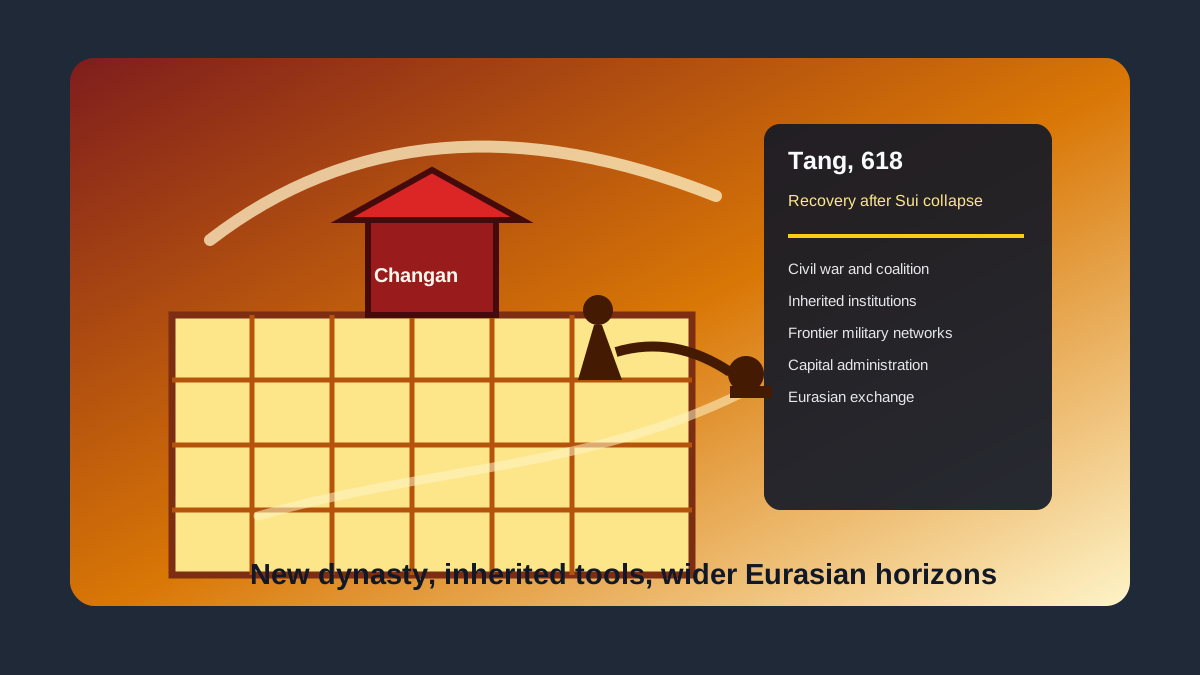
The new dynasty was not a total reset; it was a reworking of imperial tools after civil war. Li Yuan's rise and the later power of Li Shimin show the mix of military coalition, aristocratic alliance, frontier experience, and bureaucratic restoration behind the dynasty. Tang power grew from both Chinese imperial traditions and Inner Asian connections.
The Turning Point
The act of founding the Tang in 618 changed who made decisions and how those decisions reached the countryside and the frontiers. Gaozu of Tang and members of the Li family consolidated control in and around Chang'an, the great imperial city whose political gravity shaped appointments, tax collection and military command. Their choices mattered: they drew on networks of retired Sui officials and local elites while also relying on commanders and garrisons whose loyalty could not be taken for granted.
In practical terms this meant reorganizing offices, naming new officials, and projecting military force where it mattered most; in symbolic terms it meant making a visible claim to legitimate rule that could be accepted by rival elites, monks and foreign envoys. At the same time, city life—markets, temples, artisans and foreign traders—continued to function and to influence what the new court prioritized. Monks, merchants and diplomats carried ideas, religious practices and goods across borders, pressuring the new regime to engage with transregional exchange. Gaozu’s decisions therefore did not occur in isolation but were responses to the complex needs and expectations of officials, soldiers, religious communities and merchants who all shaped the reach of Tang authority.
The turning point was the consolidation of Chang'an-centered authority after rebellion. The Tang court could promise order while keeping useful Sui structures, rebuilding legitimacy, and projecting power across a wider Eurasian world.
Consequences
In the near term, the Tang foundation brought a measure of restored central authority: officials were dispatched from the capital, military commands were clarified, and large urban centers like Chang'an regained a central role in administration and diplomacy. That restoration encouraged the revival of long-distance trade and the movement of religious communities, especially Buddhist monasteries, which found patronage and new audiences. Over the longer arc, historians trace how Tang rule broadened administrative networks, extended military reach into adjacent regions, and fostered an urban and court culture that became a model for later polities in East Asia. The dynasty’s reputation for fostering exchange—of goods, ideas, technologies and religious practices—made Chang'an a hub for travelers and scribes alike.
Yet these outcomes were uneven: expansion and cosmopolitanism sat alongside local contestation, economic strain, and divergent memories among peasants, soldiers and frontier peoples. Interpretations of what the Tang founding achieved therefore depend on whose evidence one centres—official chronicles, local gazetteers, material remains, or the oral traces of communities affected by imperial rule. The founding opened the way for one of East Asia's most influential imperial periods: cosmopolitan Chang'an, examination culture, Buddhist patronage and backlash, poetry, frontier war, and models of rule studied by neighboring states. It also makes Tang history a useful bridge between Chinese dynastic recovery, Inner Asian politics, and wider Afro-Eurasian exchange.
Interpretation Notes
Interpretations of Tang Dynasty Founded depend on whose evidence is centered: rulers and official records, affected communities, oral memory, archaeology, law, diplomacy, labor, and later public memory do not always tell the same story.
Why Keep Reading
Follow the Tang’s next moves to see how a newly founded court translated authority into everyday structures: who the dynasty promoted, how it managed taxation and land, and how the capital’s markets and monasteries reshaped cultural life. Tracing the Tang’s consolidation illuminates why later centuries remembered Chang'an as a cosmopolitan crossroads and why neighbouring polities adjusted their diplomacy and trade. Reading on will take you from the seizure of power in Chang'an to the tense work of governing a plural and expansive empire—an account of decisions, compromises and connections that helps explain medieval East Asia’s political and cultural map.
Read the Tang founding with Taizong, Nara, Silk Road exchange, Abbasid Baghdad, and Song founding to compare imperial recovery, cosmopolitan culture, and state administration.
Reading Path
Follow the story without losing the thread
Before This
- Sui Reunifies China589
- Han Dynasty Founded202 BCE
- Qin Unification of China221 BCE
After This
- Umayyad Caliphate Founded661 CE
- Abbasid Revolution750 CE
- Battle of Talas751 CE
Same Period
- Qin Unification of China221 BCE
- Battle of Talas751 CE
- First Opium War Begins1839 CE
Wider Timeline
Mind Map
How to think about Tang Dynasty Founded
Sui pressures
Central projects and military campaigns strained local economies and opened spaces for political challengers.
Map Layer
Where this event sits geographically
Gold pins mark the approximate locations of published event pages. This is a schematic locator map, not a historical border map.
Coordinates are approximate and are used to help readers orient themselves before opening a full event page.
References
Where to Check the Facts
- Encyclopaedia Britannica: Tang dynastyReference for Tang state formation, government, culture, and regional influence.
- Encyclopaedia Britannica: Song dynastyReference for Song political chronology, economy, technology, and culture.
- Official UNESCO World Heritage Centre: Historic Monuments of Ancient NaraInstitutional reference for Nara's capital landscape, Buddhist monuments, and East Asian cultural exchange.