At a Glance
The shape of the event
- Date
- 1331 CE
- Place
- Kilwa Kisiwani
- Type
- Travel account
Ibn Battuta's visit to Kilwa placed the Swahili Coast inside a written travel route that connected Morocco, Arabia, East Africa, India, and wider Islamic networks.
1331 CE; place the event in Kilwa Kisiwani before comparing causes or consequences.
The visit helps readers see East Africa through Muslim travel, port diplomacy, and oceanic movement rather than through later colonial categories.
Ibn Battuta / Kilwa sultans are the first names or groups to compare before widening the story.
Kilwa entered one of the best-known medieval travel narratives as a wealthy and connected city on the East African coast.
Kilwa entered one of the best-known medieval travel narratives as a wealthy and connected city on the East African coast.
The visit helps readers see East Africa through Muslim travel, port diplomacy, and oceanic movement rather than through later colonial categories.
Follow this thread to see how names, routes, and reputations travel.
Background
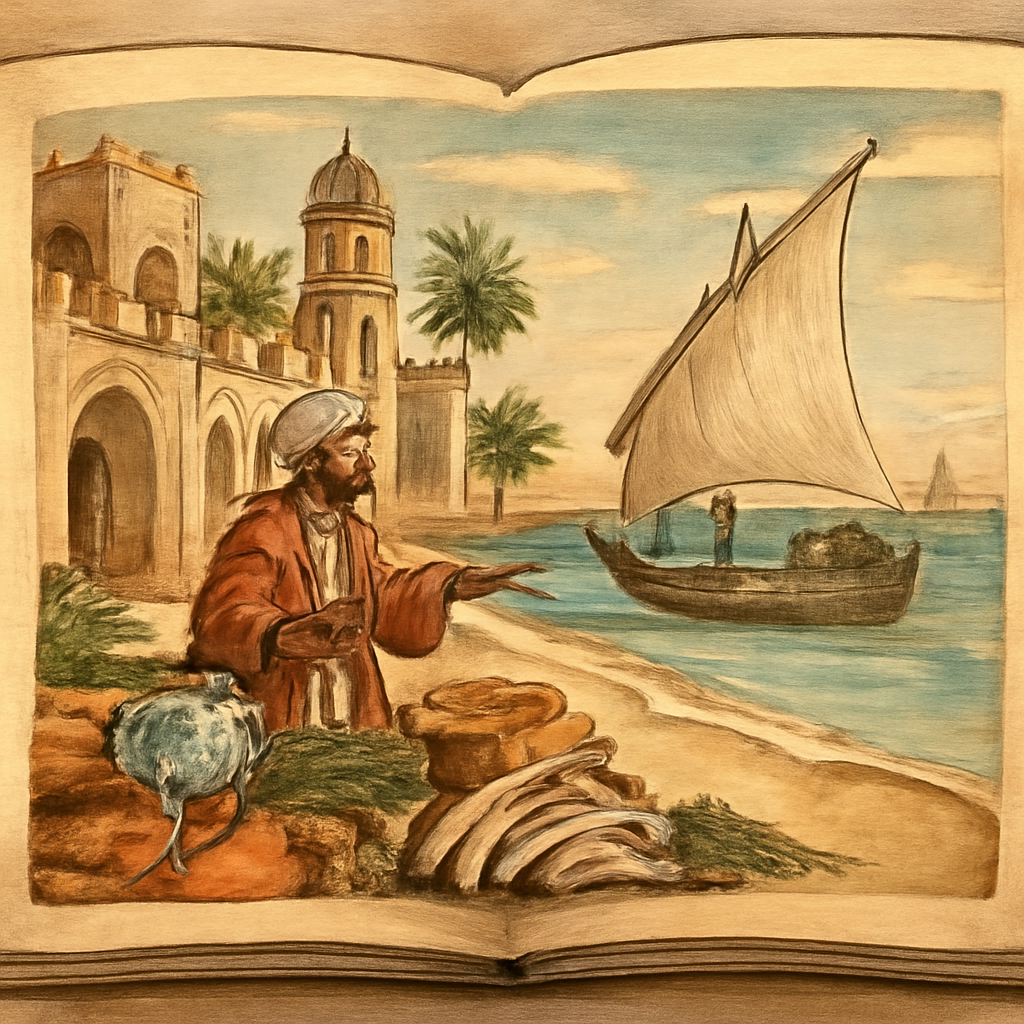
By the early fourteenth century the shores of the Swahili Coast were part of a real and persistent web of maritime movement. Sailors, merchants, clerics, and envoys moved seasonally between East Africa, Arabia, India, and the Red Sea, carried by monsoon winds and by diplomatic ties that cut across languages and polities. Kilwa Kisiwani sat at one of those crossroads: a settled island port ruled by local sultans, engaged in maritime commerce and political exchange, and routinely visited by seafarers from many regions. Travel writing in the Islamic world — a genre that mixed itinerary, legal and religious observation, and personal memoir — offered readers a framework for comparing distant places.
When a well-traveled author from Morocco recorded a place on that circuit, he did more than describe landscape; he enrolled that place into a recognizable route stretching from North Africa to the Indian Ocean. That process did not erase local agency or complexity, but it did reframe Kilwa for audiences far beyond the archipelago. Ibn Battuta's visit to Kilwa is more than a travel anecdote. It gives readers a witness to a Swahili port city tied to gold routes, Indian Ocean shipping, Islamic scholarship, local rulers, coral-stone architecture, monsoon timing, and commercial relationships that connected East Africa with Arabia, Persia, India, and beyond. The source needs careful handling.
Ibn Battuta is valuable because he describes movement, status, hospitality, and urban wealth, but travel writing also filters places through the writer's expectations. Archaeology and coastal history help readers compare his account with material evidence.
The Turning Point
Ibn Battuta’s arrival at Kilwa in 1331 involved choices on both sides that altered Kilwa’s visibility. For the sultans, receiving a traveler with credentials in the wider Muslim world was an act of port diplomacy: hosting, exchanging news, and displaying rulership to an outside witness. For Ibn Battuta, deciding to record Kilwa — its rulers, its architecture, its place within maritime circuits — was a deliberate act of selection. His account transformed an embodied, local encounter into text that could travel in place of people. That textual act did not invent Kilwa’s wealth or connections, but it re-specified them for distant readers who relied on travel narratives as sources of geographic and political knowledge.
The change was not instantaneous governance or a new trade route; it was a discursive shift. Kilwa moved from being one node among many to being a named exemplar of East African port life in one of the period’s best-known itineraries. The actors — visiting scholar and hosting sultans — both shaped what details survived, and which aspects of Kilwa became the durable image for later readers. The turning point for the page is evidentiary rather than military. A single visit makes Kilwa visible in a wider written geography and lets readers connect African urban life to the routes that carried people, goods, and ideas across the ocean.
Consequences
In the near term, Ibn Battuta’s report made Kilwa legible to audiences that would never sail to the Swahili Coast, and that legibility mattered. Historians and antiquarians later treated his narrative as a key testimony about East African urbanism and connectivity. Long-term consequences are more subtle. The visit helped embed Kilwa within a broad Islamic maritime imagination that linked Morocco, Arabia, East Africa, and India; that framing oriented later readers and polities to see the coast through networks of Muslim travel and seafaring diplomacy rather than through the categories imposed by later colonial mapping. At the same time, this episode cautions against flattening history into a single dramatic date.
Ibn Battuta’s note is a documentary hinge — important because of the networks it plugged Kilwa into — but the city’s fortunes, the lives of its inhabitants, and the political uses later rulers or historians made of the visit evolved independently over centuries. Reading the visit carefully invites us to separate the immediate human encounter from the deeper structural forces — commerce, monsoon navigation, local rulership — and from the ways memory and state-building later amplified a single narrative. The afterlife runs through later Portuguese attacks, Omani influence, Swahili Coast memory, archaeology, and debates over how to teach African history without making outsiders the only narrators. Kilwa remains important because its stones and routes show deep local power.
Interpretation Notes
Ibn Battuta Visits Kilwa is easy to flatten into one dramatic date. A stronger reading separates immediate action from deeper causes, affected communities, and the memory later states or movements built around the event.
Why Keep Reading
Follow this thread to see how names, routes, and reputations travel. Tracing Kilwa from local island port to a recurring entry in travel literature reveals how texts reconfigure geography. Read on to compare how other Indian Ocean ports appeared in contemporary itineraries, how sultans used visitors to project authority, and how the monsoon shaped the rhythm of connections. Each next stop helps you judge what travel narratives include, what they omit, and how a single traveler’s choice can amplify one portrait of a place for centuries. Read this event with Kilwa's earlier flourishing, Portuguese capture of Kilwa, Indian Ocean trade, Mombasa 1698, and Swahili Coast routes. That path makes East Africa central to ocean history.
Reading Path
Follow the story without losing the thread
Before This
- Ibn Battuta Begins His Travels1325 CE
- Great Zimbabwe Flourishesc. 1250 CE
- Kilwa Sultanate Flourishesc. 1200 CE
After This
Same Period
- Chola Raid on Srivijaya1025 CE
- Swahili Coast City-States Risec. 900 CE
- Kilwa Sultanate Flourishesc. 1200 CE
Wider Timeline
Mind Map
How to think about Ibn Battuta Visits Kilwa
Monsoon networks
Seasonal winds enabled regular voyages linking East Africa with Arabia and India, creating the maritime backdrop for Kilwa’s connections.
Map Layer
Where this event sits geographically
Gold pins mark the approximate locations of published event pages. This is a schematic locator map, not a historical border map.
Coordinates are approximate and are used to help readers orient themselves before opening a full event page.
References
Where to Check the Facts
- Encyclopaedia Britannica: KilwaReference for Kilwa as a Swahili city-state, commercial center, Portuguese occupation, and later decline.
- Official UNESCO World Heritage Centre: Ruins of Kilwa Kisiwani and Songo MnaraReference for the material remains and Indian Ocean setting of Kilwa and Songo Mnara.
- Encyclopaedia Britannica: Ibn BattutaReference for Ibn Battuta's travels and Rihla.