Historical Role
James Cook's biography needs two truths at once: his voyages advanced European mapping and scientific travel, and they also opened routes that colonial power later used against Pacific peoples. He did not discover lands without histories. Tahiti, Aotearoa, Australia, Hawaii, and other Pacific worlds already had navigators, genealogies, diplomacy, food systems, sacred places, and political relationships before European ships arrived.
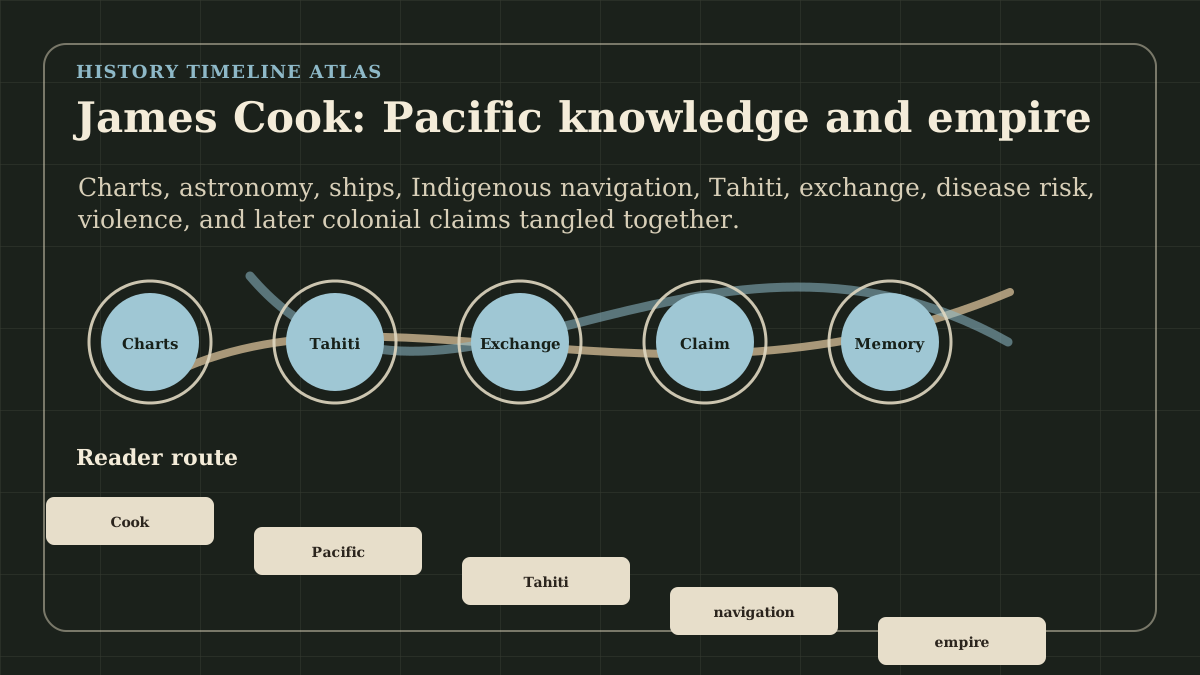
Cook is therefore most useful as a page about encounter, translation, and unequal consequence. His crews carried instruments, charts, naturalists, imperial orders, disease risk, exchange goods, and assumptions about possession. Pacific communities responded with their own knowledge, curiosity, caution, diplomacy, resistance, and strategic judgment.
The Tahiti event keeps Indigenous knowledge visible. Astronomical observation, route knowledge, local mediation, language, ceremony, and political negotiation shaped what Europeans could understand. A biography that only praises navigation misses the people who made Pacific travel intelligible and the later colonial consequences that followed.
Tupaia's role is a doorway into that wider problem. European instruments mattered, but so did Polynesian wayfinding, memory of islands, language skill, diplomacy, and the ability to translate social worlds. Cook's page becomes more honest when navigation is treated as an encounter among knowledge systems rather than a one-way European achievement.
Natural history also belonged to empire. Plants, animals, specimens, drawings, journals, and classification turned Pacific life into data that could travel back to European institutions. That knowledge was not harmless in its afterlife; it helped make distant places legible to states, collectors, traders, missionaries, and settlers.
Cook's death in Hawaii reveals the fragility of encounter. Exchange, status, misunderstanding, violence, sacred timing, ship discipline, and local politics all shaped the crisis. The event warns readers against imagining contact as smooth curiosity interrupted by a single accident.
The biography's strongest route runs from shipboard science to Pacific sovereignty. Later settlement, disease, land pressure, missions, military visits, and legal claims used some of the routes and maps that voyages helped normalize. Cook matters because knowledge and power traveled together.
A reader arriving from a Cook timeline or biography search gets more than voyage dates here: the page asks how maps are made, who helps make them, who is erased by their captions, and who later bears the consequences when a chart becomes a claim.
The page also benefits from following objects and words after the voyage. Botanical specimens, place names, ship journals, engravings, museum collections, and Admiralty charts carried Pacific encounters into European institutions. Those traces became evidence, but they also carried unequal power because they often translated living societies into categories useful to outsiders.
James Cook helps connect individual action with wider historical change in Britain and the Pacific. The biography works best when it keeps the surrounding world visible: authority, conflict, belief, reform, or discovery moved through decisions made under pressure.
The related events show how roles such as Navigator, Cartographer, Explorer can be read through dates, places, institutions, and consequences rather than through reputation alone. The biography explains why this person matters, while the linked events explain what changed around them.
A richer reading starts with the limits around the person. Some figures acted through offices, armies, courts, laboratories, churches, parties, ships, trade networks, or protest movements; others became important because later communities turned their lives into symbols. The page therefore asks what this person could actually change, what was already moving before them, and which consequences later readers attached to the name.
Read the biography against absence as well. Many lives around James Cook are less visible in the record: opponents, collaborators, family members, workers, soldiers, students, subjects, victims, translators, scribes, or local communities. Keeping those surrounding people in view makes the page less like a name card and more like an entry point into historical systems.
James Cook also works as a navigation point. Open the linked event pages to see where the biography becomes chronology, then use the topic routes to test whether the same pattern appears beyond one life. That extra step matters because historical importance is rarely contained inside a single decision; it usually spreads through institutions, witnesses, opponents, imitators, and later arguments over memory.
Sources and Method
Source method: read Cook through the Tahiti event and Pacific/Oceania routes, treating European logs and maps as evidence that must be checked against Indigenous presence, navigation, and memory.
Evidence Notes
How Sensitive Claims Are Sourced
- 1
Charts, instruments, and scientific voyaging
Cook's voyages belong to eighteenth-century navigation, astronomy, cartography, natural history, naval discipline, and imperial sponsorship.
- 2
Pacific knowledge before and during contact
The page avoids discovery language by foregrounding Pacific communities, existing settlement, diplomacy, local knowledge, and the later consequences of colonial contact.
Why This Person Matters
James Cook matters because the connected events make a larger historical pattern easier to follow. The page links biography to consequences so readers can move from a life story into the wider atlas, compare the person with contemporaries, and understand why later memory kept returning to this figure. James Cook matters because his voyages show how science, navigation, charting, empire, Indigenous knowledge, contact, violence, disease risk, and memory became entangled in the Pacific. The biography helps readers move from shipboard achievement to the larger question of who gets to name, map, and claim a world already known to others.
How can Cook's navigational importance be explained without repeating discovery language that erases Pacific histories?
How to Read This Life
James Cook is easiest to understand when the biography is read beside James Cook Arrives at Tahiti. Those events show the historical setting in motion: dates, places, institutions, conflict, and consequences give the life a structure that a short biography alone cannot provide.
The surrounding route crosses Early Modern Pacific and locations such as Tahiti. That matters because influence rarely stays inside one person. It moves through offices, armies, movements, laws, texts, speeches, institutions, and later memory.
A useful reading path starts with the role labels, then opens the event pages to see what changed, and finally compares this person with other actors facing similar pressures.
For readers who arrive on a biography first, this page is meant to become a doorway rather than a stop. Read one paragraph for the answer, then use the turning points, topic routes, and event links to test whether the person's reputation matches the wider evidence.
Read James Cook beside Tahiti, Waitangi, Hawaiian sovereignty, Pacific voyaging, Paris climate diplomacy, and Oceania routes. That path turns one voyager into a wider history of ocean knowledge, encounter, empire, and survival.
Then compare Cook with Zheng He, Ibn Battuta, Columbus, and Tupaia where available. The comparison asks how travel, mapping, sponsorship, and local knowledge produce very different histories.
Read James Cook through the roles of Navigator, Cartographer, Explorer rather than as reputation alone.
Place the biography inside Britain and the Pacific and the wider events linked below.
Ask which choices were personal and which were constrained by institutions or crisis.
Follow how later memory simplified, contested, or reused this person's role.
Read instruments, charts, astronomy, ships, and route discipline as tools of eighteenth-century science.
Place Pacific diplomacy, language, exchange, caution, resistance, and knowledge in the center of the story.
Follow how mapping and scientific travel later supported possession, settlement, extraction, and colonial rule.
Legacy, Limits, and Memory
A useful biography keeps scale in view. James Cook mattered because individual choices met a wider structure: institutions, enemies, allies, audiences, technologies, beliefs, and inherited conflicts. The related event pages help separate personal agency from conditions that no single person controlled.
Memory is part of the biography too. Later readers often simplify a figure into a hero, villain, founder, reformer, conqueror, prophet, scientist, or symbol. Those labels can be helpful, but they become misleading when they hide conflict, compromise, exclusion, uncertainty, or the experiences of people outside the main biography.
For the next step, compare this life with a topic route rather than stopping at the name. If the same pattern appears across several figures, the reader has found a historical structure; if this person breaks the pattern, the contrast is usually where the most interesting question begins.
The page avoids the word discover as an explanation. Cook entered inhabited, named, governed, and remembered places.
A second risk is making Pacific peoples background scenery for European science. Their knowledge, choices, and later losses are central to what the voyages meant.
Turning Points to Read Next
James Cook Arrives at Tahiti
James Cook's arrival at Tahiti connected British scientific voyaging with Pacific knowledge, Polynesian diplomacy, astronomy, mapping, and future imperial contact.
Related Timeline
- 1769 CEJames Cook Arrives at Tahiti
James Cook's arrival at Tahiti connected British scientific voyaging with Pacific knowledge, Polynesian diplomacy, astronomy, mapping, and future imperial contact.
References
Where to Check the Facts
- Encyclopaedia Britannica: James CookBiographical reference for Cook's voyages, mapping, and Pacific contact.
- Encyclopaedia BritannicaBackground reference for chronology, names, and historical context.
- WikidataStructured reference for dates, places, alternate names, and entity links.