Fast Answer
Slavery and forced labor shaped modern history because empires, plantations, mines, shipping, finance, law, and racial hierarchy extracted wealth from coerced people while resistance and abolition transformed politics. Key sequence: coerced labor expanded with Atlantic and colonial systems after 1500, became central to plantation and mining economies, faced resistance and abolition campaigns, and left legacies in law, wealth, racism, and memory. The map matters because West Africa, the Atlantic, Caribbean plantations, Brazil, North America, Potosi, Indian Ocean ports, and colonial frontiers reveal different forced-labor regimes. The human stakes are concrete: enslaved people, Indigenous laborers, maroon communities, ship crews, abolitionists, plantation owners, merchants, families, and freedpeople shaped the system and its overthrow.
Why Did Slavery and Forced Labor Shape Modern History cannot be answered by a definition alone. The answer has to name the people, places, institutions, corridors, and conflicts that made the process visible.
Reading Paths
Choose a reading path
Why Did Slavery and Forced Labor Shape Modern History? becomes clearer when the broad answer stays tied to sequence, place, and concrete next pages.
Start with a concrete event, then return to the fast answer with evidence in view.
Atlantic Slave Trade Expands
The Atlantic slave trade expanded as European colonial demand, coastal trade networks, African political conflicts, and plantation economies became violently connected.
Potosi Silver Boom Begins
Silver mining at Potosi became a massive colonial enterprise linking Andean labor, Spanish finance, and global silver flows.
Zong Massacre
The killing of enslaved Africans aboard the slave ship Zong became a notorious example of how commerce treated human life as insurable property.
Haitian Revolution Begins
Enslaved people in Saint-Domingue rose against plantation slavery, turning the French colony into the center of the Atlantic world's most radical revolution.
Britain Abolishes the Slave Trade
Parliament abolished British participation in the transatlantic slave trade after decades of Black resistance, abolitionist campaigning, and political pressure.
How to Think About It
Slavery and forced labor shaped modern history because empires, plantations, mines, shipping, finance, law, and racial hierarchy extracted wealth from coerced people while resistance and abolition transformed politics
coerced labor expanded with Atlantic and colonial systems after 1500, became central to plantation and mining economies, faced resistance and abolition campaigns, and left legacies in law, wealth, racism, and memory
West Africa, the Atlantic, Caribbean plantations, Brazil, North America, Potosi, Indian Ocean ports, and colonial frontiers reveal different forced-labor regimes
enslaved people, Indigenous laborers, maroon communities, ship crews, abolitionists, plantation owners, merchants, families, and freedpeople shaped the system and its overthrow
Debate centers on how to measure slavery's relationship to capitalism, empire, racial ideology, abolition, compensation, and repair
Fast Explanation
Slavery and forced labor shaped modern history because empires, plantations, mines, shipping, finance, law, and racial hierarchy extracted wealth from coerced people while resistance and abolition transformed politics. The answer becomes persuasive only when it is tied to named places, institutions, and choices rather than repeated as a slogan.
coerced labor expanded with Atlantic and colonial systems after 1500, became central to plantation and mining economies, faced resistance and abolition campaigns, and left legacies in law, wealth, racism, and memory. That order matters because it shows when pressure built, when people still had choices, and when later outcomes narrowed those choices.
Dates, places, institutions, names, and affected groups carry the explanation. enslaved people, Indigenous laborers, maroon communities, ship crews, abolitionists, plantation owners, merchants, families, and freedpeople shaped the system and its overthrow.
A reader can test the answer by following one named case first, then asking whether the same pattern appears elsewhere. The best examples usually show a pressure becoming visible in law, labor, violence, diplomacy, technology, or public memory.
The useful question is never only what happened. Ask who had leverage, who had to react, what place made action possible, what institution preserved the change, and what later memory simplified. That habit turns a broad answer into a historical argument instead of a glossary entry.
Causes and Conditions
The causes sit in layers. Long-term conditions created pressure: resources, labor systems, beliefs, state capacity, borders, technology, public language, and inherited inequality. Immediate triggers then made the pressure visible through a crisis, law, protest, battle, treaty, discovery, or institutional failure.
The common misconception is that slavery was separate from modern capitalism and state power. That misconception survives because it is simple, but it hides the sequence. A better answer separates background conditions from triggers and then follows the decisions that made one outcome more likely than another.
The strongest causal explanation also includes people who did not control formal institutions. Workers, enslaved people, colonized communities, soldiers, women, migrants, students, religious communities, scientists, officials, and local leaders often changed the path by resisting, adapting, organizing, translating, or refusing.
The same cause can also work differently across regions. A port, empire, plantation, school, borderland, laboratory, or city council could translate the larger pressure into a local choice with its own risks and limits.
Geography and Movement
West Africa, the Atlantic, Caribbean plantations, Brazil, North America, Potosi, Indian Ocean ports, and colonial frontiers reveal different forced-labor regimes. The map determines what could move, how fast, and at what cost. Ports, rivers, mountain passes, railroads, plantations, capitals, treaty ports, islands, borderlands, and disease corridors all change the shape of the explanation.
Geography also changes whose experience becomes visible. A capital may preserve speeches and laws, while a port reveals labor, disease, migration, customs records, and commercial pressure. A battlefield shows command decisions; a village or settlement may show taxes, land loss, hunger, religious change, or family separation.
Once the places are visible, the reader can ask why the story unfolded there and not somewhere else. The geography is part of the cause, not scenery behind the cause.
Affected Groups and Unequal Power
enslaved people, Indigenous laborers, maroon communities, ship crews, abolitionists, plantation owners, merchants, families, and freedpeople shaped the system and its overthrow. The people most affected were not always the people most visible in official sources. A careful explanation keeps both formal decision-makers and less powerful communities in the same frame.
Unequal power changes the evidence. Officials leave records that explain policy; communities under pressure may appear through petitions, court cases, archaeology, oral memory, music, protest, missionary records, business records, or hostile descriptions written by others. Reading those sources requires attention to voice and silence.
This human layer also makes the topic more readable. Readers keep going when the stakes are concrete: land, food, family, wages, law, schooling, worship, voting, safety, sovereignty, mobility, or memory. The explanation becomes richer when those stakes are named directly.
Debate and Misconception
Debate centers on how to measure slavery's relationship to capitalism, empire, racial ideology, abolition, compensation, and repair. Debate does not weaken the explanation. It shows where historians, communities, and public memory disagree about cause, responsibility, significance, or moral language.
The common mistake is to make the topic too clean. Some histories are remembered as progress, but they also include coercion. Others are remembered as catastrophe, but they also include survival, adaptation, and new political claims. A useful explainer keeps those tensions on the surface.
Another mistake is to treat later categories as if actors at the time already shared them. Words such as empire, nation, rights, race, science, globalization, reform, sovereignty, and civilization changed meaning. The page works when it explains vocabulary as part of the history.
Consequences and Why It Still Matters
This history matters because wealth, law, racial categories, diaspora memory, and modern rights politics remain tied to coerced labor's long aftermath. The consequences belong in more than one time frame. Immediate effects changed institutions and decisions; medium-term effects changed alliances, economies, education, borders, movements, or laws; long-term effects shaped memory and later political language.
Each connected event adds a case where the topic becomes visible. Order matters, because wars, reforms, revolutions, treaties, migrations, technologies, and social movements stop looking isolated when their sequence is clear.
The strongest follow-up is to test the fast answer against one concrete case, then return to the larger question with sharper evidence.
How to Use This Reading Path
The reading path works best in three passes. First, read the fast answer to get the basic claim. Second, follow the event links in chronological order. Third, return to the question and ask which event changed the claim most. That rhythm turns a broad topic into a sequence of evidence rather than a loose definition.
The linked timelines add another layer. They reveal whether the topic was a short crisis, a long transformation, or a recurring pattern that changed meaning in different periods. A single event can explain a trigger, but a timeline explains why the trigger had consequences beyond the moment.
The topic hubs widen the frame without scattering the reader. A question about why did slavery and forced labor shape modern history? may lead into trade, empire, rights, religion, science, disease, nationalism, or decolonization. The hub links show those neighboring paths while keeping the original search intent anchored to one canonical answer.
Source awareness belongs inside the reading path. Official documents often preserve decisions; museum and archive collections preserve material evidence; encyclopedias stabilize chronology; community memory preserves experiences that formal records may flatten. Reading across source types makes the explanation less brittle.
The first layer is economic, but not in a narrow accounting sense. Plantations, mines, ships, insurance, credit, ports, warehouses, auction systems, and imperial customs all depended on coerced labor. Sugar, cotton, silver, tobacco, coffee, rice, and other commodities moved through markets that made distant consumers part of the system. The history is modern because coercion was tied to finance, law, paperwork, and global demand.
The second layer is legal. Slavery and forced labor were not only private brutality; they were structured by courts, property claims, patrols, contracts, colonial ordinances, inheritance rules, racial categories, punishment systems, and imperial jurisdiction. Law could define a human being as property, restrict movement, protect buyers, punish resistance, and later define emancipation in ways that compensated owners while leaving freedpeople exposed.
The Atlantic path is central, but the page keeps other forced-labor systems in view. Indigenous labor in mines and colonial projects, Indian Ocean bondage, convict labor, debt peonage, forced cotton schemes, corvee demands, and coerced wartime labor reveal that modern states and empires repeatedly sought work without consent. The forms differed, yet each connected power to extraction.
Resistance belongs inside the explanation rather than after it. Enslaved people slowed work, fled, built maroon communities, preserved family ties, rebelled, negotiated, sued, bought freedom, spread news, joined armies, and gave testimony. The Haitian Revolution shows resistance at revolutionary scale, while everyday refusal shows that coerced labor systems were never simply accepted by the people trapped inside them.
Abolition also needs a material reading. Campaigns used petitions, pamphlets, court cases, ship diagrams, testimony, boycotts, parliamentary pressure, Black organizing, religious argument, and revolutionary fear. Legal abolition did not automatically produce equality. Apprenticeship, sharecropping, vagrancy laws, colonial labor schemes, racial violence, compensation to former owners, and land exclusion shaped the long afterlife of emancipation.
Family rupture is one of the clearest human stakes. Markets, sale, transport, sexual violence, inheritance, and punishment could separate partners, parents, children, and kin networks. At the same time, enslaved and coerced communities built relationships, religion, music, memory, burial practice, mutual care, and political imagination under conditions designed to deny stability. That survival is historical evidence, not only moral background.
The page's path through Atlantic trade, Potosi, Zong, Haiti, British abolition, emancipation law, and the Thirteenth Amendment lets readers see change across scales. One event reveals oceanic commerce. Another reveals mining. Another reveals legal horror at sea. Another reveals revolution. Later events reveal how law ended some forms of bondage while leaving new inequalities to fight.
The evidence is difficult because many records were made by owners, merchants, courts, missionaries, ship captains, or colonial officials. Names, ages, prices, punishments, cargo lists, and laws can be precise while still hostile to the people they describe. A strong reading treats those records as evidence of systems and then looks for testimony, archaeology, oral memory, music, petitions, and community history to recover lived experience.
The reason this topic still matters is not only ancestry or guilt. It matters because modern wealth, policing, citizenship, land ownership, racial ideology, migration, reparations debates, museum collections, and public memory carry traces of coerced labor. The path gives readers a way to move from moral shock to historical explanation: who profited, who resisted, what law preserved, and what emancipation left unfinished.
Plantation and mining systems also changed environments. Forest clearing, sugar mills, irrigation, soil exhaustion, mine tunnels, mercury use, port construction, and monocrop landscapes tied coerced work to ecological change. Modern history was shaped not only by the wealth extracted from labor, but by the landscapes transformed to make extraction repeatable.
The topic also explains why freedom after abolition remained contested. A law ending ownership of people did not automatically provide land, wages, safety, schooling, political power, or repair. Formerly enslaved and coerced communities often had to fight new labor controls, debt, racial terror, segregation, colonial rule, and exclusion from the wealth their work had created.
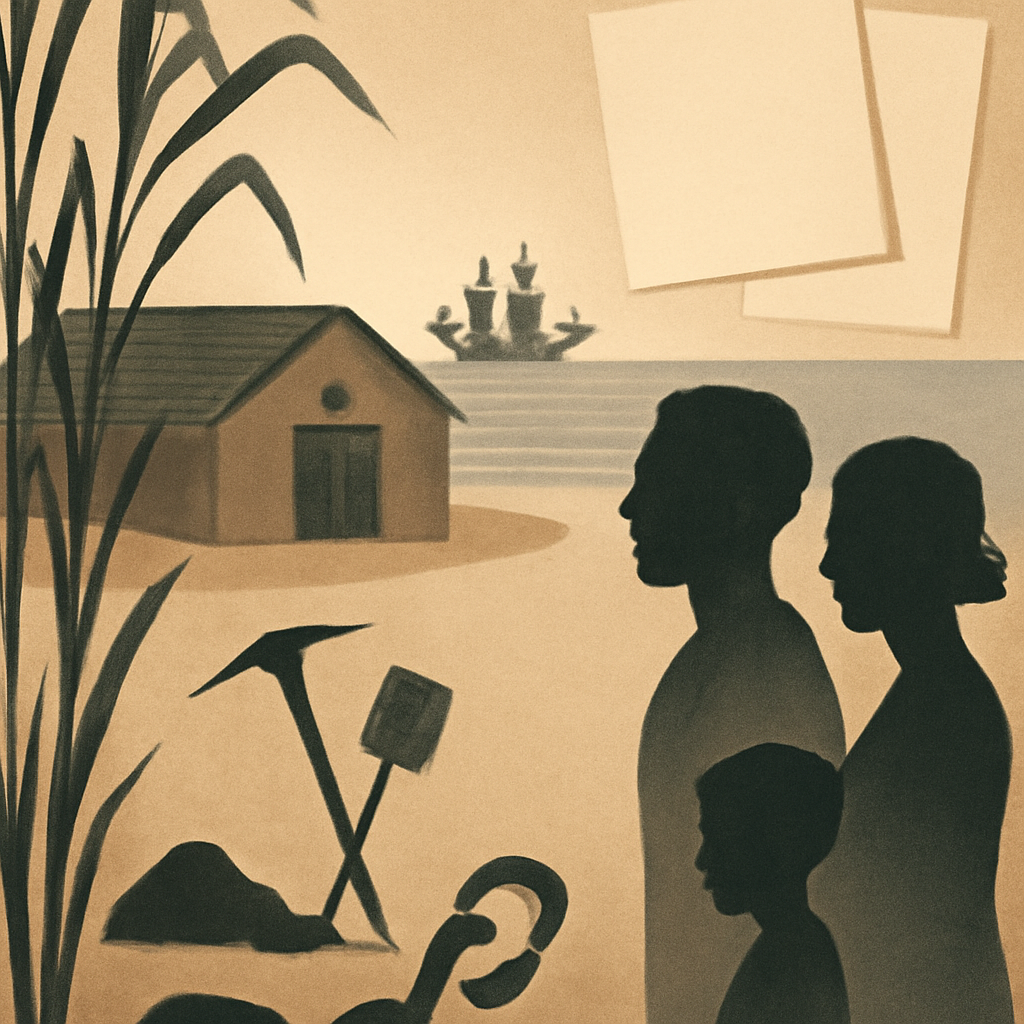
This is why the visual uses objects, landscape, tools, paper, and family silhouettes rather than a dramatic scene of violence. The page needs a sober orientation image that points toward systems and memory. The hard history belongs in the prose, sources, and linked paths where readers can inspect causes, resistance, abolition, and afterlife without reducing people to spectacle.
A reader can carry one question through every linked event: where did coercion become profitable, where did law protect it, where did people resist it, and where did freedom remain incomplete after formal abolition?
Counterexamples are useful too. When one linked event does not fit the quick answer, it may reveal a regional difference, a missing institution, a weaker source trail, or a later memory that changed the topic's meaning.
The most useful note-taking method is to separate four columns: pressure, trigger, institution, and consequence. Pressure explains why change became possible. Trigger explains why it became visible. Institution explains how change became durable. Consequence explains why later people remembered it.
The final reading question is not whether the topic was important in general. It is which concrete people, places, and institutions made it important. Once those are visible, the explanation can support essays, classroom study, search snippets, and deeper browsing without losing historical texture.
A second path is comparative. Place two linked events beside each other and ask what changed: the actors, the geography, the technology, the legal language, the scale of violence, or the memory afterward. Comparison keeps the explainer from becoming a one-directional summary.
A third path is source-led. Start with the strongest institutional source, then ask which voices it privileges. Move to a museum, archive, or event page to recover material evidence and local experience. The answer becomes stronger when it treats evidence as part of the story instead of a footnote.
A fourth path is vocabulary-led. Terms such as empire, rights, reform, globalization, nation, revolution, science, and religion carry different meanings in different periods. Track how the term changes from the earliest linked event to the latest one, and the broad question becomes a historical sequence.
The reading path also supports a practical study habit: after reading, summarize the answer in one sentence, then add one example that proves it and one example that complicates it. If both examples fit, the explanation has enough depth to be useful beyond a search snippet.
The last pass is human. Name who gained, who paid, who moved, who was forced, who argued, who recorded the event, and who later remembered it differently. Broad explanations become memorable when they end with people rather than abstractions.
That human pass also reveals limits. Some sources make officials easy to quote while leaving workers, families, captives, migrants, or local witnesses harder to hear. The reading path keeps those limits visible so the answer remains curious rather than overconfident, and it gives the next click a real historical purpose grounded in evidence, geography, lived stakes, public memory, institutions, consequences, contingency, conflict over power, and changing historical vocabulary. It also helps readers notice when an apparently simple answer is really a dispute over records, authority, survival, and interpretation.
Map Layer
Why Did Slavery and Forced Labor Shape Modern History? map examples
Gold pins mark the approximate locations of published event pages. This is a schematic locator map, not a historical border map.
Coordinates are approximate and are used to help readers orient themselves before opening a full event page.
Examples
Events That Make the Pattern Visible
Atlantic Slave Trade Expands
The Atlantic slave trade expanded as European colonial demand, coastal trade networks, African political conflicts, and plantation economies became violently connected.
Potosi Silver Boom Begins
Silver mining at Potosi became a massive colonial enterprise linking Andean labor, Spanish finance, and global silver flows.
Zong Massacre
The killing of enslaved Africans aboard the slave ship Zong became a notorious example of how commerce treated human life as insurable property.
Haitian Revolution Begins
Enslaved people in Saint-Domingue rose against plantation slavery, turning the French colony into the center of the Atlantic world's most radical revolution.
Britain Abolishes the Slave Trade
Parliament abolished British participation in the transatlantic slave trade after decades of Black resistance, abolitionist campaigning, and political pressure.
British Slavery Abolition Act
The Slavery Abolition Act ended slavery in most British colonies, though apprenticeship and compensation structures limited immediate freedom.
Thirteenth Amendment Ratified
The Thirteenth Amendment abolished slavery in the United States except as punishment for crime.
References
Where to Check the Facts
- Encyclopaedia Britannica: Atlantic slave tradeReference for forced migration and Atlantic slavery.
- National Museum of African American History and Culture: Slavery and FreedomMuseum reference for slavery, resistance, and freedom struggles.
- Encyclopaedia Britannica: Haitian RevolutionReference for the Haitian Revolution and Atlantic abolition.