Fast Answer
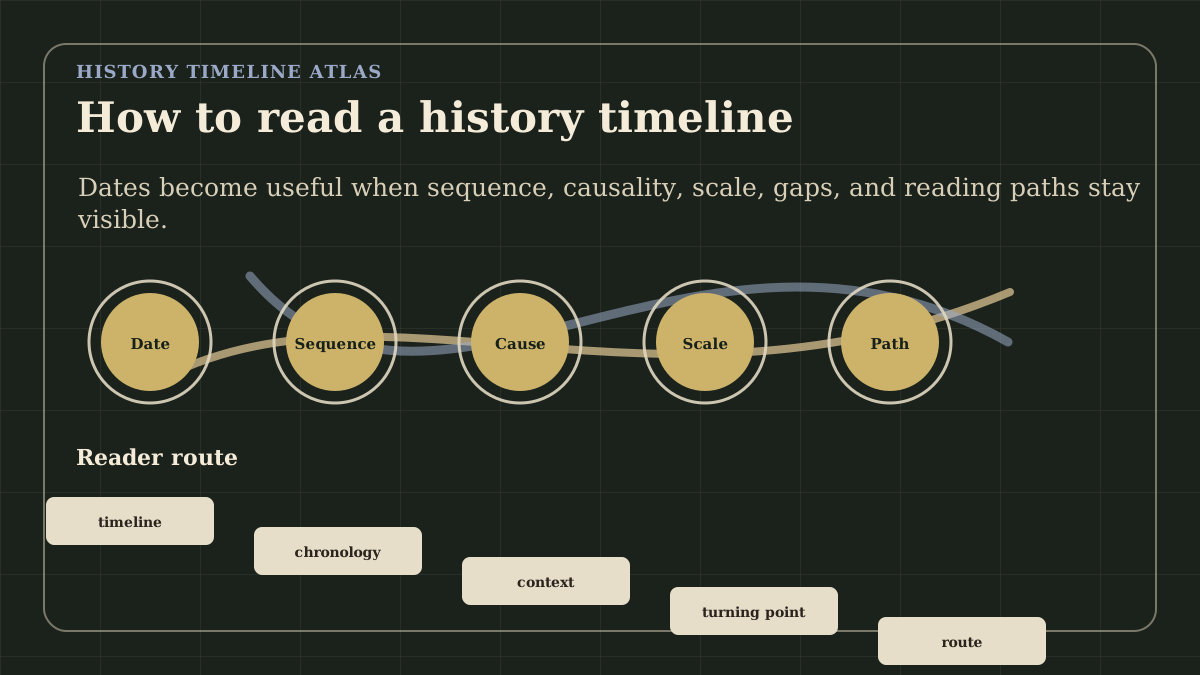
Read a history timeline by asking five questions: what question is the timeline trying to answer, which dates are anchors rather than decoration, what changed before and after each anchor, which places and people are missing, and what source type supports the sequence. A timeline becomes useful when it makes a first answer more precise.
A strong history timeline does not merely say what happened first. It helps a reader test causation, compare scales of time, notice missing voices, and decide which linked event or source should be inspected next.
Reading Paths
Choose a reading path
How to Read a History Timeline becomes clearer when the broad answer stays tied to sequence, place, and concrete next pages.
Start with a concrete event, then return to the fast answer with evidence in view.
Assassination of Julius Caesar
A group of senators killed Julius Caesar during a meeting in Rome; their motives mixed republican language, elite fear, personal rivalry, and later interpretations after years of civil war and personal rule.
Qin Unification of China
The Qin state defeated its rival kingdoms and declared a unified imperial order, creating institutions that later dynasties would adapt, contest, and remember.
Armistice of 1918
Germany signed an armistice with the Allies, ending the fighting on the Western Front after four years of industrialized warfare.
How to Think About It
Read events in order before drawing a cause-and-effect conclusion.
Check where the events happened and which borders or paths are anachronistic.
Distinguish source-backed claims from later memory and simplified textbook labels.
Ask how the event was reused by later states, movements, classrooms, or public memory.
Start With the Question, Not the First Date
A timeline is usually built around a hidden question. A Roman timeline may ask how republican offices turned into imperial rule. A World War I timeline may ask how a local assassination became an industrial war. A civil-rights timeline may ask how law, protest, courts, and federal enforcement changed each other. If the reader starts only with the earliest date, the page becomes a list. If the reader starts with the question, each date has a job.
The first pass should identify the anchor dates. An anchor date is not simply famous. It changes the available explanation. The assassination of Julius Caesar matters because it opens a chain of civil war, legitimacy problems, and memory. Qin unification matters because it turns conquest into administrative standardization. The 1918 armistice matters because it ends fighting while leaving a settlement problem that later pages must explain.
This is why a good timeline should be read twice. The first pass gives order. The second pass tests whether the order actually explains anything. A reader should be able to say which date begins a pressure, which date reveals a pressure, and which date shows the pressure becoming durable.
Separate Sequence From Cause
Events that come after another event are not automatically caused by it. A timeline makes that confusion tempting because every item appears in a neat row. The safer method is to ask what mechanism connects the entries: mobilization, law, trade, disease, technology, ideology, migration, court politics, or military command.
For World War I, Sarajevo comes before the Marne, the Somme, armistice, and Versailles, but the assassination alone cannot carry the whole explanation. Alliance obligations, military planning, imperial rivalry, nationalism, state finance, and public language made the trigger powerful. A timeline helps only when the reader can see those layers moving through the dates.
The same rule works outside war. In a technology timeline, invention does not automatically mean adoption. A patent, factory process, railway, telegraph line, public standard, school curriculum, or corporate platform may carry the change. The date tells the reader where to look; it does not finish the argument.
Watch Scale Changes
A reliable timeline moves across scales without hiding the shift. A single assassination, a decade of reform, a century of imperial expansion, and a long memory tradition are not the same kind of evidence. When a page jumps from one scale to another, the reader should slow down and ask what the jump is meant to reveal.
The most common weak timeline treats every item as equally important. That flattens history. A local protest, a national statute, a regional war, a global economic shock, and a later museum memory can all belong on one path, but they do different work. The reader should mark whether a date is a scene, a decision, an institution, a turning point, or an afterlife.
Scale is also geographic. A timeline of empire may begin in a capital but become visible in ports, tax offices, villages, frontiers, courts, schools, and battlefields. A date that looks political from the center may look like labor extraction, displacement, opportunity, or danger from the edge.
Use Linked Events as Evidence Tests
A timeline should invite inspection. When a timeline names an event, open the event page and ask what evidence supports the summary. Does the source base rely on archives, museum interpretation, reference works, eyewitness accounts, law, material objects, maps, or later memory? Each source type can support some claims better than others.
This matters because a timeline compresses. Compression is useful, but it can hide uncertainty. A date may be approximate, a motive may be debated, a casualty figure may depend on method, and a boundary may be anachronistic. The event page should restore the friction that the timeline necessarily smooths.
The habit is simple: read the timeline for order, read the event for texture, return to the timeline with one correction. If the correction changes the path, the timeline is doing real work. If no event changes the first impression, the page may be too thin or too certain.
Look for Missing People
Many timelines preserve the actions of rulers, commanders, parliaments, companies, and states more easily than the experiences of workers, enslaved people, colonized communities, women in households, refugees, migrants, and local intermediaries. That imbalance is not always bad faith. It often reflects which records survived and which institutions had the power to write.
A careful reader asks who appears only as background. In a war timeline, civilians may be present through rationing, forced labor, occupation, bombing, grief, and displacement. In a trade timeline, merchants may be visible while dockworkers, sailors, farmers, artisans, and coerced labor remain harder to hear. In a reform timeline, lawmakers may be named while implementation is hidden.
The point is not to make every timeline encyclopedic in one screen. The point is to use absence as a reading signal. If a date changes ordinary life but the timeline names only officials, the next click should go to an event, topic, or source that restores the affected groups.
A Practical Reading Drill
Choose three dates: one early pressure, one visible trigger, and one long consequence. Write one sentence for each. Then write the bridge between them. If the bridge is vague, the timeline has not yet become an explanation. The reader needs either a source check or a better intermediate event.
Now test geography. Where did each date become visible? A treaty room, capital, frontier, port, factory, railway, river valley, classroom, or battlefield changes the interpretation. Timelines are stronger when the reader can imagine the path on a map rather than only in a column.
Finally, revise the first answer. A good timeline should make the reader's first sentence more precise: not simply 'the empire fell,' but 'the center lost the ability to coordinate revenue, troops, elite loyalty, and frontier response.' That revision is the proof that the timeline helped.
Check the Gaps Between Dates
The spaces between timeline entries are often more important than the entries themselves. If a page jumps from a reform to a revolution, or from a conquest to a collapse, the reader should ask what happened in the interval. Did an institution adapt, did a population move, did prices change, did an alliance harden, did a border become harder to cross, or did a memory of the earlier event become politically useful?
This gap check prevents a polished timeline from becoming false clarity. Many historical processes are visible only in accumulation: tax pressure, legal exclusion, military exhaustion, ecological strain, literacy, religious organization, industrial capacity, or diplomatic isolation. A single date may make the process legible, but the process did not begin only when the date appeared.
A useful note-taking method is to write one verb for each gap. Between two dates, did power consolidate, fragment, migrate, radicalize, professionalize, centralize, or lose legitimacy? The verb turns the gap into an argument. If no verb fits, the reader has found a weak bridge and should open a linked event or topic page before accepting the timeline's implied connection.
Use the Timeline Against Itself
A timeline is strongest when it can survive challenge. After reading the path once, choose the entry that seems least necessary and ask what would be lost if it disappeared. If nothing changes, the entry may be decorative. If the explanation collapses, the entry is doing structural work and deserves closer reading.
Then choose the most famous date and reduce its importance on purpose. Ask what else would still explain the later outcome. This is a useful guard against textbook memory. Famous dates attract attention because they are teachable, dramatic, or symbolic, but historical explanation often depends on quieter administrative, economic, social, or geographic changes around them.
Finally, look for the page's preferred direction. Some timelines are written as rise-and-fall stories, some as progress stories, some as crisis stories, and some as paths through memory. The reader should notice that shape. A timeline that feels inevitable may be hiding alternatives; a timeline that feels chaotic may be missing the institution that links its events.
Turn the Path Into a Better Question
The final use of a timeline is question-making. After the first pass, the reader should not only know more dates; the reader should have a sharper question than the one they arrived with. A broad question such as 'why did Rome fall?' might become 'which western institutions lost the ability to coordinate taxation, army loyalty, and frontier defense?' A broad question such as 'what caused decolonization?' might become 'which wartime pressures made imperial rule harder to finance and justify?'
This matters because search pages often reward fast answers while historical understanding needs better questions. A timeline should help the reader move from a named event to a testable explanation. If the next question names a place, institution, source type, affected group, or competing interpretation, the timeline has done more than arrange dates.
The reader can finish by choosing one next page deliberately. Open an event page when the question needs texture, a timeline when the order is still unclear, a map path when geography matters, or a topic hub when the pattern appears across several cases. That chosen next step is the difference between passive browsing and historical reading.
What to Write Down
A useful timeline note has four short lines: the anchor date, the pressure before it, the mechanism that made it matter, and the later consequence. That format keeps the reader from copying the page as a list. It also makes weak explanations visible because a missing mechanism leaves an empty line. If the note cannot name a mechanism, the next click should be a source or event page.
Map Layer
How to Read a History Timeline map examples
Gold pins mark the approximate locations of published event pages. This is a schematic locator map, not a historical border map.
Coordinates are approximate and are used to help readers orient themselves before opening a full event page.
Examples
Events That Make the Pattern Visible
Assassination of Julius Caesar
A group of senators killed Julius Caesar during a meeting in Rome; their motives mixed republican language, elite fear, personal rivalry, and later interpretations after years of civil war and personal rule.
Qin Unification of China
The Qin state defeated its rival kingdoms and declared a unified imperial order, creating institutions that later dynasties would adapt, contest, and remember.
Armistice of 1918
Germany signed an armistice with the Allies, ending the fighting on the Western Front after four years of industrialized warfare.
References
Where to Check the Facts
- Library of Congress: Teaching with Primary SourcesReference for treating primary sources as evidence with creator, audience, context, and purpose.
- National Archives: DocsTeachReference for using documents, sequencing, and evidence questions in historical interpretation.
- American Historical Association: Historical ThinkingReference for chronology, causation, context, evidence, and interpretation as historical-thinking skills.