Practice worksheet
BC and AD Timeline Calculations: Crossing Year One Without a Year Zero
For historical dates, 1 BC/BCE is followed by AD 1/1 CE. To find the gap across that boundary, add the two year numbers and subtract one: 8 BCE to 5 CE gives 12 yearly steps. Use eight explained exercises to distinguish those steps from the number of year labels, and from an exact duration that requires months and days.
The short rule: cross the boundary once, without adding year zero
In historical BC/AD and BCE/CE numbering, 1 BCE is immediately followed by 1 CE. The same sequence can be written 1 BC, then AD 1. To calculate the gap across that boundary, add the positive year numbers and subtract one. For example, 8 BCE to 5 CE gives 8 + 5 − 1 = 12 yearly steps.
The subtraction does not delete a year that really occurred. It corrects the temptation to add a zero-labeled year to a convention that has none. If you instead count every year label in an inclusive list, the answer is one greater than the number of gaps: the list from 8 BCE through 5 CE has thirteen labels.
Keep the unit in your answer. A year-label gap, a count of labeled years and an exact historical duration are separate results. The examples below use corresponding points in the named years, usually their beginnings. A real event with only a year recorded does not automatically supply its month, day or exact elapsed duration.
Read BC/BCE and AD/CE before choosing a formula
BC means “Before Christ”; BCE means “Before Common Era.” AD abbreviates the Latin Anno Domini; CE means “Common Era.” For the year-number calculations here, BC and BCE refer to the same numbered years, as do AD and CE. Replacing a label with its counterpart does not move the date or create a different starting year.
| Historical notation | Equivalent notation | Calculation coordinate |
|---|---|---|
| 4 BC | 4 BCE | −3 |
| 1 BC | 1 BCE | 0 |
| AD 1 | 1 CE | +1 |
| AD 4 | 4 CE | +4 |
BCE numbers decrease as time moves toward the boundary: 4 BCE, 3 BCE, 2 BCE, 1 BCE. CE numbers then increase: 1 CE, 2 CE, 3 CE, 4 CE. A large BCE number therefore names an earlier year, while a large CE number names a later one.
The coordinate column is a calculation aid, using the astronomical numbering relationship described by NASA’s year-dating explanation. Its zero corresponds to historical 1 BCE. It does not mean that BC/AD or BCE/CE suddenly contains a year labeled zero. Keep the two columns distinct when reading a date produced by astronomical software.
An original year-number line: inspect the one-step boundary
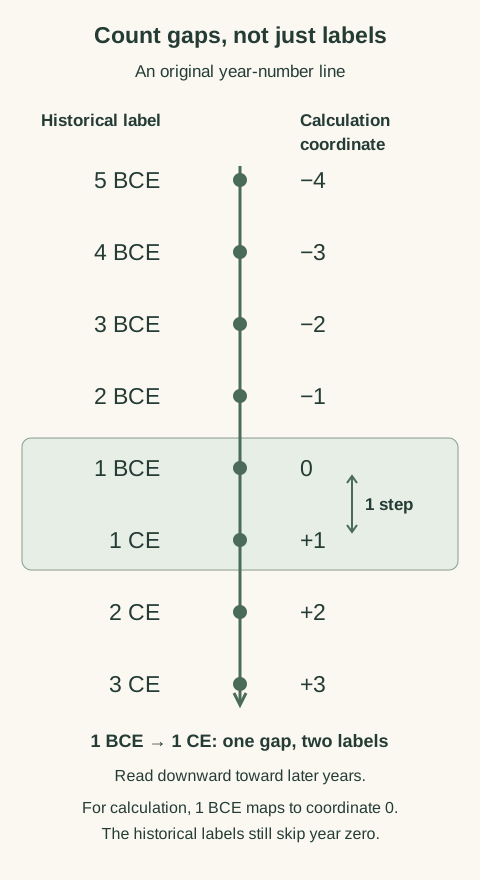
Cover the coordinate column and read only the historical labels. Then uncover it and check how each yearly step increases the coordinate by one. This gives you a way to catch the common error of mapping 1 BCE to −1: doing that while keeping 1 CE at +1 would create a two-step gap where the historical sequence has only one.
Two reliable methods: count the gaps or use coordinates
Method 1: split the route at the boundary
For 8 BCE to 5 CE, count 8 BCE to 1 BCE as seven steps. Add the single step from 1 BCE to 1 CE. Then add the four steps from 1 CE to 5 CE. The total is 7 + 1 + 4 = 12. This method is useful when a diagram makes the skipped-zero convention easier to see than a formula.
Method 2: put both endpoints on one numerical scale
Convert BCE year b to coordinate 1 − b, using a positive value for b. A CE year keeps its number. Eight BCE therefore maps to −7, while 5 CE maps to +5. Later coordinate minus earlier coordinate gives 5 − (−7) = 12.
This is especially helpful when moving a specified number of yearly steps forward or backward. Calculate the new coordinate first, then translate it back: a positive coordinate c is c CE; coordinate zero is 1 BCE; a negative coordinate y is (1 − y) BCE. Label the final answer in the convention requested by the question.
| Task | Year-label gap | Inclusive labels |
|---|---|---|
| BCE b to CE c | b + c − 1 | b + c |
| Two years in the same era | Difference of the two numbers | Difference + 1 |
| Any two calculation coordinates | Later coordinate − earlier coordinate | Gap + 1 |
These rules assume that your inputs use the same year-numbering convention. They do not convert an Islamic, Hebrew or other calendar date into a BCE/CE date. The US Naval Observatory’s calendar introduction explains why calendar systems need their own rules.
Elapsed gaps and inclusive year labels answer different questions
A line with two marks has one connecting gap. A line with thirteen marks has twelve gaps. The same distinction applies to a list of historical year labels. Before calculating, underline what the question asks you to count: yearly steps between points, labels in a list, completed years of life, or days between recorded dates.
“From 8 BCE through 5 CE, including both year labels” asks for a list count of thirteen. “From the start of 8 BCE to the start of 5 CE” asks for twelve annual steps. “An event began during 8 BCE and ended during 5 CE” supplies less information: the year-label gap is twelve, but the precise elapsed interval depends on the missing dates.
Inclusive counting is useful for labels, inventories or a deliberately defined reporting period. It becomes misleading when its result is presented as an exact duration without explaining the convention. Write “thirteen labeled years, counting both endpoints” when that is what you actually counted.
Eight original calculations with explained answers
Write a result and its unit before opening each answer. Use the number line or a list of intermediate labels as a second check. All unnamed dates and people in these exercises are invented teaching inputs, not documentary findings.
Case 1
A number line marks the beginning of 1 BCE and the beginning of 1 CE. How many yearly steps separate the marks? How many year labels are listed if both endpoints are included?
Show answer and explanation for case 1
One yearly step separates the marks; the inclusive list contains two year labels.
The historical sequence is 1 BCE, then 1 CE. It contains no intervening year zero. The calculation is 1 + 1 − 1 = 1 step. If you list labels rather than gaps, you write “1 BCE” and “1 CE,” giving two labels. These answers count different things. Do not turn the pair of labels into two elapsed years. A point at the start of 1 BCE and the corresponding point at the start of 1 CE are one annual step apart.
Independent check: the coordinates are 0 and 1; their difference is 1. Draw two marks and count the single connecting gap.
Case 2
Find the gap from the beginning of 8 BCE to the beginning of 5 CE. Then count all the historical year labels from 8 BCE through 5 CE, including both endpoints.
Show answer and explanation for case 2
The gap is 12 yearly steps. The inclusive list has 13 year labels.
Across the boundary, add the year numbers and subtract one: 8 + 5 − 1 = 12. The BCE part has eight labels, from 8 BCE down to 1 BCE; the CE part has five, from 1 CE up to 5 CE. That list has 8 + 5 = 13 labels and therefore 12 gaps between successive labels. The coordinate check is −7 to +5, a difference of 12. An answer of 13 elapsed years has counted the endpoint labels instead of the intervals. An answer of 14 labels has inserted a nonexistent historical year zero.
Start-of-year marks: 8 BCE → 1 BCE is 7 steps; 1 BCE → 1 CE is 1; 1 CE → 5 CE is 4. Together: 7 + 1 + 4 = 12.
Case 3
A worksheet uses the beginning of 80 BCE as its earlier point and the beginning of 70 BCE as its later point. Does the falling number mean that time has moved backward? Calculate the gap.
Show answer and explanation for case 3
Time moves forward by 10 yearly steps, despite the falling BCE numbers.
BCE numbers count backward from the era boundary. In chronological order, 80 BCE precedes 79 BCE, which precedes 78 BCE, and so on toward 70 BCE. Within the same era, subtract the numbers: 80 − 70 = 10. The coordinates are −79 and −69; the later coordinate is larger, and the difference is 10. Writing only “the number decreased by ten” is incomplete because it does not explain the direction of historical time. If the question instead asks for every label from 80 BCE through 70 BCE, the inclusive list contains eleven labels.
Case 4
Compare the gap from the beginning of 5 CE to the beginning of 17 CE with the gap from the beginning of 14 BCE to the beginning of 2 BCE. Must you subtract one because the labels refer to ancient years?
Show answer and explanation for case 4
Both gaps are 12 yearly steps. Neither calculation needs the cross-boundary subtraction of one.
Each pair stays within a single era. For the CE pair, 17 − 5 = 12. For the BCE pair, 14 − 2 = 12. The minus-one adjustment applies when you add BCE and CE year numbers across the missing-zero boundary; it is not a rule for every ancient date. In coordinate form, the pairs are 5 to 17 and −13 to −1. Both differences are 12. If a list includes both endpoints, each pair spans thirteen labeled years. First identify the conventions and the task, then choose the arithmetic.
Case 5
Begin at the start of 14 BCE and move forward twenty corresponding annual steps. Which historical year label do you reach?
Show answer and explanation for case 5
You reach the beginning of 7 CE.
Fourteen BCE has calculation coordinate 1 − 14 = −13. Moving forward twenty steps gives −13 + 20 = 7, which is 7 CE. A second check avoids coordinates: reaching 1 BCE takes thirteen steps; reaching 1 CE takes one more, for fourteen so far. Six steps remain, carrying 1 CE to 7 CE. The answer 6 CE comes from treating 14 BCE as coordinate −14, silently inserting an extra year at the boundary. Negative coordinates and BCE labels are related, but their numbers are not interchangeable.
Case 6
An invented study sheet uses 27 BCE and 14 CE as endpoints. Its writer says: “27 plus 14 is 41, so exactly 41 years elapsed.” What can you correct before inspecting any actual event dates?
Show answer and explanation for case 6
The year-label gap is 40; 41 is the inclusive number of labeled years. Exact elapsed duration still requires the actual dates.
The coordinate of 27 BCE is −26 and the coordinate of 14 CE is +14. Their difference is 40. Equivalently, 27 + 14 − 1 = 40. Listing every BCE and CE year label between the endpoints gives 27 + 14 = 41 labels. That does not show that a historical office, journey or lifetime lasted exactly forty years either: starting late in one labeled year and ending early in the other changes the duration. These endpoints are hypothetical worksheet inputs here, not a verified claim about a named person’s reign.
Case 7
The first century BCE includes the labels 100 BCE through 1 BCE. Why are there one hundred labels when the gap between the beginnings of 100 BCE and 1 BCE is only ninety-nine steps?
Show answer and explanation for case 7
The inclusive label count is 100, but the final year has not yet elapsed at the beginning of 1 BCE.
The label list is 100, 99, 98 and so on down to 1 BCE: one hundred labels, separated by ninety-nine gaps. Starting the last labeled year is not the same as completing it. To include the entire final year, continue to the beginning of 1 CE. That adds one more annual step and completes the century’s one hundred-year span. The coordinate check is −99 to 0 for the first pair, then −99 to +1 for the complete span. Do not conclude that a century contains only ninety-nine years; the original endpoint stopped at the start of its last year.
Case 8
A fictional person was born in 10 BCE and died in 10 CE. No month or day is recorded. Assume the same calendar and the usual annual birthday convention, with no leap-day issue. Can you establish an exact age of nineteen?
Show answer and explanation for case 8
No. The year-label gap is 19; the completed-anniversary age could be 18 or 19 under the stated assumptions.
Ten plus ten minus one gives a gap of nineteen between corresponding points in the two years. If the death date reached the birthday in 10 CE, nineteen anniversaries had passed; if it came earlier in that year, only eighteen had passed. The missing months and days prevent choosing between those cases. A source using another convention for reporting age would require a further check. Arithmetic should reveal this uncertainty, rather than turning two year labels into an exact biographical statement. For an actual person, inspect the source’s dating and age conventions before drawing a conclusion.
What year-only dates cannot tell you
A year is a span of time, not a uniquely specified instant. A statement that a journey started in one year and ended in another can support a chronological comparison without giving an exact elapsed length. If the months and days matter to your argument, obtain them from a source rather than infer them from the year numbers.
Nor does a gap of ten calendar-year steps mean exactly 3,650 days. Leap-day rules, the calendar used and the actual endpoints matter for a day count. A Julian date and a Gregorian date may require conversion even when both are written with AD year numbers. Changing BC to BCE is a change of era label; converting between calendars is a different operation.
For biography, distinguish a year-label gap from a completed-anniversary age. For a reign or war, distinguish a beginning-of-year model from the actual accession, declaration, surrender or departure date. If only the years are known, give the calculation you can defend and state what remains unspecified.
Check the convention before attaching a calculation to history
The US Naval Observatory’s century explanation places the first CE century in years 1 through 100. That makes the beginning of 101 CE the next century boundary. The first BCE century runs in chronological order from 100 BCE through 1 BCE. Case 7 shows why starting its final labeled year is not the same as finishing the century.
Historical year numbers are also a way of arranging records retrospectively. A modern timeline may label an ancient event BCE even though the original community used regnal years or another dating system. The arithmetic is performed on the modern labels; it does not prove that an ancient author used those same labels.
When a source or data file uses a zero or a negative year, check its documentation. NASA distinguishes historical BCE/CE notation from astronomical year numbering. Under that mapping, astronomical −1 corresponds to 2 BCE, not 1 BCE. Copying a signed number directly into a BCE label can shift the date by a year.
Finally, arithmetic alone cannot establish that two records describe the same event, that a quoted date is securely known, or that one event caused another. Use the timeline-reading guide to examine sequence, source limits and causation after the numerical question is settled.
Keep a short calculation record you can check
For a classroom answer or research note, record the original labels before converting them. Then write the coordinates, the operation and the unit. Leave the exact-duration line unresolved when the source does not supply enough information.
Question and object being counted:
Start year label and convention:
End year label and convention:
Chronological direction:
Start calculation coordinate:
End calculation coordinate:
Year-label gap:
Inclusive year labels, if requested:
Months, days and calendar supplied:
Answer with units:
What the record does not establish:
Download the blank text calculation record. For a quick final check, ask three questions: did I insert a historical year zero, did I count gaps or labels, and did my conclusion require dates the source never supplied? Each question catches a different kind of error.
Sources and further reading
- NASA: Year Dating ConventionsHistorical BCE/CE notation, astronomical numbering, and the mapping of BCE year b to coordinate 1−b. The historical zero convention is distinguished from the calculation coordinate.
- US Naval Observatory: The 21st Century and the 3rd MillenniumHistorical year numbering has no year zero; first-century boundaries and the distinction from astronomical numbering.
- US Naval Observatory: Introduction to CalendarsCalendar systems have different rules. Year-label arithmetic is distinguished from calendar conversion and exact day counting.