Fast Answer
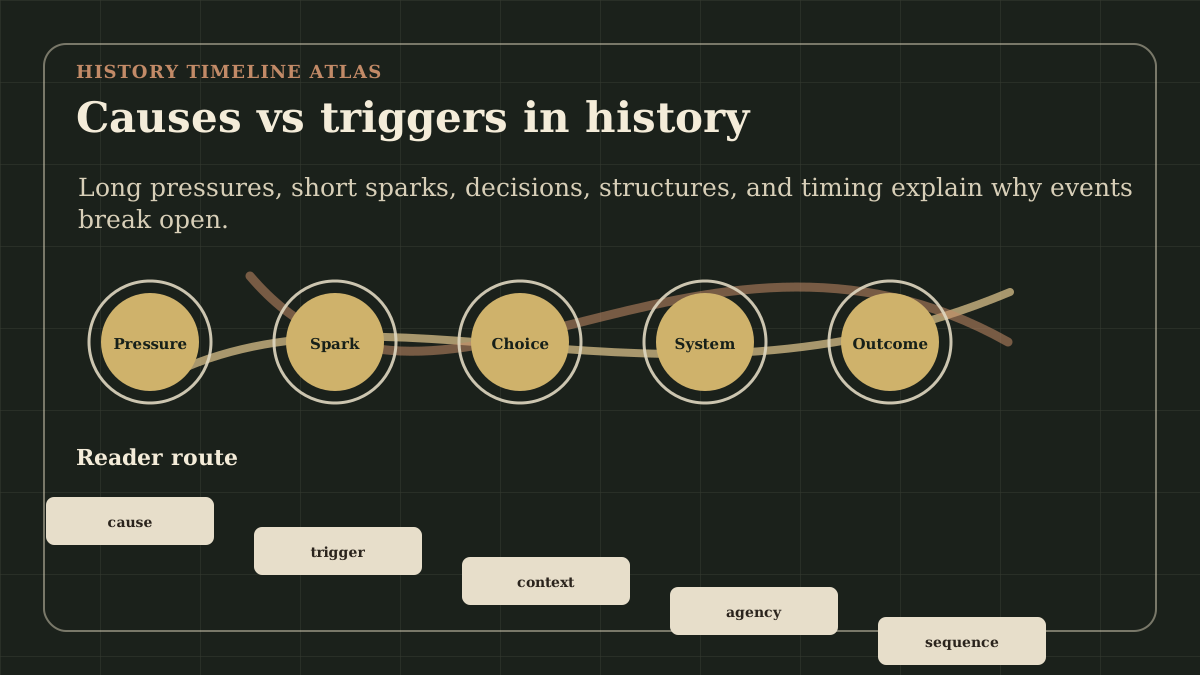
A cause is a condition that made an event more likely or shaped its direction. A trigger is the immediate event that opened the sequence. A turning point is a moment after which the available futures changed. The best answer keeps all three visible and asks who still had room to choose.
A trigger matters only when deeper conditions make it powerful. Good historical explanation shows how structures, decisions, timing, and contingency meet without pretending that one spark explains the whole fire.
Reading Paths
Choose a reading path
Causes vs Triggers in History becomes clearer when the broad answer stays tied to sequence, place, and concrete next pages.
Start with a concrete event, then return to the fast answer with evidence in view.
Assassination of Julius Caesar
A group of senators killed Julius Caesar during a meeting in Rome; their motives mixed republican language, elite fear, personal rivalry, and later interpretations after years of civil war and personal rule.
Armistice of 1918
Germany signed an armistice with the Allies, ending the fighting on the Western Front after four years of industrialized warfare.
Wall Street Crash of 1929
A severe stock market collapse in New York signaled financial instability that helped deepen the worldwide Great Depression.
How to Think About It
Read events in order before drawing a cause-and-effect conclusion.
Check where the events happened and which borders or paths are anachronistic.
Distinguish source-backed claims from later memory and simplified textbook labels.
Ask how the event was reused by later states, movements, classrooms, or public memory.
The Spark Is Not the Fuel
The easiest historical mistake is to treat a famous trigger as if it were the whole cause. Sarajevo did not by itself create World War I. The Wall Street Crash did not by itself create every political crisis of the 1930s. Caesar's assassination did not by itself destroy republican government. Each trigger mattered because older pressures were already present.
A cause can be slow: fiscal weakness, land concentration, racial hierarchy, military planning, imperial rivalry, climate stress, technological change, or legitimacy loss. A trigger is often fast: a murder, crash, invasion, proclamation, court decision, battle, protest, or failed harvest. The historian's task is to explain why the fast event had the power it did.
This distinction improves search answers because readers often arrive with a simple question: what caused this? The honest answer needs layers. One layer explains background conditions. One layer explains immediate decisions. One layer explains why later people remembered one date as the moment everything changed.
Agency Still Matters
Structural causes do not remove human choice. They make some choices easier, harder, more dangerous, or more likely. Diplomats could still choose language. Generals could still choose mobilization. Legislators could still delay, compromise, repress, or concede. Protesters, workers, soldiers, merchants, judges, and local officials could still act within limits.
The point is not to choose between structure and agency. The point is to show where they meet. A grain shortage may create pressure, but people decide whether to hoard, riot, tax, subsidize, migrate, suppress, or negotiate. A frontier threat may create fear, but courts and commanders decide how much power to give local military leaders.
A strong page therefore asks who had options and who did not. Elite actors often leave records of decision. Ordinary people may appear through tax records, petitions, wages, migration, court cases, oral memory, or material evidence. Causes become more precise when the unequal distribution of choice is visible.
Turning Points Narrow the Future
A turning point is not just a dramatic event. It is a moment when the set of realistic futures changes. After a decisive conquest, a legal settlement, a technological adoption, a military defeat, or a mass mobilization, some paths become harder to return to. That is why not every trigger is a turning point.
The fall of Constantinople in 1453 is a useful test. The conquest was dramatic, but its meaning comes from more than the date. It ended Byzantine imperial rule in the city, confirmed Ottoman control of a strategic capital, changed Christian and Muslim political memories, and shifted Mediterranean calculations. The trigger and the long-term turning point overlap, but they are not identical.
A weaker answer says 'this changed everything.' A stronger answer names what changed: sovereignty, trade paths, military balance, law, religious authority, labor, information, or memory. The more specific the changed future, the better the explanation.
Use Counterfactuals Carefully
Counterfactual questions can help if they are disciplined. Asking whether World War I would have happened without Sarajevo is useful only if the reader also asks which pressures remained: alliances, military timetables, imperial rivalry, Balkan nationalism, public honor, and decision-making cultures. The counterfactual should test the cause, not become a fantasy story.
A good counterfactual changes one condition and watches the mechanism. If the trigger disappears but the pressure remains, another trigger may have been possible. If the pressure disappears, the same trigger may fail to produce the same result. This is how counterfactual thinking helps separate necessary conditions from dramatic moments.
The danger is hindsight. Later outcomes can make earlier events look inevitable. A careful reader resists that pull by asking what people at the time knew, feared, misunderstood, and could still imagine. Causes should explain why an outcome happened without pretending everyone already knew the ending.
Source Types Change the Cause
Different sources highlight different causes. Diplomatic records make state decisions visible. Economic data can reveal prices, wages, debt, and trade. Newspapers show public language and propaganda. Court records reveal disputes. Maps reveal path and scale. Archaeology can show settlement, diet, destruction, disease, and material change. No one source family gives the whole cause.
This is why a page should avoid unsupported monocausal claims. If a source only anchors chronology, it cannot by itself prove motive. If a source shows ideology, it cannot by itself prove material capacity. If a source shows economic stress, it cannot by itself prove why one political choice was made instead of another.
The best method is triangulation. Use one source for sequence, another for mechanism, and another for affected groups. When those sources pull in different directions, the explanation should name the tension rather than smoothing it away.
A Better Answer Pattern
Begin with one sentence that separates layers: 'The immediate trigger was X, but it became decisive because Y and Z had already weakened the system.' That sentence prevents the answer from becoming a list and gives the reader a structure for evidence.
Then assign evidence to each layer. Use a timeline for order, an event page for sequence, a map for geography, and a source note for uncertainty. If a linked example does not fit the pattern, use it as a limit. Good causation does not require every case to behave the same way.
End with consequence and memory. Causes explain why a path opened; consequences explain what changed; memory explains why later people kept returning to that date. A strong history answer needs all three because the question 'what caused it?' is usually also asking why it still matters.
Do Not Erase Decision-Makers
Structural causes can become another shortcut if they make human decisions disappear. Economic pressure, ideology, imperial rivalry, class conflict, state weakness, or religious tension may explain why a situation became dangerous, but they do not decide exactly who mobilized, who negotiated, who delayed, who escalated, or who refused compromise. People still acted inside constraints.
A strong explanation therefore keeps three levels visible at once. Conditions made some choices more likely. Institutions made some choices easier to execute than others. Individual and group decisions selected a path through that pressure. If one level vanishes, the answer becomes too mechanical, too leader-centered, or too vague.
This matters for moral and political judgment. Saying that a war, revolution, reform, or collapse had deep causes does not mean everyone involved was powerless. It means responsibility has to be placed carefully: who inherited the pressure, who intensified it, who benefited from it, who tried to reduce it, and who later claimed the outcome was inevitable?
Use Language Carefully
Words such as inevitable, accidental, caused, triggered, sparked, led to, produced, and enabled do not mean the same thing. A page that uses them casually can make history sound cleaner than it was. 'Enabled' leaves room for other conditions. 'Triggered' points to timing. 'Caused' carries a heavier explanatory burden. 'Inevitable' should be used rarely because it claims that realistic alternatives had effectively disappeared.
A practical editing test is to replace 'led to' with a more specific verb. Did the event legitimize, expose, finance, radicalize, accelerate, block, militarize, centralize, or discredit something? The specific verb forces the writer and reader to name the mechanism. It also makes the page easier to challenge, which is good historical practice.
When the mechanism is unclear, the honest answer is not to add certainty. It is to say what kind of evidence would be needed: cabinet records, price data, military orders, letters, newspapers, oral testimony, court records, archaeological evidence, or later memory. That keeps cause-and-trigger language from becoming a polished guess.
Make the Final Claim Proportional
The last sentence of a causation answer should be proportional to the evidence. If the page has shown only chronology, the conclusion should not claim motive. If the page has shown motive but not capacity, it should not claim inevitability. If the page has shown elite decision-making but not ordinary experience, it should say so. Proportional claims are less dramatic, but they are more useful.
This proportionality also helps compare events. Two revolutions may share food prices and political anger, but differ in military loyalty, tax systems, ideology, foreign pressure, or local organization. Two wars may share a trigger but differ in alliance systems and public mobilization. The reader should leave with a method for seeing why similar sparks sometimes produce different fires.
A good final claim therefore has three parts: the trigger that opened the sequence, the deeper causes that made it powerful, and the limit that prevents overstatement. That shape gives the reader an answer that is clear enough to use and honest enough to revise.
What to Write Down
A useful causation note has one line for background pressure, one line for the trigger, one line for the decision that connected them, and one line for what changed afterward. If any line is empty, the explanation is not ready. That simple format keeps the answer from becoming either a single spark story or a vague list of conditions. It also shows where another source or linked case is needed. The final line should name what changed for institutions and for people living through the event. If the note cannot name both, the answer is still too narrow and should return to the timeline, map, or event evidence.
A Final Reader Check
Before leaving the page, test the explanation against one neighboring event. If the same background pressure appears but the outcome differs, the trigger, institution, or decision deserves more attention. If the trigger looks similar but the deeper pressure differs, the comparison warns against a simple spark story. This final check turns causation into a reusable method rather than a memorized answer, and it keeps the reader alert to contingency, agency, and source limits.
Map Layer
Causes vs Triggers in History map examples
Gold pins mark the approximate locations of published event pages. This is a schematic locator map, not a historical border map.
Coordinates are approximate and are used to help readers orient themselves before opening a full event page.
Examples
Events That Make the Pattern Visible
Assassination of Julius Caesar
A group of senators killed Julius Caesar during a meeting in Rome; their motives mixed republican language, elite fear, personal rivalry, and later interpretations after years of civil war and personal rule.
Armistice of 1918
Germany signed an armistice with the Allies, ending the fighting on the Western Front after four years of industrialized warfare.
Wall Street Crash of 1929
A severe stock market collapse in New York signaled financial instability that helped deepen the worldwide Great Depression.
References
Where to Check the Facts
- American Historical Association: Historical Thinking StandardsReference for causation, chronology, context, and evidence-based interpretation.
- Library of Congress: Analyzing Primary SourcesReference for source context, purpose, audience, and evidence questions.
- Encyclopaedia Britannica: World War IReference case for distinguishing the Sarajevo trigger from longer alliance, military, imperial, and nationalist pressures.