Practical guide
Why Did Britain Skip 11 Dates in September 1752? Reading the Calendar Reform
Read the Calendar Act to distinguish missing date labels from passing days, the January year-start change, and calendar conversion. Includes a diagram and answered exercises.
Eleven date labels were omitted; time kept passing
In the British reform of 1752, the natural day after 2 September was called 14 September. The date labels 3–13 September were omitted on that occasion. People did not travel through eleven physical days instantaneously. Section 1 of the Calendar (New Style) Act makes this distinction in its own wording: it refers to the next “natural day” and the omitted “nominal days.”
A timeline can therefore show adjacent days with apparently non-adjacent dates. Before subtracting the numbers in two historical dates, identify the calendar and the local dating convention. A gap between labels is not necessarily a gap in surviving events.
This guide uses one documented reform in British dominions. It does not supply a universal conversion rule for every country, century or religious calendar. Start with this worked example, then use the record checklist when you encounter a different place.
Start with the law and its version
The source is the Calendar (New Style) Act, identified on legislation.gov.uk as 1750, chapter 23, 24 George II. Its current short title and its actions are different pieces of information: the displayed notes say the short title was given by the Short Titles Act 1896, while the operational changes discussed here occurred in 1752. A short title containing “1750” is not evidence that every date change happened that year.
The linked text is the website’s available revised text, checked on 5 November 2026. It contains repeal markers, editorial information and later statutory references. It is not presented here as an untouched scan of the law as first enacted. Section 1 still supplies the relevant September instruction; when a question depends on deleted language, obtain the appropriate historical version before answering it.
The preamble describes an English legal year beginning on 25 March and explicitly distinguishes that reckoning from Scotland’s legal method and common usage. This matters for archival work: “British record before 1752” is not enough information to assign every document the same year-start rule.
Two changes that a timeline should keep separate
| Instruction in section 1 | What changes | What to record |
|---|---|---|
| The January day after 31 December 1751 is the first of 1752; future years begin on 1 January. | The legal beginning of the numbered year. | Whether a record’s year uses a March or January start. |
| Date numbering continues in the old order through 2 September 1752; the next natural day is called 14 September. | The day-of-month labels used at the transition. | The calendar attached to each complete date. |
Changing a year label and converting a calendar date are two operations. A January or February record using a March year-start may need its year explained even before you discuss Julian and Gregorian day numbering. Conversely, a September 1752 record can raise a day-label problem without crossing the start of a numbered year.
Do not hide both operations behind “I added eleven days.” That phrase would leave the reader unable to see what you did to the year or why the chosen offset applies to this place and date.
Count the omitted labels and the passing days
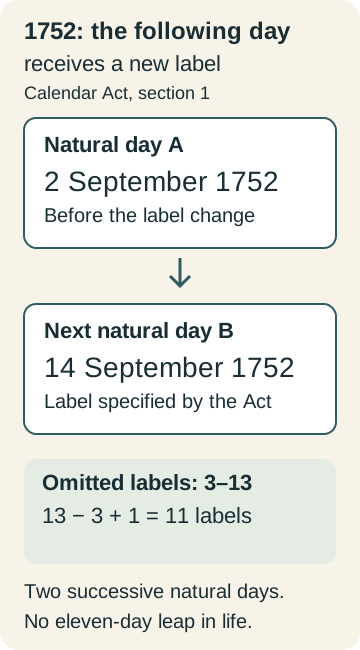
The omitted label count is inclusive: 13 − 3 + 1 = 11. The difference between the two printed day numbers is 14 − 2 = 12. Neither calculation, by itself, measures the elapsed interval between the two successive natural days specified by the Act.
For this transition, the legal instruction is the decisive evidence: the natural day next immediately following 2 September receives the label 14 September. Say “the following day,” rather than claiming an exact number of hours between two archival timestamps whose clock times are unknown.
Now compare two notes. “Nothing happened between 2 and 14 September” is unsupported. “This local sequence omits the nominal labels 3–13 September under the reform” explains the gap while leaving historical activity on the successive days visible. The diagram is a modern aid to reading the law, not a facsimile calendar or evidence that a particular diary contains either entry.
Why correct the calendar, and why not always eleven days?
The Act’s preamble connects the reform with the drift of the equinox in the calendar and with the inconvenience of differing date reckoning in correspondence and accounts. The US Naval Observatory explains the underlying distinction: the Julian rule inserts a leap day every four years, while the Gregorian rule excludes century years unless divisible by 400. The Gregorian calendar was first introduced in 1582; that statement dates its introduction, rather than every jurisdiction’s adoption.
The British Act’s section 2 names the century exception. It treats 1800 and 1900 as common years and 2000 as a leap year. These examples explain why two systems with different leap-year rules do not stay the same number of days apart forever.
For that reason, eleven is a documented correction at this particular British transition. It is not a permanent offset to apply to all Julian dates. If you need an exact conversion elsewhere, identify the calendar, place, period and treatment of the year, and use a conversion method documented for that case. A familiar number is not a substitute for those inputs.
Did every deadline move in the same way?
No single rule about ordinary obligations should be inferred from the skipped labels. Section 1 moves many named court and corporate dates onto the new nominal calendar. Section 4 separately preserves specified markets, fairs and associated courts on the natural days on which they would have occurred without the Act. Section 6 protects specified payments, leases and agreements against acceleration, using natural-day language.
The useful reading question is therefore “which clause governs this obligation?” A rent record and a court sitting need not be interpreted by the same simplified slogan. The linked revised text contains repealed words and an unreliable marginal-note warning in section 6; this guide makes no claim about its deleted age-of-majority provisions.
Make an honest date note for an actual record
- Copy the date as written. Preserve the record’s wording before normalizing it.
- Name the place and creator. Establish the jurisdiction or community whose convention is relevant.
- Identify the calendar and year-start. Treat them as separate fields; if either is uncertain, keep that uncertainty visible.
- Check the edition. A modern transcript may already normalize dates. Read its editorial note before converting them again.
- Describe the operation. Say whether you changed the year label, converted a day/month date, or merely expanded an ambiguous abbreviation.
- Keep both forms when useful. Mark the original and the normalized date clearly, with the source of the conversion rule.
An editor’s note is evidence about an editor’s practice, not automatic proof of the original writer’s convention. If a transcript supplies no rule, a careful caption may preserve the original date and state what still needs checking. Uncertainty can be more useful than a precise but unexplained conversion.
Four questions with explained answers
- A British reform timeline places 14 September immediately after 2 September 1752. Is its spacing necessarily wrong?
- No. Section 1 assigns those labels to successive natural days. The chart should explain that its spacing follows successive days at this transition, rather than ordinary subtraction of the printed numbers.
- How many nominal labels are omitted: eleven or twelve?
- Eleven: 3 through 13 inclusive. Twelve is the difference between 14 and 2. Neither should be labelled eleven or twelve days of missing life.
- A note says “all dates before 1752 used a March year-start throughout Britain.” Does the cited preamble support it?
- No. The preamble itself distinguishes England’s legal reckoning from Scotland and common usage. Check the particular record before assigning a convention.
- Can the Act’s eleven-label correction be applied to a Julian date from another century without further work?
- No. The calendars have different century leap-year rules, and adoption was jurisdiction-specific. Establish the actual inputs and an appropriate rule first.
These are original exercises based on the cited passages, not reports of classroom testing. For a different arithmetic problem, continue to crossing the BCE/CE boundary without a year zero. For choosing which action a date marks, use the timeline-reading method.
Sources and further reading
- Calendar (New Style) Act 1750 — legislation.gov.uk, current revised textPreamble and section 1: year-start and September labels; section 2: century leap-year rule; sections 4 and 6: specified natural-day protections. Revision notes are visible and must not be treated as original 1750 wording.
- US Naval Observatory — Introduction to CalendarsPrincipal Solar Calendars: Gregorian introduction in 1582, Julian and Gregorian leap-year rules, astronomical motivation. Does not establish one adoption date for every country.