At a Glance
The shape of the event
- Date
- 589
- Place
- Chang'an and southern China
- Type
- Imperial Reunification
The Sui dynasty reunified China after centuries of division, creating institutions and infrastructure later expanded by the Tang.
589; place the event in Chang'an and southern China before comparing causes or consequences.
The event gives East Asia a transition from post-Han division to medieval imperial consolidation.
Emperor Wen of Sui / Sui officials are the first names or groups to compare before widening the story.
A renewed imperial state connected north and south more tightly.
A renewed imperial state connected north and south more tightly.
The event gives East Asia a transition from post-Han division to medieval imperial consolidation.
Follow this thread to see how the administrative and infrastructural choices made at reunification shaped the next chapters of imperial China.
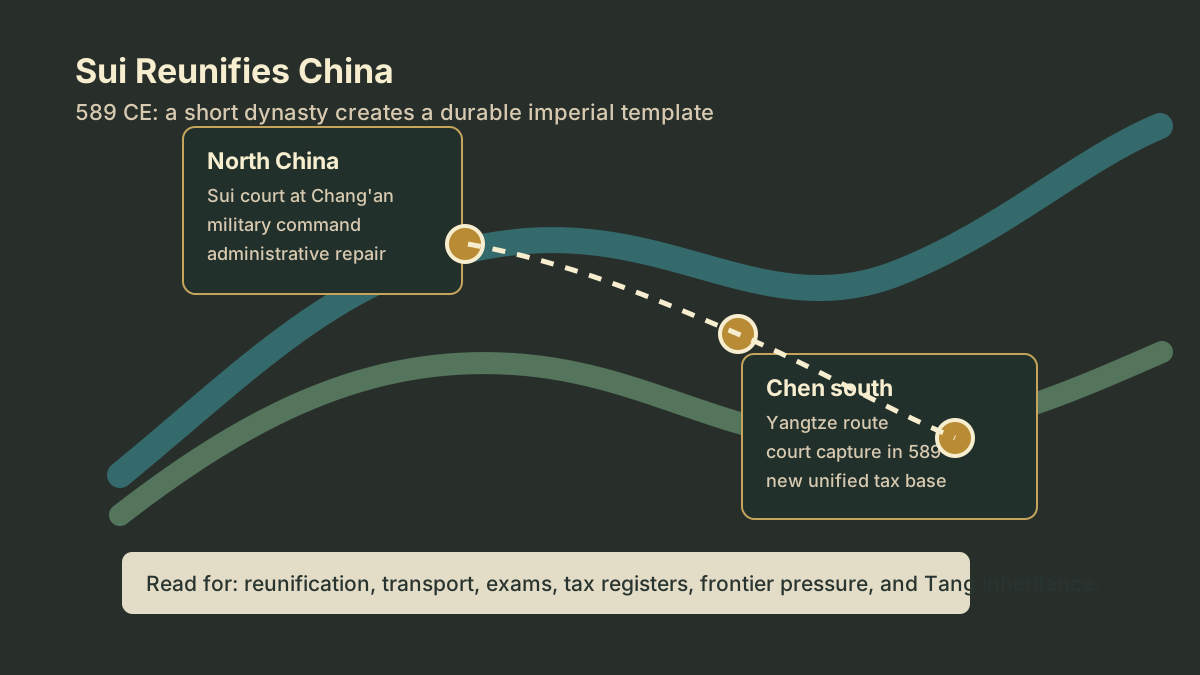
Background
The centuries after Han were defined by political fragmentation across what we now call China: multiple regimes, regional elites, and divergent economies in the north and the south. Local powerholders governed cities, commanded militias and negotiated tax and labor obligations differently in each region. Trade routes, seasonal harvests and cultural networks continued to link places, but competing courts made central authority inconsistent. By the late sixth century, several pressures mounted on would-be unifiers. Rulers who imagined a single empire faced the practical problem of binding distant provinces into a coherent administration; officials needed legal codes, tax registers and channels for moving grain and troops.
At the same time communities remembered different loyalties and suffered different disruptions when states demanded men and materials. Archaeology, law codes, oral memory, diplomatic correspondence and official chronicles each record parts of this story, and they do not always line up. Any account of reunification must hold open the gap between the ambitions of rulers and the lived experiences of the people they sought to govern. The Sui reunification matters because it ended centuries in which north and south China had developed different political habits, elite networks, military systems, and cultural memories. Emperor Wen, born Yang Jian, inherited northern institutions shaped by steppe contact, military households, and mixed aristocratic traditions.
The southern Chen court had its own literary and regional base along the lower Yangtze. Reunification in 589 therefore required more than battlefield success. The Sui had to integrate tax registers, law, transport, official appointments, ritual claims, and elite loyalties across a landscape that had not been governed as one empire for a long time. The result was short-lived as a dynasty but long-lived as a template.
The Turning Point
What changed in 589 was not only military domination of one region by another but a set of concrete choices about statecraft. Emperor Wen of Sui and his officials pursued reunification as a political program: they subordinated regional authorities to a central court at Chang'an, standardized or reasserted administrative practices in newly acquired southern territories, and invested political will in projects that connected the empire’s pieces. The process involved campaign planning, the reassignment of officials, and legal and fiscal measures intended to make rule uniform across distance and diversity. For communities in southern China, reunification meant new officials, new registers and new obligations; for the capital, it meant the task of integrating distant provinces into a single polity.
Sui rulers framed this work as restoring imperial order, while officials on the ground translated that claim into specific institutions and infrastructure. The result was an imperial center capable of imposing a single political framework across north and south—at least for a time—creating administrative precedents and logistical connections later dynasties would inherit and reshape. The campaign against Chen succeeded because the Sui combined military preparation with political messaging. Northern armies moved through river and land routes while the court presented reunification as restoration of proper order rather than simple conquest.
Once the Chen capital fell, the new rulers faced a practical problem: conquest can seize a court, but it cannot by itself make grain move, officials obey, or local elites cooperate. The Sui response was administrative integration. Registers, legal codes, transport projects, and central appointments worked to turn victory into governance. This is why the event deserves more attention than a line on a dynastic chart. The important turn was the shift from divided regional courts to a state that again imagined China as a single administrative field.
Consequences
In the near term, reunification produced a renewed imperial state with stronger ties between Chang'an and southern provinces. The central court could, with greater ease, dispatch officials, negotiate with foreign polities, and attempt to standardize law and taxation. Infrastructure and institutional initiatives undertaken during reunification changed how people, goods and information moved; they also altered labor demands and local economies. In the longer view, the Sui settlement marks a turning toward medieval imperial consolidation in East Asia: it provided administrative patterns and a political geography that the Tang would expand and adapt. Yet the story is complex. Different kinds of evidence emphasize different outcomes.
Official records highlight restored order and legal reform; local memories and archaeological traces reveal social dislocation, the stresses of labor mobilization and continuity of regional practices despite centralizing efforts. Diplomacy and law evolved in response to the new scale of the state; public memory and later histories would debate whether reunification brought liberation, stability or coercion. The Sui achievement therefore looks like both restoration and remaking, depending on the lens used. The consequences are easiest to see in the Tang dynasty that followed. Sui rule collapsed under the strain of vast projects, frontier campaigns, and elite resentment, but its institutions and ambitions did not disappear.
The Grand Canal system, strengthened central administration, examination practices, legal models, and the renewed idea of empire-wide integration all shaped the Tang. Reunification also changed East Asian diplomacy because neighboring states now faced a powerful centralized court instead of a fragmented set of regional regimes. The Sui page therefore teaches a useful historical pattern: a dynasty can fail politically while still leaving behind infrastructure and institutions that successors use. Its brevity is part of its significance.
Interpretation Notes
Interpretations of Sui Reunifies China depend on whose evidence is centered: rulers and official records, affected communities, oral memory, archaeology, law, diplomacy, labor, and later public memory do not always tell the same story.
Why Keep Reading
Follow this thread to see how the administrative and infrastructural choices made at reunification shaped the next chapters of imperial China. The Tang dynasty expanded on many of the institutions and routes established in this moment, and later debates about legitimacy, labor and law trace back to the Sui court's decisions. If you are curious about how states turn fragmented territories into governing circuits, or how different sources—official histories, local memories and material culture—tell conflicting stories about the same event, the next entries will show those tensions unfolding across politics, society and diplomacy. Read next into Tang Taizong, the Grand Canal, East Asian diplomatic systems, and later Song statecraft.
The Sui makes those later stories clearer because it shows the costs of rebuilding empire after long division.
Reading Path
Follow the story without losing the thread
Before This
- Gupta Empire Risesc. 320 CE
- Han Dynasty Founded202 BCE
- Qin Unification of China221 BCE
After This
- Tang Dynasty Founded618
- Taika Reforms645
- Tiwanaku State Expandsc. 700 CE
Same Period
- Qin Unification of China221 BCE
- First Opium War Begins1839 CE
- Meiji Restoration1868 CE
Wider Timeline
Mind Map
How to think about Sui Reunifies China
political fragmentation
centuries of rival courts and regional elites after Han created the fragmentation Sui aimed to reverse
Map Layer
Where this event sits geographically
Gold pins mark the approximate locations of published event pages. This is a schematic locator map, not a historical border map.
Coordinates are approximate and are used to help readers orient themselves before opening a full event page.
References
Where to Check the Facts
- Encyclopaedia Britannica: Tang dynastyReference for Tang state formation, government, culture, and regional influence.
- Encyclopaedia Britannica: Song dynastyReference for Song political chronology, economy, technology, and culture.
- Official UNESCO World Heritage Centre: Historic Monuments of Ancient NaraInstitutional reference for Nara's capital landscape, Buddhist monuments, and East Asian cultural exchange.