At a Glance
The shape of the event
- Date
- c. 320 CE
- Place
- Magadha
- Type
- Imperial Formation
The Gupta dynasty rose in northern India, building a durable imperial order from the Ganges heartland.
c. 320 CE; place the event in Magadha before comparing causes or consequences.
The period became central to later memory of Sanskrit learning, political authority, religious patronage, and classical Indian culture.
Chandragupta I are the first names or groups to compare before widening the story.
Gupta rulers consolidated power through alliance, war, patronage, and court culture.
Gupta rulers consolidated power through alliance, war, patronage, and court culture.
The period became central to later memory of Sanskrit learning, political authority, religious patronage, and classical Indian culture.
Follow the thread from imperial formation to cultural consolidation.
Background
The landscape into which the Guptas stepped was the Ganges heartland: river-fed fields, dense settlement, and channels of movement that connected towns and forests. Power in this region had long been distributed among local elites—landholders, priestly patrons and warrior households—each with their own claims to authority. Religious institutions and evolving literary practices around Sanskrit provided new forms of prestige; at the same time, markets and seasonal migrations knitted distant places together, creating both opportunity and competition for ambitious rulers. Political life hinged on networks—marriage ties, clientage, temple patronage—and on the capacity to mobilize men and resources in campaigns or to reward allies.
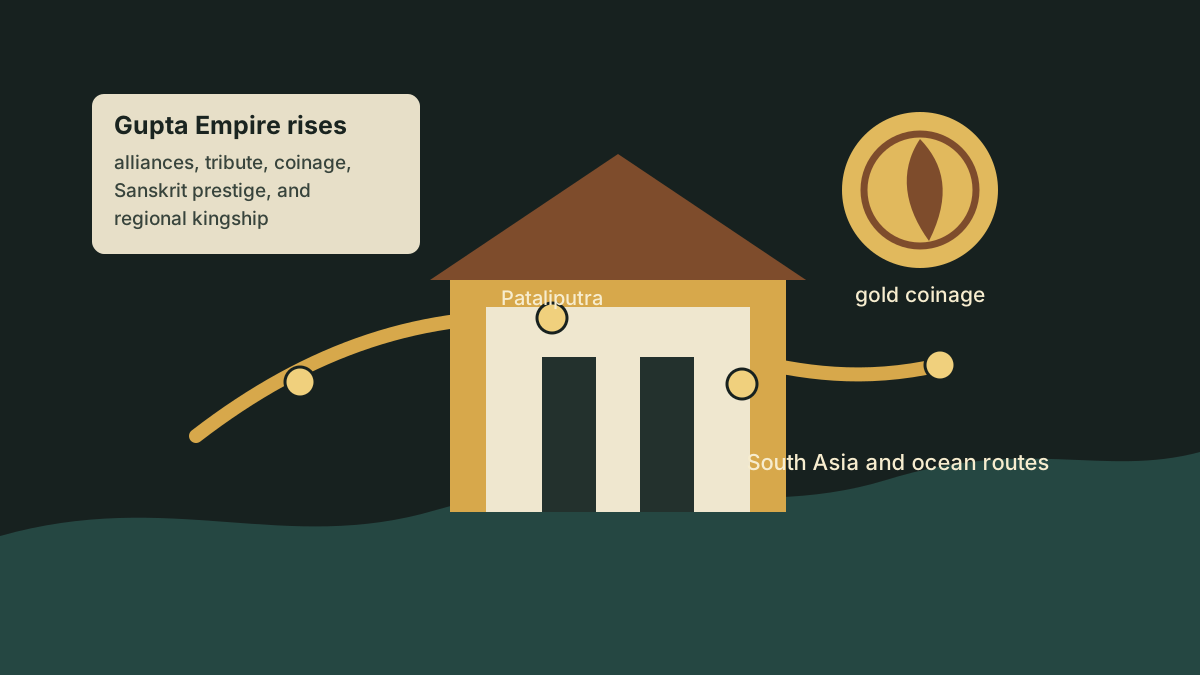
Scholars debate whether the appearance of a durable imperial order was driven mainly by particular choices made by leaders or by deeper structural shifts in economy, religion and social organization. This page deliberately leaves those tensions visible: the rise of the Guptas can be read as both strategic leadership and the product of broader, slowly changing conditions in northern India. The Gupta Empire rose in a South Asian landscape of regional kingdoms, trade routes, marriage alliances, Brahmanical ritual authority, and older imperial memories. Its power did not come only from conquest. Gupta rulers used titles, land grants, coinage, Sanskrit inscriptions, and strategic alliances to make authority legible across different regions.
Pataliputra and the Ganges plain mattered, but the empire's reach depended on negotiated relationships with local elites. This helps explain why Gupta history is a story of cultural and political formation rather than a simple golden-age label.
The Turning Point
Around 320 CE Chandragupta I emerges in the sources as the decisive actor who transformed a powerful family into the core of an expanding polity. He consolidated influence in Magadha—the basin of the Ganges—by combining marriage alliances and military action, and by investing in visible forms of patronage that bound elite groups to his court. Those were not abstract decisions: they were negotiated settlements with local rulers, targeted campaigns to secure trade corridors and symbolic acts—temple endowments, court rituals—that signalled a new centre of authority. The Guptas built administrative routines around the capital, drawing on existing village and urban structures rather than wiping them away.
Court culture mattered as much as force: ceremonies, patronage of learned men and the careful staging of royal power helped convert temporary dominance into perceived legitimacy. Historians still argue over how much of this success was the result of Chandragupta I’s personal capacities and choices, and how much owed to fertile lands, economic flows and longstanding social networks converging at the right historical moment. The rise around 320 becomes decisive when Gupta kingship found a language that connected military power with prestige. Coinage advertised rulers as warriors and patrons; inscriptions placed them inside a moral and cosmic order; alliances extended influence without requiring the same direct control everywhere. The court's use of Sanskrit was not just literary taste.
It was a political medium that could travel across regions and mark elite participation in a shared culture. The turning point was the formation of a durable imperial style.
Consequences
In the decades after the dynasty took shape, the Guptas consolidated a pattern of rule that blended military authority, alliance-making and cultural patronage. Near-term consequences included the stabilization of rule across large tracts of the Ganges basin, the sharpening of court institutions that could coordinate taxation and military levies, and the creation of patronage circuits that tied poets, priests and local elites to the centre. Over the longer term, later generations remembered this period as foundational for classical forms of Sanskrit learning, for models of political authority and for particular patterns of religious patronage. Those memories became templates: later rulers and literati pointed to Gupta precedents when asserting cultural or political claims.
Importantly, not all regions were fully subsumed; local forms of power continued alongside imperial structures. Scholars remain cautious: the Guptas’ legacy is as much a product of later memory-making as of immediate administrative innovations. Yet the combination of alliance, war, patronage and cultivated court life left durable traces in how states were imagined and represented in South Asia. The consequences shaped later South Asian memory. Gupta rule is associated with achievements in literature, mathematics, astronomy, art, temple culture, and political imagination, though historians now avoid treating the period as uniformly prosperous or peaceful. Regional inequality, contested frontiers, and later Huna pressures complicate the picture.
A stronger page lets readers hold both views: Gupta power supported influential cultural production, but it did so through hierarchy, patronage, and negotiation rather than effortless brilliance.
Interpretation Notes
The memory of Gupta Empire Rises often depends on who tells the story. A court, army, religious community, merchant network, or later nation can emphasize different causes and make Magadha stand for different lessons.
Why Keep Reading
Follow the thread from imperial formation to cultural consolidation. Next pages trace how court patronage shaped literary and religious production, how administrative practices spread across regions, and how successive rulers invoked Gupta precedents. If you want to see how ideas of kingship and learning were made tangible—on inscriptions, in temple foundations, or through patterns of land grant and taxation—those sources show the everyday mechanisms by which an emerging empire became a model. Explore timelines and maps to watch the slow expansion of networks and the contested geographies of power that made the Guptas a touchstone for later generations. Follow the Gupta route into Sanskrit culture, South Asian state formation, Buddhism and Brahmanical traditions, and comparisons with Maurya.
The useful question is how political power turns cultural prestige into a governing resource.
Reading Path
Follow the story without losing the thread
Before This
- Edict of Milan313 CE
- Mauryan Empire Foundedc. 322 BCE
- Kingdom of Kush Risesc. 1070 BCE
After This
- Council of Nicaea325 CE
- Constantinople FoundedMay 11, 330 CE
- Fall of the Western Roman Empire, 476 AD: What Happened Next476 CE
Same Period
- Beginning of Muhammad's Revelationsc. 610 CE
- Hijra to Medina622 CE
- Battle of BadrMarch 624 CE
Wider Timeline
Mind Map
How to think about Gupta Empire Rises
Strategic geography
The Ganges heartland provided fertile land and transport corridors that facilitated resource mobilization and networked control.
Map Layer
Where this event sits geographically
Gold pins mark the approximate locations of published event pages. This is a schematic locator map, not a historical border map.
Coordinates are approximate and are used to help readers orient themselves before opening a full event page.
References
Where to Check the Facts
- Encyclopaedia Britannica: Gupta DynastySpecific reference for Gupta chronology, geography, and dynasty formation.
- Encyclopaedia Britannica: India, the Gupta EmpireContext reference for Gupta rule, statecraft, and cultural setting.