Historical Role
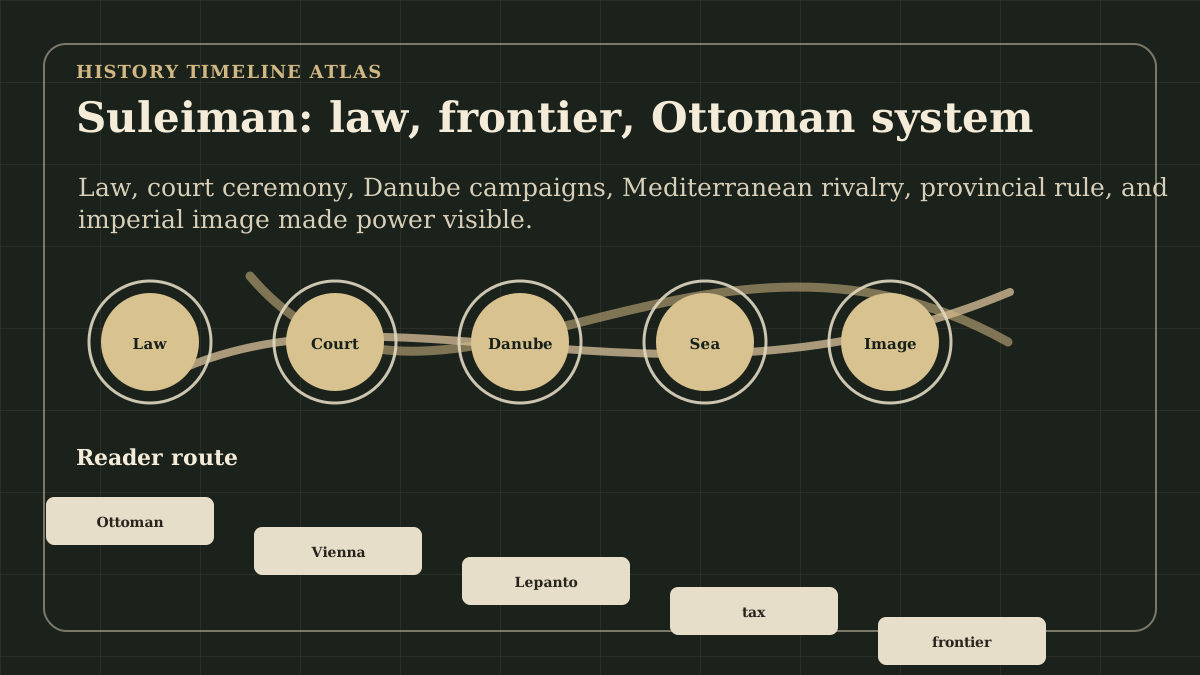
Suleiman the Magnificent is most useful when read as a ruler of imperial systems, not only as a conqueror near Vienna. His reign joined military campaigning, law, court ceremony, architecture, taxation, provincial administration, Mediterranean naval struggle, and Ottoman claims to universal sovereignty. The siege of Vienna gives the page a dramatic point, but the biography becomes richer when the Danube, Balkans, Anatolia, Arab provinces, and Mediterranean routes stay visible.
The nickname Magnificent can flatten the page if it turns rule into spectacle. Suleiman's importance also lies in institutions: legal ordering, scribal administration, relations with religious scholars, provincial governors, military households, fiscal extraction, and court politics. A ruler's image traveled through mosques, laws, campaigns, coins, petitions, and ceremonies as much as through battlefield reputation.
Lepanto and Vienna show limits as well as reach. Ottoman power remained formidable, but Habsburg rivalry, naval coalitions, logistics, weather, fortifications, and regional politics constrained expansion. The biography should help readers ask how empires project confidence while constantly negotiating limits.
The legal title associated with Suleiman matters because it turns magnificence into governance. Law codes, petitions, judges, scholars, tax rules, provincial officials, and court records helped organize imperial life far from ceremonial display. Readers should see why a ruler remembered for splendor was also remembered for ordering rules.
The Mediterranean adds a second stage. Naval rivalry, corsair politics, North African connections, Venetian interests, Habsburg power, and the battle of Lepanto made Ottoman power maritime as well as land-based. Suleiman's reign therefore belongs on a sea map, not only on a Danube frontier map.
The biography should also keep subjects visible. Christians, Muslims, Jews, soldiers, farmers, merchants, enslaved people, provincial elites, and frontier communities experienced Ottoman rule differently. Magnificence from Istanbul could mean protection, taxation, opportunity, coercion, or war depending on where a person stood.
Architecture gives the page another concrete layer. Mosques, complexes, bridges, and urban patronage made authority visible in daily life, not only in court ceremony. Sinan's architectural world helps readers see how imperial image could be built from stone, worship, welfare, and skyline.
The strongest search answer should say why Suleiman is called magnificent and why that label is incomplete. Splendor, conquest, law, and court culture explain the reputation; taxation, war, provincial burden, and frontier limits explain why the reign needs analysis rather than admiration alone.
Succession and palace politics add a final layer. A long reign did not remove uncertainty about heirs, court factions, elite households, and the future direction of the dynasty. Reading Suleiman through family, bureaucracy, and the later problem of continuity keeps the page from treating imperial height as a permanent condition.
Suleiman the Magnificent helps connect individual action with wider historical change in Ottoman Empire. The biography works best when it keeps the surrounding world visible: authority, conflict, belief, reform, or discovery moved through decisions made under pressure.
The related events show how roles such as Ottoman sultan, Lawgiver, Imperial commander can be read through dates, places, institutions, and consequences rather than through reputation alone. The biography explains why this person matters, while the linked events explain what changed around them.
A richer reading starts with the limits around the person. Some figures acted through offices, armies, courts, laboratories, churches, parties, ships, trade networks, or protest movements; others became important because later communities turned their lives into symbols. The page therefore asks what this person could actually change, what was already moving before them, and which consequences later readers attached to the name.
Read the biography against absence as well. Many lives around Suleiman the Magnificent are less visible in the record: opponents, collaborators, family members, workers, soldiers, students, subjects, victims, translators, scribes, or local communities. Keeping those surrounding people in view makes the page less like a name card and more like an entry point into historical systems.
Suleiman the Magnificent also works as a navigation point. Open the linked event pages to see where the biography becomes chronology, then use the topic routes to test whether the same pattern appears beyond one life. That extra step matters because historical importance is rarely contained inside a single decision; it usually spreads through institutions, witnesses, opponents, imitators, and later arguments over memory.
Sources and Method
Source method: read Suleiman through the Vienna and Lepanto route, Ottoman-Safavid and Mediterranean contexts, and biography references that connect campaigns with law, court culture, and administration.
Why This Person Matters
Suleiman the Magnificent matters because the connected events make a larger historical pattern easier to follow. The page links biography to consequences so readers can move from a life story into the wider atlas, compare the person with contemporaries, and understand why later memory kept returning to this figure. Suleiman matters because his reign shows Ottoman imperial power at scale: law, campaign, court, architecture, naval rivalry, administration, and memory all worked together. The page helps readers see empire as a system that looked magnificent from the capital while imposing obligations and limits across many regions. It also gives Ottoman history a route beyond one siege or one title, toward law, sea power, frontier life, provincial society, architecture, and memory.
That makes the biography a practical guide to how early modern empire projected order while negotiating distance and resistance.
What becomes clearer when Suleiman is read through law, administration, and imperial routes as well as through famous sieges?
How to Read This Life
Suleiman the Magnificent is easiest to understand when the biography is read beside Siege of Vienna, Battle of Lepanto. Those events show the historical setting in motion: dates, places, institutions, conflict, and consequences give the life a structure that a short biography alone cannot provide.
The surrounding route crosses Gunpowder Empires, Early Modern World and locations such as Vienna, Gulf of Patras. That matters because influence rarely stays inside one person. It moves through offices, armies, movements, laws, texts, speeches, institutions, and later memory.
A useful reading path starts with the role labels, then opens the event pages to see what changed, and finally compares this person with other actors facing similar pressures.
For readers who arrive on a biography first, this page is meant to become a doorway rather than a stop. Read one paragraph for the answer, then use the turning points, topic routes, and event links to test whether the person's reputation matches the wider evidence.
Read Suleiman beside the Ottoman-Safavid timeline, Vienna, Lepanto, Chaldiran, Zuhab, and modern Middle East routes. That path turns one reign into a map of Ottoman reach and constraint.
Then compare him with Akbar, Abd al-Malik, Louis XIV, and Mehmed II where available. The comparison asks how rulers used law, religion, architecture, warfare, and court culture to make authority visible.
Read Suleiman the Magnificent through the roles of Ottoman sultan, Lawgiver, Imperial commander rather than as reputation alone.
Place the biography inside Ottoman Empire and the wider events linked below.
Ask which choices were personal and which were constrained by institutions or crisis.
Follow how later memory simplified, contested, or reused this person's role.
Track how legal order, petitions, scholars, and administration made rule repeatable.
Use Vienna, the Danube, Mediterranean, and eastern routes to test the limits of power.
Ask how architecture, ceremony, titles, and later memory made the reign look magnificent.
Legacy, Limits, and Memory
A useful biography keeps scale in view. Suleiman the Magnificent mattered because individual choices met a wider structure: institutions, enemies, allies, audiences, technologies, beliefs, and inherited conflicts. The related event pages help separate personal agency from conditions that no single person controlled.
Memory is part of the biography too. Later readers often simplify a figure into a hero, villain, founder, reformer, conqueror, prophet, scientist, or symbol. Those labels can be helpful, but they become misleading when they hide conflict, compromise, exclusion, uncertainty, or the experiences of people outside the main biography.
For the next step, compare this life with a topic route rather than stopping at the name. If the same pattern appears across several figures, the reader has found a historical structure; if this person breaks the pattern, the contrast is usually where the most interesting question begins.
The main risk is treating the reign as a golden-age postcard. A stronger biography keeps taxation, warfare, frontier communities, enslaved and conscripted labor, provincial subjects, and rival powers in the story.
Another risk is viewing Suleiman only through Europe. His reign belongs equally to Ottoman, Islamic, Mediterranean, Balkan, Middle Eastern, and Indian Ocean routes.
Turning Points to Read Next
Siege of Vienna
The Ottoman siege of Vienna tested the empire's ability to project power deep into Central Europe and made the Habsburg-Ottoman frontier a durable strategic zone.
Battle of Lepanto
A Holy League fleet defeated Ottoman naval forces at Lepanto, one of the largest galley battles in Mediterranean history.
Related Timeline
- 1529 CESiege of Vienna
The Ottoman siege of Vienna tested the empire's ability to project power deep into Central Europe and made the Habsburg-Ottoman frontier a durable strategic zone.
- October 7, 1571Battle of Lepanto
A Holy League fleet defeated Ottoman naval forces at Lepanto, one of the largest galley battles in Mediterranean history.
References
Where to Check the Facts
- Encyclopaedia Britannica: Suleiman the MagnificentBiographical reference for Suleiman's reign, law, and imperial campaigns.
- Encyclopaedia Britannica: Ottoman EmpireReference for Ottoman imperial chronology, institutions, reform, war, and decline.
- Encyclopaedia Britannica: TanzimatReference for the nineteenth-century Ottoman reform program and its administrative setting.