At a Glance
The shape of the event
- Date
- June 25, 1950
- Place
- Korean Peninsula
- Type
- War Outbreak
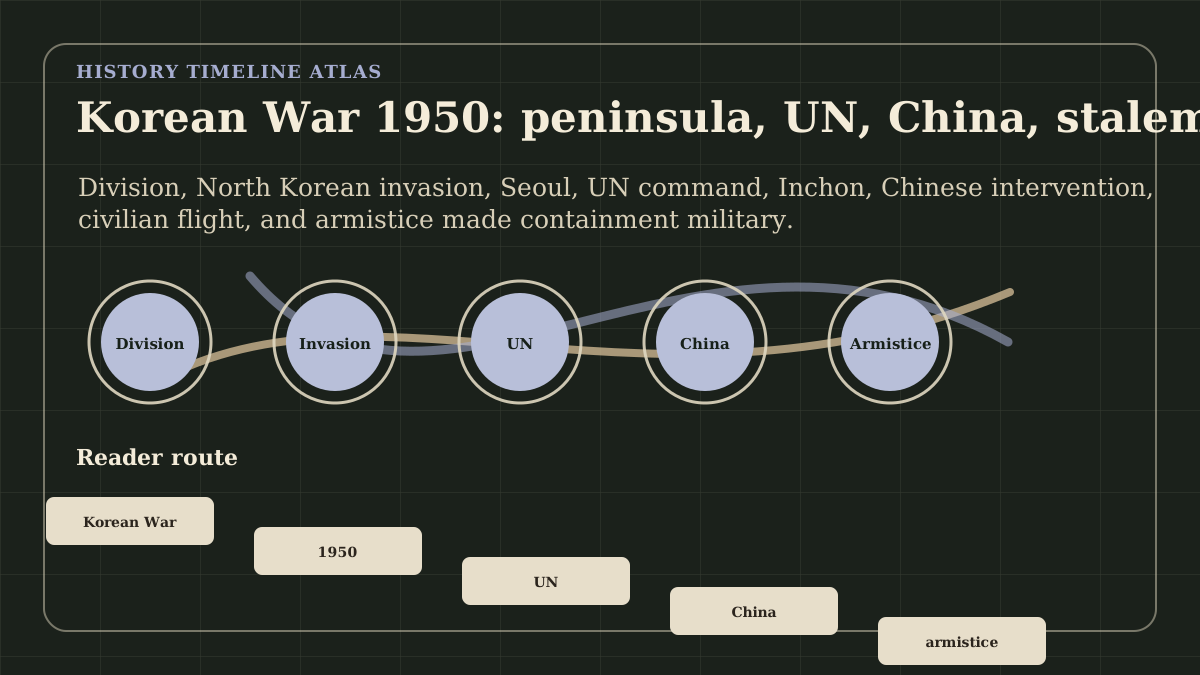
North Korean forces crossed into South Korea, turning a divided peninsula into a major Cold War war involving the United Nations, China, and the United States.
June 25, 1950; place the event in Korean Peninsula before comparing causes or consequences.
The war militarized containment, intensified Cold War alliances in Asia, and left Korea divided after immense destruction.
Kim Il Sung / Harry Truman are the first names or groups to compare before widening the story.
The conflict expanded quickly and eventually settled into a military stalemate around the peninsula's division.
The conflict expanded quickly and eventually settled into a military stalemate around the peninsula's division.
The war militarized containment, intensified Cold War alliances in Asia, and left Korea divided after immense destruction.
Follow the immediate aftermath to see how diplomacy, emergency decisions and battlefield fortunes interacted.
Background
By mid-1950 the Korean Peninsula was already a place of competing claims and international tension. The larger Cold War rivalry between communist and non-communist blocs made Korea a visible fault line: policymakers in capitals from Seoul to Washington and Beijing treated events there as having consequences beyond the peninsula. ‘‘Containment’’—the policy of limiting further spread of communism—had become a guiding strategic idea for Western states, and it shaped how political leaders read any move north or south of the dividing line. At the same time, Korean actors and institutions on the ground carried their own ambitions and fears. Domestic politics, regional balance-of-power concerns and the global rivalry of the United States and the Soviet bloc all pressed on leaders’ choices.
Historians still debate whether the outbreak on June 25 should be read mainly as the product of individual decisions by leaders or as the culmination of deeper structural pressures. This page avoids a single verdict and keeps those tensions visible: structural Cold War forces and immediate choices intersected in ways that made sudden war possible. The beginning of the Korean War should not read as a Cold War map arrow alone. Korea had been liberated from Japanese empire in 1945 but divided into rival zones and then rival states, each claiming legitimacy over the whole peninsula. Families, villages, activists, police, soldiers, refugees, and political prisoners lived inside that division before open war began.
The international layer mattered because local division sat inside global rivalry. Soviet, American, Chinese, United Nations, and regional calculations shaped how leaders interpreted the North Korean attack, but Korean actors were not puppets on an empty board. Both Seoul and Pyongyang had their own state-building projects, security fears, and coercive institutions. A richer page keeps the war's movement visible: the June invasion, Seoul's fall, UN intervention, the Pusan Perimeter, Inchon, the push north, Chinese intervention, brutal reversals, civilian flight, bombing, prisoner issues, and the eventual armistice line. The outbreak only makes sense when readers see how quickly it became more than the first crossing.
The Turning Point
The decisive change on June 25, 1950, was concrete and immediate: North Korean forces crossed into South Korea, turning a drawn boundary into open warfare. That crossing converted a political dispute into kinetic reality—front lines, mass movements of civilians, and urgent calls for reinforcement. Key actors reacted quickly. North Korean leadership, associated with Kim Il Sung among the listed figures, had set forces in motion; those forces’ advance forced rapid responses elsewhere. The United States, led by President Harry Truman, and the United Nations found themselves confronting a question about commitment: should the movement be countered as a regional aggression or be treated as a test of the wider policy of containment?
The answer to that question—decided in capitals and international bodies in the days that followed—expanded the conflict beyond Korea. The crossing did not merely change troop positions; it altered political framing. What might have remained a localized fighting became a proxy battleground in which the UN, the United States and, later, China made strategic and military choices with far-reaching consequences. Those choices converted the initial invasion into a broader Cold War confrontation. The turning point was the crossing of the 38th parallel and the decision by outside powers to treat it as a test of the postwar order. The United Nations and United States moved from condemnation to military intervention, making Korea a major armed case for containment.
Another turning point came later in 1950 when the war expanded after the UN advance north and Chinese intervention. That shift turned hopes of quick reunification or quick defense into a long, destructive stalemate.
Consequences
The immediate consequence was wartime escalation: what began as an incursion prompted international intervention and transformed the peninsula’s insecurity into a larger military struggle. The United Nations and the United States intervened; Chinese forces later entered the contest, and the fighting moved well beyond the initial borders. Within months the war extended into sustained campaigns and shifting front lines. Over the longer term, the war militarized the policy of containment—making military commitment a central instrument of Cold War strategy in Asia—and tightened alliances and security structures across the region. The human and material cost was enormous and deeply disruptive to Korean society; the peninsula was left divided after the combat settled into a military stalemate around the existing division.
Politically, the invasion hardened positions on all sides: governments prioritized military readiness, alliance-building grew more intense, and diplomatic space for reconciliation narrowed. Historians caution that these outcomes were not mechanically determined: the expansion and eventual stalemate flowed from a mix of battlefield dynamics, leadership decisions, and broader ideological confrontations. Debates continue about how much weight to give to individual choices versus structural forces in producing the conflict and its settled division. The immediate consequences were invasion, civilian displacement, rapid military collapse and recovery, and international intervention. The war devastated Korean society long before the armistice froze the front. The longer consequences militarized the Cold War in Asia: U. S.
alliances hardened, Japan's strategic role changed, China and the United States confronted each other directly, and the Korean Peninsula remained divided under heavy militarization.
Interpretation Notes
The hardest question around Korean War Begins is causation. The event had immediate actors, but its meaning also came from institutions, geography, resources, and expectations already present in East Asia.
Why Keep Reading
Follow the immediate aftermath to see how diplomacy, emergency decisions and battlefield fortunes interacted. Read on to trace the UN Security Council debates, the U. S. executive’s crisis deliberations, the arrival of international forces, and how Chinese intervention reshaped strategy. Each of those episodes shows how quickly local violence can escalate into international war—and how subsequent negotiations, ceasefires and political settlements carried forward consequences for a divided Korea and for Cold War policy across East Asia. Understanding the sequence helps explain why the peninsula remained split and why the conflict became a template for later Cold War crises. Read the Korean War beside Chinese Revolution, Cold War containment, Japan's postwar settlement, Vietnam escalation, and the Korean Armistice.
That route shows how Asian decolonization, civil war, and superpower strategy became entangled.
Reading Path
Follow the story without losing the thread
Before This
- NATO FoundedApril 4, 1949
- Berlin Blockade, 1948-1949: Causes, Airlift Timeline, Result1948-1949
- Truman DoctrineMarch 1947
After This
- ANZUS Treaty Signed1951
- Korean ArmisticeJuly 27, 1953
- Battle of Dien Bien Phu1954 CE
Same Period
- Cuban Missile CrisisOctober 1962
- Apollo 11 Moon LandingJuly 20, 1969
- Fall of the Berlin WallNovember 9, 1989
Wider Timeline
Mind Map
How to think about Korean War Begins
Containment
The Cold War strategy of preventing the spread of communism shaped how U.S. and UN policymakers framed the invasion and chose intervention.
Map Layer
Where this event sits geographically
Gold pins mark the approximate locations of published event pages. This is a schematic locator map, not a historical border map.
Coordinates are approximate and are used to help readers orient themselves before opening a full event page.
References
Where to Check the Facts
- U.S. National Archives: The Cold WarArchive reference hub for Cold War records, federal documentation, and research guidance.
- Office of the Historian: The Early Cold War, 1945-1952Official diplomatic history reference for early Cold War foreign-policy context.