At a Glance
The shape of the event
- Date
- 1948-1949
- Place
- Berlin
- Type
- Crisis
The Berlin Blockade, or blockade of Berlin, was a 1948-1949 Cold War crisis. The Soviet Union blocked western land access to West Berlin after currency and occupation disputes, creating a map problem: a western-held city sector inside the Soviet zone. The United States, Britain, and their allies answered with an airlift until the blockade failed in May 1949.
1948-1949; place the event in Berlin before comparing causes or consequences.
The crisis hardened Cold War divisions in Europe and made Berlin a central symbol of the divided continent.
Harry Truman / Joseph Stalin are the first names or groups to compare before widening the story.
The blockade failed to force Western withdrawal, and separate German states soon emerged.
The blockade failed to force Western withdrawal, and separate German states soon emerged.
The crisis hardened Cold War divisions in Europe and made Berlin a central symbol of the divided continent.
Trace what came next to see how this crisis threaded into the wider Cold War story: the choices made in 1948–49 reshaped institutions, alliances and popular perceptions across Europe and set patterns repeated in later...
Background
After 1945 Berlin carried an outsized symbolic and practical weight. The defeated German capital lay inside the Soviet occupation zone but was itself divided among the four victorious powers; over time that division became a fault line. Political leaders and occupation authorities confronted shortages, displaced populations, currency disputes and the mismatch between wartime victory and peacetime administration. Tensions between the Soviet Union and the Western Allies—rooted in different visions for Germany, security fears, and competing economic plans—compressed into local disputes over checkpoints, transit rights and administration. By 1948 these pressures fed a crisis: the Soviet Union moved to block western land access to the sectors controlled by the United States, Britain and France.
That action did not happen in a vacuum. Everyday life in Berlin—access to food, fuel and medical supplies—became tangled with diplomatic signals; a blockage could be read as both a bargaining move and an existential threat. Local commanders, municipal officials and military governments all played roles in the breakdown and the response. Historians continue to debate how much the blockade reflected the immediate choices of leaders such as Joseph Stalin or deeper structural forces—security dilemmas, economic reconstruction and the emerging Cold War alignment. This page keeps those disputes visible instead of treating a single cause as final. The Berlin Blockade is clearest when the city is read as a test of access, credibility, and daily survival.
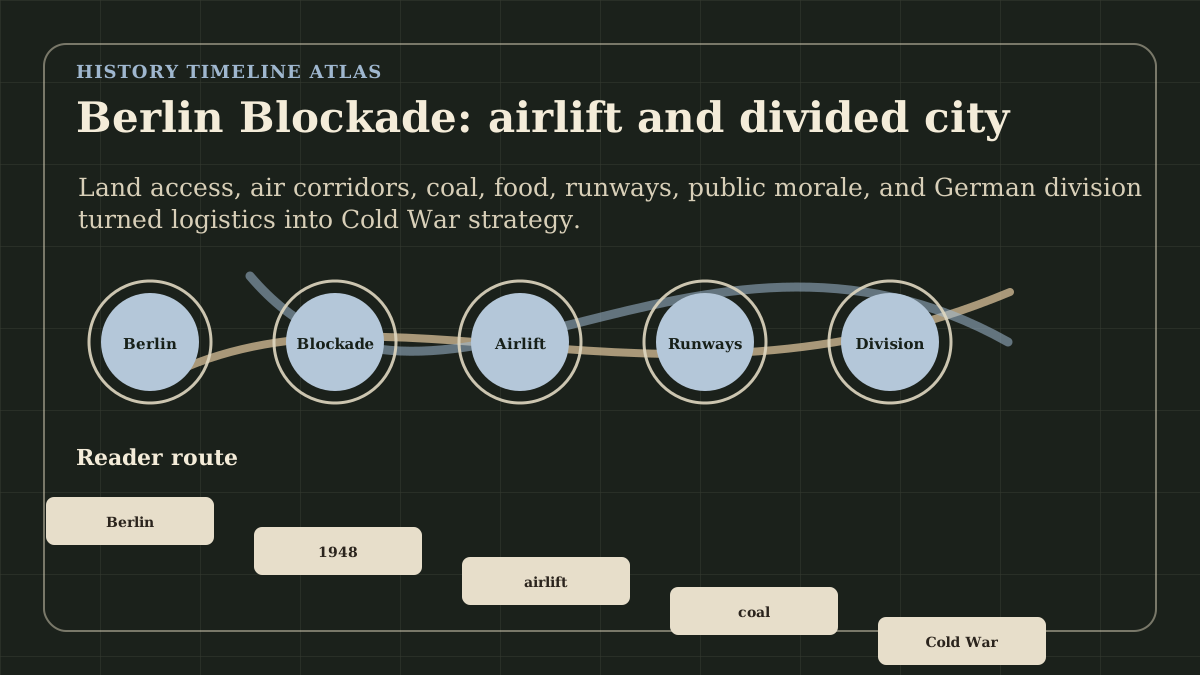
Western Berlin sat deep inside the Soviet zone, so the crisis was not only about streets and checkpoints. It was about rail lines, canals, air corridors, coal, flour, medicine, public morale, and the question of whether the Western Allies would stay when pressure became practical rather than rhetorical. The airlift made logistics visible as politics. Pilots, ground crews, weather officers, mechanics, air traffic controllers, Berlin workers, children, families, and municipal leaders all belonged to the story. Every loaded aircraft was also a message: the city could be supplied without surrendering the political claim that Berlin's western sectors were not negotiable.
The Turning Point
In June 1948 the balance of control shifted from routine friction to open confrontation when the Soviet Union sealed off western land access to the western sectors of Berlin. That blockade turned a local administrative dispute into a test of wills: could Moscow use physical constriction to compel the Western Allies to yield the city or its political aims? The Western response was decisive in its method if cautious in language. Rather than evacuate or immediately storm supply routes, the Western Allies chose to sustain the city by air, organizing an intense and sustained flow of food, coal and other necessities through designated corridors.
Leaders on both sides—most visibly Harry Truman in Washington and Joseph Stalin in Moscow—found themselves constrained by broader strategic calculations even as they weighed immediate options. The air supply transformed the nature of the contest: it raised the stakes of maintaining access without turning Berlin into a battlefield, while also denying the Soviets the political victory they sought. In the end, the blockade did not force Western withdrawal. That outcome did not settle the larger contest, but it changed expectations about what direct pressure on a divided city could accomplish. The turning point was the decision to answer blockade with sustained air supply rather than military confrontation or withdrawal.
That choice avoided immediate war, but it demanded a long demonstration of capacity: tonnage, frequency, safety, runway repair, and public confidence had to hold day after day. Another turning point came when the blockade failed to break Western resolve. The crisis helped make German division more durable and made Berlin a symbol before the Wall existed.
Consequences
The immediate result of the crisis was plain: the blockade failed to force the Western Allies out of Berlin. In practical terms the city's western sectors continued under allied control, and the episode accelerated political developments that led, in short order, to the consolidation of separate German states. Politically and psychologically the blockade hardened lines across Europe. For populations and policymakers alike, Berlin became a concentrated emblem of division—an urban fault line that now carried the meanings of collective resolve, vulnerability and rivalry. The crisis reshaped planning for future confrontations: the methods of pressure, the value of deterrent signaling, and the willingness of outside powers to sustain enclaves by extraordinary means mattered more than before.
Over the longer run, Berlin's centrality in Cold War politics deepened. It attracted attention, resources and repeated crises precisely because it offered a visible test of commitments on both sides. Historians still debate how much of this trajectory flowed from individual decisions—choices by figures like Truman and Stalin—and how much from structural factors such as geopolitical rivalry, economic reconstruction and mutual suspicion. This account keeps those debates visible: the blockade changed outcomes, but it also exposed the limits of single explanations. The blockade's consequence was a harder European Cold War. It strengthened the case for western coordination, helped accelerate the emergence of separate German states, and turned NATO-style security thinking from possibility into political urgency.
For Berliners, the memory was also local. The crisis connected hunger, cold, children watching aircraft, workers unloading cargo, and the strange geography of a divided city supplied through the sky. May 12 1949 ended the blockade, but not the wider struggle over Berlin.
Interpretation Notes
Berlin Blockade raises a debate about scale: did the decisive change come from the visible crisis, or from older pressures around Cold War and Germany that had already narrowed what people could do?
Why Keep Reading
Trace what came next to see how this crisis threaded into the wider Cold War story: the choices made in 1948–49 reshaped institutions, alliances and popular perceptions across Europe and set patterns repeated in later stand-offs over Berlin. Readers who follow the timeline will see how a single city's condition influenced policy debates in capitals, how administrative measures hardened into political borders, and how symbolic contests produced material consequences. If you want to understand why Berlin became shorthand for the Cold War, or how local hardship became an international decision point, proceed to the sequence of events, profiles of the main actors, and comparative episodes that illuminate both immediate reactions and long-term shifts.
Read the blockade after the Marshall Plan and before NATO, the Berlin Wall, and the fall of the Wall. That route shows how economic recovery, city access, military alliance, border control, and public memory became one Cold War sequence.
Reading Path
Follow the story without losing the thread
Before This
- Marshall Plan AnnouncedJune 1947
- Truman DoctrineMarch 1947
- Iron Curtain SpeechMarch 5, 1946
After This
- NATO FoundedApril 4, 1949
- Korean War BeginsJune 25, 1950
- ANZUS Treaty Signed1951
Same Period
- Cuban Missile CrisisOctober 1962
- Apollo 11 Moon LandingJuly 20, 1969
- Fall of the Berlin WallNovember 9, 1989
Wider Timeline
Mind Map
How to think about Berlin Blockade, 1948-1949: Causes, Airlift Timeline, Result
Soviet blockade
A deliberate closure of western land access to Berlin aimed at coercing political concessions
Map Layer
Where this event sits geographically
Gold pins mark the approximate locations of published event pages. This is a schematic locator map, not a historical border map.
Coordinates are approximate and are used to help readers orient themselves before opening a full event page.
References
Where to Check the Facts
- Encyclopaedia Britannica: Berlin blockadeReference for the blockade, airlift, West Berlin, Soviet pressure, and 1948-1949 chronology.
- Truman Library: Berlin AirliftArchive collection reference for the Berlin Airlift, U.S. policy, and public documents.
- Office of the Historian: FRUS 1948 Berlin Blockade documentPrimary diplomatic document reference for the 1948 Berlin crisis and Allied policy discussions.
- Office of the Historian: The Berlin Crisis, 1958-1961Official diplomatic-history context for Berlin's continuing Cold War crisis after the 1948 blockade.
- U.S. National Archives: The Cold WarArchive reference hub for Cold War records, federal documentation, and research guidance.
- Office of the Historian: The Early Cold War, 1945-1952Official diplomatic history reference for early Cold War foreign-policy context.