Historical Role
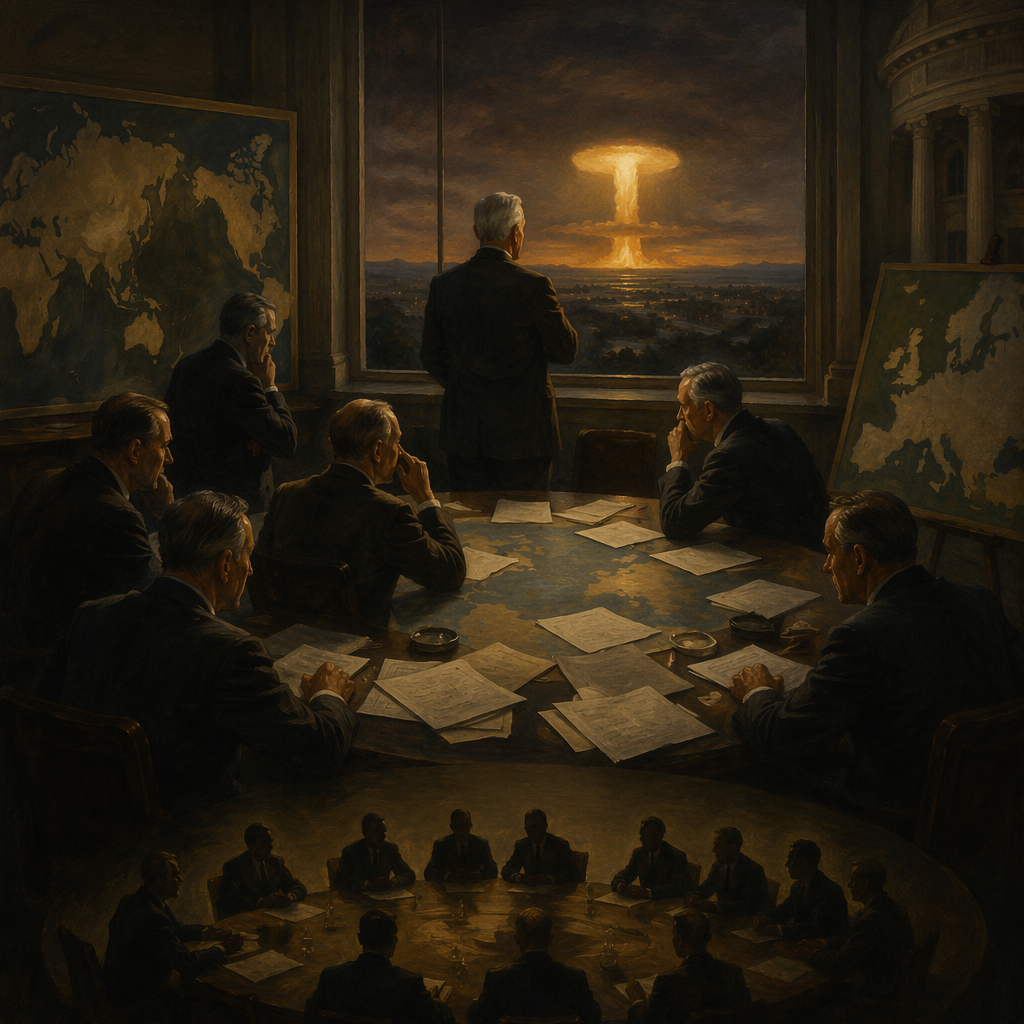
Harry Truman is best read as a president of transition: he inherited the last stage of World War II and then governed through the first architecture of the Cold War. Hiroshima, the Truman Doctrine, Marshall Plan context, NATO, containment, recognition of Israel, civil-rights pressure, labor conflict, and the Korean War all belong to the same problem of postwar statecraft.
The atomic bombing of Hiroshima gives the page moral and strategic weight. Truman did not create the Manhattan Project, but he made decisions inside a wartime system shaped by Japan's resistance, Allied casualties, Soviet entry, military advice, racialized war memory, domestic politics, and the desire to end the war. A strong biography explains decision-making without turning mass civilian death into an abstract policy lever.
The early Cold War frame keeps Truman from looking like a lone architect. Containment emerged through advisers, Congress, European reconstruction needs, Soviet actions, Greek and Turkish crises, military planning, public speeches, and institutional design. Truman mattered because he gave presidential authority to choices that became durable policy habits.
The domestic layer belongs inside the same biography. Demobilization, strikes, inflation, housing pressure, the Fair Deal, civil-rights orders, and party conflict show how victory abroad did not produce easy peace at home. Truman's 1948 desegregation order for the armed forces also reveals a postwar contradiction: the United States claimed democratic leadership while racial segregation still shaped law, work, military life, and political power.
Korea extends the page beyond 1945. The Korean War tested containment as a military commitment, drew the United Nations into armed action, intensified U.S.-Chinese confrontation, and made limited war a central Cold War problem. Truman's firing of Douglas MacArthur belongs in that frame because civilian control, nuclear risk, public opinion, and alliance strategy all collided over how far war aims should go.
For readers, Truman is compelling because he sits where decisions become systems. Atomic weapons, security councils, aid programs, alliances, loyalty investigations, civil-rights pressures, and limited war all became recurring features of the postwar world. The biography therefore asks not only what Truman decided, but how those decisions taught later governments to imagine danger, leadership, and acceptable cost.
Harry Truman helps connect individual action with wider historical change in United States. The biography works best when it keeps the surrounding world visible: authority, conflict, belief, reform, or discovery moved through decisions made under pressure.
The related events show how roles such as U.S. president can be read through dates, places, institutions, and consequences rather than through reputation alone. The biography explains why this person matters, while the linked events explain what changed around them.
A richer reading starts with the limits around the person. Some figures acted through offices, armies, courts, laboratories, churches, parties, ships, trade networks, or protest movements; others became important because later communities turned their lives into symbols. The page therefore asks what this person could actually change, what was already moving before them, and which consequences later readers attached to the name.
Read the biography against absence as well. Many lives around Harry Truman are less visible in the record: opponents, collaborators, family members, workers, soldiers, students, subjects, victims, translators, scribes, or local communities. Keeping those surrounding people in view makes the page less like a name card and more like an entry point into historical systems.
Harry Truman also works as a navigation point. Open the linked event pages to see where the biography becomes chronology, then use the topic routes to test whether the same pattern appears beyond one life. That extra step matters because historical importance is rarely contained inside a single decision; it usually spreads through institutions, witnesses, opponents, imitators, and later arguments over memory.
Sources and Method
Source method: read Truman through Hiroshima, the Truman Doctrine, NATO, and postwar-order routes. The page separates personal decision from the institutions and advisers that made policy durable.
Evidence Notes
How Sensitive Claims Are Sourced
- 1
Nuclear decision and civilian catastrophe
The biography keeps Hiroshima visible as human destruction and strategic decision, not only as an ending to World War II.
- 2
Containment becomes institutional
The Truman Doctrine and NATO show how crisis language, aid, alliances, and military planning became a durable Cold War framework.
Why This Person Matters
Harry Truman matters because the connected events make a larger historical pattern easier to follow. The page links biography to consequences so readers can move from a life story into the wider atlas, compare the person with contemporaries, and understand why later memory kept returning to this figure. Harry Truman matters because his presidency links the end of total war to the start of the nuclear and Cold War order. The biography helps readers connect decision, institution, alliance, ideology, reconstruction, and moral consequence without pretending one president controlled the whole postwar world.
How did Truman's decisions help turn victory in 1945 into a nuclear, alliance-based Cold War order, and what human costs sit inside that transition?
How to Read This Life
Harry Truman is easiest to understand when the biography is read beside Atomic Bombing of Hiroshima, Truman Doctrine, NATO Founded. Those events show the historical setting in motion: dates, places, institutions, conflict, and consequences give the life a structure that a short biography alone cannot provide.
The surrounding route crosses Twentieth Century, Cold War and locations such as Hiroshima, Washington, D.C.. That matters because influence rarely stays inside one person. It moves through offices, armies, movements, laws, texts, speeches, institutions, and later memory.
A useful reading path starts with the role labels, then opens the event pages to see what changed, and finally compares this person with other actors facing similar pressures.
For readers who arrive on a biography first, this page is meant to become a doorway rather than a stop. Read one paragraph for the answer, then use the turning points, topic routes, and event links to test whether the person's reputation matches the wider evidence.
Read Truman beside Hiroshima, 1945, Truman Doctrine, NATO, Cold War, and postwar institutions. That route turns a presidency into a map of nuclear age, alliance politics, and containment.
Then compare him with Roosevelt, Stalin, Churchill, Kennedy, and Gorbachev. The comparison asks how presidents and party-state leaders used institutions to make crisis decisions last beyond one term.
Read Harry Truman through the roles of U.S. president rather than as reputation alone.
Place the biography inside United States and the wider events linked below.
Ask which choices were personal and which were constrained by institutions or crisis.
Follow how later memory simplified, contested, or reused this person's role.
Ask which choices were Truman's and which were shaped by institutions, advisers, military plans, and inherited war aims.
Read Hiroshima through human destruction, strategy, memory, and later fear.
Track how speeches, aid, alliances, and military commitments turned crisis response into doctrine.
Legacy, Limits, and Memory
A useful biography keeps scale in view. Harry Truman mattered because individual choices met a wider structure: institutions, enemies, allies, audiences, technologies, beliefs, and inherited conflicts. The related event pages help separate personal agency from conditions that no single person controlled.
Memory is part of the biography too. Later readers often simplify a figure into a hero, villain, founder, reformer, conqueror, prophet, scientist, or symbol. Those labels can be helpful, but they become misleading when they hide conflict, compromise, exclusion, uncertainty, or the experiences of people outside the main biography.
For the next step, compare this life with a topic route rather than stopping at the name. If the same pattern appears across several figures, the reader has found a historical structure; if this person breaks the pattern, the contrast is usually where the most interesting question begins.
The main risk is a decisive-man shortcut. Truman made consequential choices, but those choices moved through military institutions, advisers, Congress, allies, enemies, and public narratives.
A second risk is treating nuclear bombing as clean strategic arithmetic. The page must keep civilian suffering, Japanese and Korean memory, and later nuclear fear in view.
Turning Points to Read Next
Atomic Bombing of Hiroshima
The United States dropped an atomic bomb on Hiroshima, causing massive civilian destruction and introducing nuclear weapons into war.
Truman Doctrine
President Harry Truman asked Congress to support Greece and Turkey, framing American policy around containing communist expansion.
NATO Founded
The North Atlantic Treaty Organization was founded as a collective security alliance linking the United States, Canada, and western European states.
Related Timeline
- August 6, 1945Atomic Bombing of Hiroshima
The United States dropped an atomic bomb on Hiroshima, causing massive civilian destruction and introducing nuclear weapons into war.
- March 1947Truman Doctrine
President Harry Truman asked Congress to support Greece and Turkey, framing American policy around containing communist expansion.
- April 4, 1949NATO Founded
The North Atlantic Treaty Organization was founded as a collective security alliance linking the United States, Canada, and western European states.
References
Where to Check the Facts
- Encyclopaedia Britannica: Harry S. TrumanBiographical reference for Harry S. Truman's life dates, roles, institutions, and historical setting.
- Encyclopaedia BritannicaBackground reference for chronology, names, and historical context.
- WikidataStructured reference for dates, places, alternate names, and entity links.