At a Glance
The shape of the event
- Date
- 480 BCE
- Place
- Thermopylae
- Type
- Battle
A small Greek force led by Sparta delayed the Persian army at Thermopylae during the second Persian invasion of Greece.
480 BCE; place the event in Thermopylae before comparing causes or consequences.
Thermopylae became central to later stories about Greek identity, military courage, and the politics of commemoration.
Leonidas I / Xerxes I are the first names or groups to compare before widening the story.
Persia won the pass, but the defense became a powerful memory of sacrifice and resistance.
Persia won the pass, but the defense became a powerful memory of sacrifice and resistance.
Thermopylae became central to later stories about Greek identity, military courage, and the politics of commemoration.
Follow Thermopylae to Marathon, Salamis, the Persian Wars, Athens, Sparta, and later Greek memory.
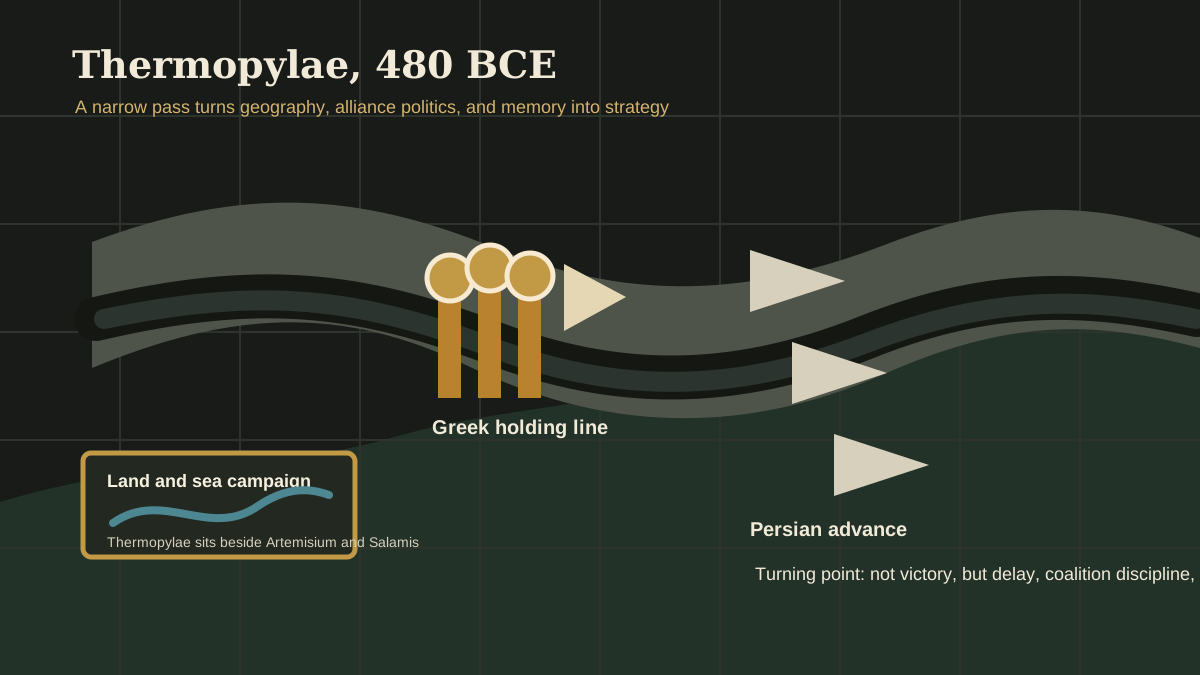
Background
By 480 BCE the second Persian invasion of Greece had become a test of wills between a continental empire and a network of independent city-states. Persia under Xerxes I projected overwhelming manpower and resources across the Aegean; Greek polities faced the prospect of invasion, siege, and political subordination. Sparta, among the Greeks, brought a distinct martial culture and a reputation for disciplined hoplite warfare, but Sparta's power rested on institutions and alliances rather than sheer numbers. The narrow coastal defile at Thermopylae—where sea pressed close to steep hills—offered a rare geographical chokepoint where a small, well-ordered infantry force could blunt a larger army's advantage.
Greek strategy in 480 BCE was not uniform: Athens and Sparta, as leading actors, disagreed on tactics and priorities, and allied contingents varied in training and loyalty. Contemporary decisions combined immediate military calculation, ritual obligations, and wider political choices about where to defend and when to cede ground. Historians continue to debate how much weight to give to individual leaders' choices versus broader structural factors—logistics, naval power, and alliance politics—but the physical geography and the political stakes made Thermopylae an attractively promising place to attempt a delay. Thermopylae is often remembered through heroic sacrifice, but the battle belongs inside a larger Greek-Persian war strategy. The pass mattered because terrain could narrow the advantage of Xerxes' larger army.
Leonidas and the Spartans became the best-known figures, yet the Greek force included allies from several communities, and the battle worked alongside naval action at Artemisium. Readers need both the legend and the logistics: geography, timing, alliance politics, Persian supply lines, and the hard choice to delay rather than win outright.
The Turning Point
Thermopylae's turning point came not from a single dramatic flourish but from a sequence of deliberate choices under pressure. Leonidas I accepted command of a small Greek force and chose the narrow pass as the place to meet Xerxes' advance—a deliberate exploitation of terrain that reduced the advantage of numerical superiority. For Xerxes I, the crossing of the Aegean and the mounting logistical effort demanded a decisive breakthrough; pushing through the pass was a political and strategic imperative to reach central Greece. In the days of combat, Greek formations used close-order hoplite fighting in constrained terrain, delaying Persian columns and buying time for Greek city-states to mobilize and reposition.
That delay shifted immediate calculations: Athens and other states could prepare naval and land responses with the knowledge that Persia was not advancing unopposed. When Persian forces eventually gained control of the pass the tactical stand ended, but the interaction of leaders' choices, soldiers' discipline and landscape transformed Thermopylae into a defining episode of the campaign. The turning point came when the Persian army found a route around the pass. Once the Greek position was outflanked, the defense could no longer hold in its original form. The last stand became memorable because it converted tactical defeat into political meaning. The Greeks lost the pass, but the delay and the story of resistance helped shape morale and later memory.
Persian victory at Thermopylae did not end the war; it moved the conflict toward Salamis and Plataea. The famous final stand needs coalition and source context. Spartan leadership mattered, but the defense was not only a Spartan story: allied Greek contingents held the pass, a final rear guard included Spartans, Thespians, and Thebans, and the reported mountain route associated with Ephialtes changed the tactical situation. The land battle also belonged to a wider campaign that included Artemisium and later Salamis, so its meaning comes from delay, coordination, and memory rather than a simple heroic last stand.
Consequences
Immediate consequences of the battle were straightforward: Persia secured the pass and continued its campaign into Greece. That tactical victory did not translate into an unchallenged conquest. The time bought by the defenders allowed other Greek forces, especially naval contingents, to adopt measures that would shape subsequent engagements across the region. Politically, the stand at Thermopylae complicated calculations in Greek councils: it became a rallying point for resistance even as some cities weighed accommodation. Over the longer term, Thermopylae acquired a cultural life that outstripped its military scale. Stories of Spartan discipline and sacrificial leadership around Leonidas fed later narratives about Greek identity, valor, and civic obligation.
Equally, the memory of the battle has been used in diverse—and sometimes conflicting—political contexts to justify different ideals, from communal sacrifice to exclusionary nationalism. Historians therefore treat Thermopylae both as a tactical episode within the Persian Wars and as a site where memory and politics intertwined. Archaeology and literary sources continue to be read against one another, so conclusions remain provisional. The battle's consequences are inseparable from its afterlife. Militarily, it delayed but did not stop the Persian advance. Culturally, it became one of the most durable examples of disciplined resistance against overwhelming force.
That memory can distort as well as illuminate: it can flatten allied participation, ignore Persian perspectives, or turn complex strategy into a simple tale of East versus West. A richer reading keeps the pass, the alliance, the naval campaign, and the later myth together.
Interpretation Notes
Thermopylae is often remembered through Spartan heroism, but the evidence needs a wider lens: allied Greek contingents, the final rear guard, Persian strategy, the reported Ephialtes route, and the naval context around Artemisium and Salamis all shape what the battle meant.
Why Keep Reading
Follow Thermopylae to Marathon, Salamis, the Persian Wars, Athens, Sparta, and later Greek memory. The next pages help separate the battle's tactical result from its afterlife: a defeat could still shape coalition morale, strategic timing, and the stories later communities told about freedom and sacrifice.
Reading Path
Follow the story without losing the thread
Before This
After This
- Peloponnesian War Begins431 BCE
- Battle of Gaugamela331 BCE
- Mauryan Empire Foundedc. 322 BCE
Same Period
Wider Timeline
Mind Map
How to think about Battle of Thermopylae
Geography
The narrow coastal defile limited how many troops could fight abreast, helping a small force resist a larger one.
Map Layer
Where this event sits geographically
Gold pins mark the approximate locations of published event pages. This is a schematic locator map, not a historical border map.
Coordinates are approximate and are used to help readers orient themselves before opening a full event page.
References
Where to Check the Facts
- Encyclopaedia Britannica: Battle of ThermopylaeSpecific reference for the 480 BCE battle, Greek defense, Persian advance, and later memory.
- World History Encyclopedia: ThermopylaeNarrative reference for the pass, forces involved, and cultural memory of the battle.