At a Glance
The shape of the event
- Date
- 508 BCE
- Place
- Athens
- Type
- Political Reform
Cleisthenes reorganized Athenian political participation around new tribes and demes, helping create the institutional foundations of Athenian democracy.
508 BCE; place the event in Athens before comparing causes or consequences.
The reforms gave Athens a durable political vocabulary for citizen participation, public debate, and later democratic memory.
Cleisthenes are the first names or groups to compare before widening the story.
Citizenship and local affiliation became more important than older aristocratic clan structures.
Citizenship and local affiliation became more important than older aristocratic clan structures.
The reforms gave Athens a durable political vocabulary for citizen participation, public debate, and later democratic memory.
Follow this thread to see how institutional language and local organization translated into practice: how assemblies used those new categories, how office-holding changed the texture of public debate, and how later At...
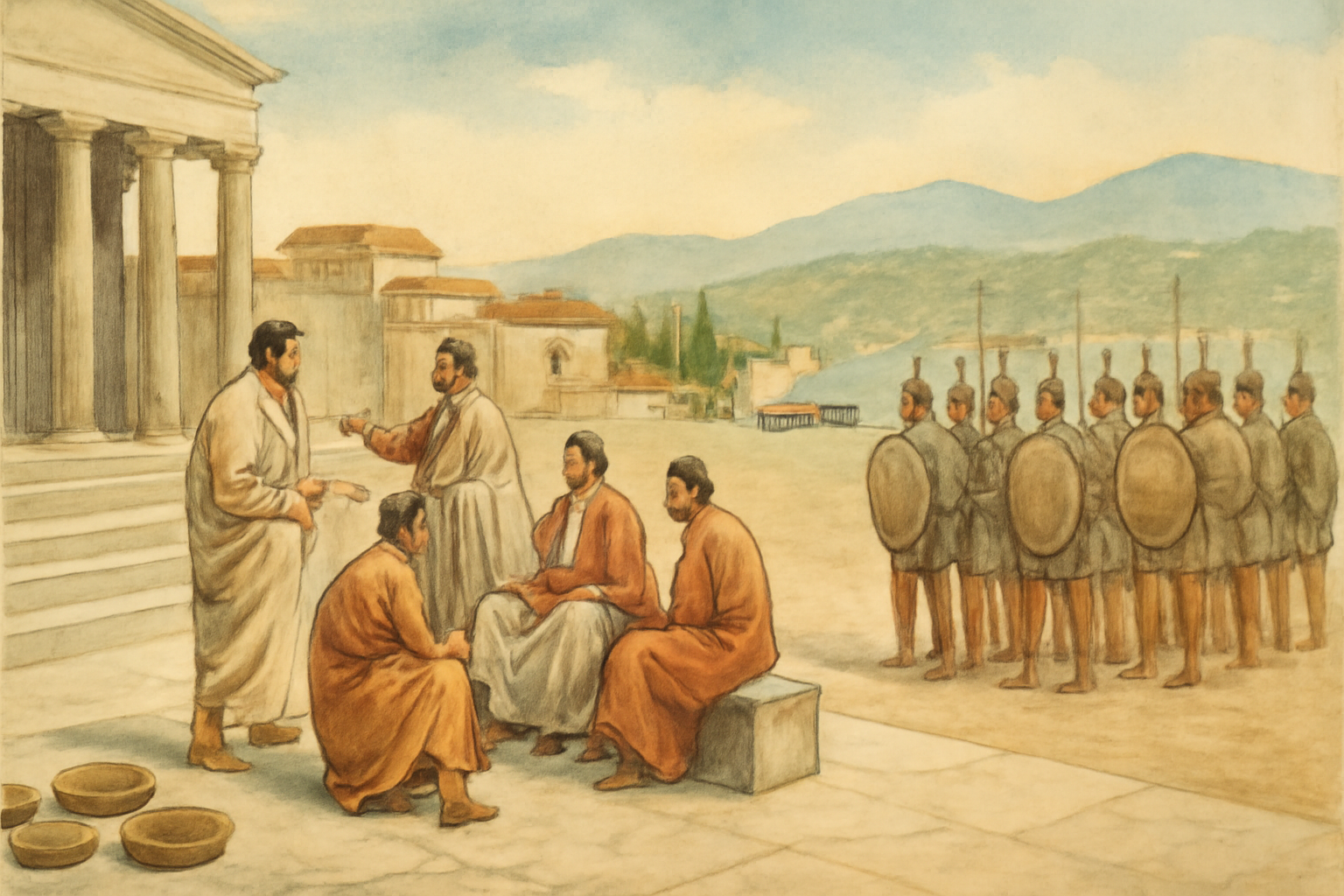
Background
Late-archaic Athens stood at a crossroads of competing pressures: rival aristocratic families long claimed political privilege through lineage and patronage; growing populations and economic change placed new strains on existing forms of representation; and the wider landscape of Greek city-states offered both models and warnings about concentration of power. Into that mix stepped a political actor working within established institutions and turbulent public expectations. The traditional clan-based loyalties that organized social and political life had long anchored authority, but they also excluded many residents from meaningful participation. Debates over who counted as a citizen, how offices should be filled, and how local communities related to the city as a whole intensified. These pressures do not yield a single cause.
Scholars continue to disagree about how much the reforms reflect Cleisthenes’ personal choices versus deeper social, economic, and military trends. This page keeps those tensions visible: the reforms are best seen as decisive steps taken within a context of broader uncertainties about belonging, representation, and public voice. Cleisthenes' reforms came after aristocratic rivalry, tyranny, Spartan intervention, and Athenian political instability. The problem was not democracy in the abstract but how to prevent a few families from monopolizing power. By reorganizing tribes, demes, and council structures, the reforms changed how citizens were grouped and how local identity entered central politics. Institutions made participation more durable than a single leader's promise.
The Turning Point
What changed in 508 BCE was not only a catalogue of administrative alterations but a shift in the grammar of political life. Cleisthenes reorganized Athenian political participation around new tribes and demes—units that tied citizens to place and collective duty rather than to inherited clan status. By redirecting the framework through which people were counted and represented, the reforms rerouted political ambition and civic obligation into new channels. Concrete choices mattered: the creation and recognition of local demes made local affiliation a practical basis for service and deliberation; the reconfiguration of tribes redistributed representation across the city and its countryside.
These were institutional moves that reshaped everyday political behavior — who voted together, who could be selected for office, and how arguments in the assembly were grounded in communal standing. At the same time, the moment was interpretively contested: some view Cleisthenes as an architect of innovation, others as someone responding to pressures already present in Athenian life. Either way, 508 BCE marked a turning point in which formal structures began to do the work of organizing civic identity and political claim-making. The decisive change was the remapping of citizenship. Instead of allowing old kinship and regional blocs to dominate political organization, the reforms mixed communities into new tribes and gave demes a stronger administrative role.
The Council of Five Hundred created a broader mechanism for agenda-setting. These changes did not create modern equality, and they excluded women, enslaved people, and foreigners, but they altered the political field for male citizens.
Consequences
The near-term consequence of the reforms was a reordering of political loyalties: citizenship and local affiliation gained formal importance over older aristocratic clan structures. That change altered patterns of recruitment to office, the composition of political coalitions, and the channels through which grievances and ambitions were expressed. In the longer term, the reforms helped generate durable institutions and a vocabulary for public participation — categories and procedures that supported collective decision-making, repeated public debate, and civic memory. Athens did not become a democracy overnight, nor were later developments inevitable, but the reorientation made it feasible for large numbers of citizens to imagine themselves as political actors with recognizable rights and responsibilities.
Interpretations differ about the extent to which these outcomes were the product of deliberate design versus structural momentum; historians continue to weigh individual agency against social and economic currents. What is clearer is that the institutional scaffolding established in 508 BCE persisted as a reference point in Athenian political life and later historical accounts, shaping how Athenians debated the meaning and limits of citizen rule. The consequences shaped Athenian democracy and Greek political memory. The reforms made later mass participation, ostracism, assembly politics, and civic identity more workable. They also remind readers that democracy was built through administrative design, not only ideals.
Athenian politics remained unequal and conflict-ridden, yet the institutional experiment became one of the ancient world's most influential models. That practical machinery matters because political ideas survive when procedures, districts, offices, calendars, and habits give them a repeatable form.
Interpretation Notes
Cleisthenes Reforms Athens can look simple when reduced to one date, but the evidence usually points to a wider setting. The useful debate is which part mattered most: leadership, logistics, belief, social pressure, or the institutions that survived afterward.
Why Keep Reading
Follow this thread to see how institutional language and local organization translated into practice: how assemblies used those new categories, how office-holding changed the texture of public debate, and how later Athenians remembered and contested their origins. Exploring related events and timelines will illuminate the messy process by which reforms became routine — and how disputes about inclusion, competence, and authority continued to define the city. If you want to understand the live questions that democracy raised for contemporaries, and why those questions still matter, the next pages trace the institutional choices, civic rituals, and contested memories that grew out of Cleisthenes’ reordering. Read next into Marathon, Pericles, Athenian empire, slavery in Athens, and comparisons with Sparta.
Cleisthenes shows democracy as an engineered system of belonging and exclusion. It also prepares the reader to notice the limits of participation, because every institution defined both who entered politics and who remained outside. The mechanism mattered as much as the ideal.
Reading Path
Follow the story without losing the thread
Before This
- Cyrus Conquers Babylon539 BCE
- Achaemenid Empire Foundedc. 550 BCE
After This
Same Period
Wider Timeline
Mind Map
How to think about Cleisthenes Reforms Athens
Tribal reorganization
Recasting political units around new tribes redistributed representation across city and countryside.
Map Layer
Where this event sits geographically
Gold pins mark the approximate locations of published event pages. This is a schematic locator map, not a historical border map.
Coordinates are approximate and are used to help readers orient themselves before opening a full event page.
References
Where to Check the Facts
- Encyclopaedia Britannica: The Reforms of CleisthenesSpecific reference for the 508 BCE Athenian reforms and tribal reorganization.
- Encyclopaedia Britannica: Cleisthenes of AthensBiographical reference for Cleisthenes and his role in Athenian democracy.