At a Glance
The shape of the event
- Date
- 539 BCE
- Place
- Babylon
- Type
- Conquest
Cyrus the Great captured Babylon, absorbing the Neo-Babylonian kingdom into the expanding Achaemenid Empire.
539 BCE; place the event in Babylon before comparing causes or consequences.
The conquest strengthened Persian claims to legitimate kingship across older Near Eastern centers of power.
Cyrus the Great / Nabonidus are the first names or groups to compare before widening the story.
Babylon became part of Persian imperial administration while retaining major symbolic and urban importance.
Babylon became part of Persian imperial administration while retaining major symbolic and urban importance.
The conquest strengthened Persian claims to legitimate kingship across older Near Eastern centers of power.
Follow the story next to see how imperial rule adapted to local traditions and how claims to legitimacy were constructed across conquered cities.
Background
By 539 BCE the Achaemenid Persian realm had been expanding for several decades, bringing together diverse lands and traditions under a single royal house. Babylon, already an ancient urban and religious center, represented a particular kind of prize: not only fertile territory and a large population, but also symbolic authority rooted in older Near Eastern political culture. Nabonidus was the reigning king of the Neo-Babylonian kingdom at the moment Cyrus advanced. For Persians, taking Babylon meant more than the addition of land; it offered a way to claim continuity with earlier rulers and to project legitimacy across cities that had long been seats of divine kingship and civic identity.
Historians debate how much the conquest was driven by immediate decisions—choices made by Cyrus, by Nabonidus and by elites inside Babylon—and how much it reflected deeper structural forces such as the administrative momentum of an expanding empire and longstanding rivalries in Mesopotamia. This page keeps that dispute visible: the capture of Babylon can be read as both the result of decisive leadership and an outcome shaped by longer political and institutional trends. Cyrus's conquest of Babylon was a military event, but its historical power lies in how it was narrated. Babylon was one of the great cities of the ancient Near East, with temples, priestly authority, scribal traditions, and imperial memory.
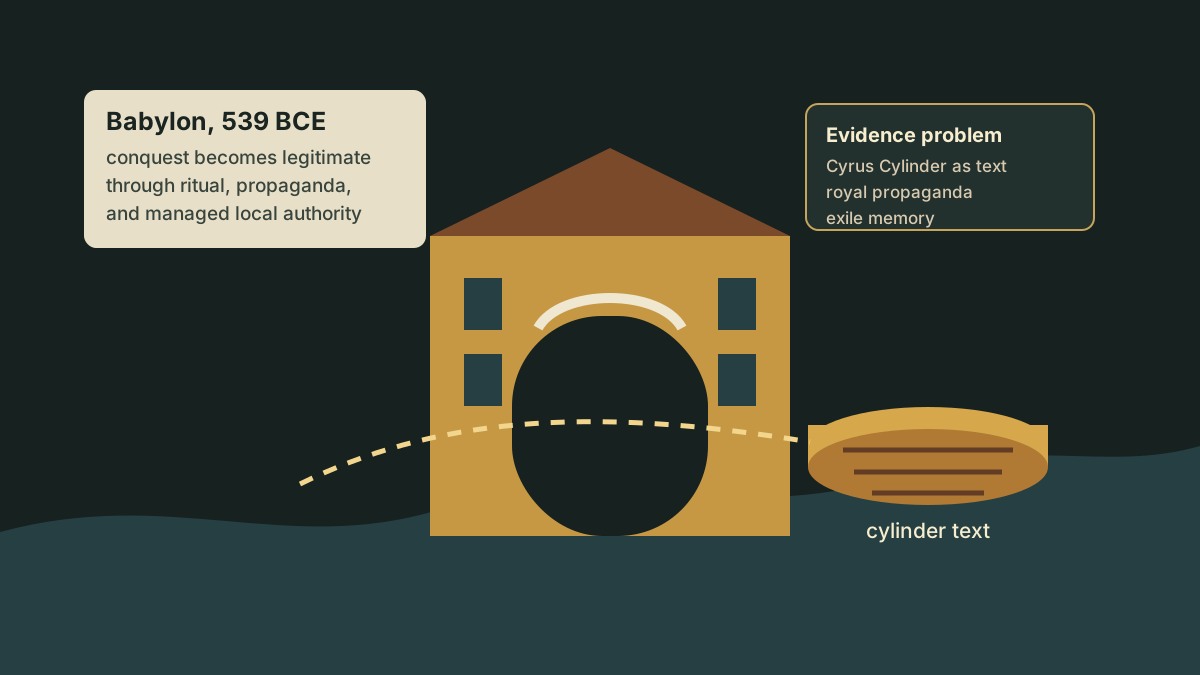
Cyrus entered that world by presenting himself not merely as conqueror but as restorer of order. Babylonian texts, the Cyrus Cylinder, biblical memory, and later Greek accounts all frame the event differently. A good reading keeps those voices separate instead of flattening them into one story of tolerance or conquest.
The Turning Point
What changed in 539 BCE was a practical and symbolic transfer of authority. Cyrus the Great succeeded in capturing Babylon and thereby absorbed the Neo-Babylonian kingdom into the Achaemenid imperial framework. That action transformed the political map: the city and its surrounding territories ceased to be an independent kingdom and became part of a larger imperial administration. At the level of concrete actors, Cyrus’s campaign placed Persian power at the center of Mesopotamian politics; Nabonidus, as the displaced king, ceased to be the focal point of the region’s sovereignty.
The immediate choices mattered—Cyrus’s decision to take Babylon and to incorporate it into his realm, and whatever defensive, political or diplomatic responses came from Babylonian authorities—yet those decisions operated inside a wider context of imperial expansion and local institutions. The capture altered who issued decrees that mattered to temple authorities, city officials and subject communities, even as many local social and ceremonial practices continued. Importantly, this turning point forced a negotiation between the persistence of Babylon’s urban and symbolic life and the new administrative logic of Persian rule, so that conquest and continuity became intertwined rather than mutually exclusive. The turning point was the capture of Babylon with limited visible destruction and the rapid production of legitimacy.
Cyrus's regime worked with local religious language, especially the claim that Marduk favored the change of rule. This does not mean modern religious freedom in a simple sense. It means imperial rule used local traditions to make obedience acceptable. The return of some displaced peoples, remembered strongly in Jewish tradition, became one part of a broader policy of stabilizing conquered communities.
Consequences
In the near term, Babylon became part of Persian imperial administration while continuing to occupy a major symbolic and urban role in Mesopotamia. That meant Persian rulers could draw on Babylon’s prestige even as they extended their fiscal, military and bureaucratic reach. Over the longer term the event strengthened Persian claims to legitimate kingship across older Near Eastern centers of power: by holding Babylon, the Achaemenids signaled that they could assume the mantle of rule associated with ancient cities and thus broaden their political authority. The conquest therefore had a stabilizing effect for Persian ambitions, because control of a major symbolic capital made it easier to present Achaemenid rule as a continuation rather than a rupture.
At the same time, the episode left open questions about how local elites, priesthoods and ordinary inhabitants experienced the change—whether through accommodation, negotiation or resistance—and historians continue to argue about those dynamics. The broader lesson is cautious: Cyrus’s capture of Babylon reshaped imperial geography and claims to legitimacy, but its full impact depended on ongoing administrative choices and the responses of local actors. The consequences strengthened Achaemenid imperial practice. Babylon became a key imperial center, and Cyrus's reputation as a ruler who could combine conquest with accommodation traveled far beyond his lifetime. The event also gives historians a source problem: royal inscriptions are persuasive texts, not neutral reports.
The conquest matters because it shows how empires survive after victory by managing memory, ritual, and local elites. Military success opened the gate; political language kept it open.
Interpretation Notes
The hardest question around Cyrus Conquers Babylon is causation. The event had immediate actors, but its meaning also came from institutions, geography, resources, and expectations already present in Mesopotamia.
Why Keep Reading
Follow the story next to see how imperial rule adapted to local traditions and how claims to legitimacy were constructed across conquered cities. Readers who continue will encounter the administrative mechanisms the Achaemenids used to govern diverse provinces, and they will watch how Babylon’s symbolic weight influenced subsequent Persian and regional politics. If you want to understand the practical consequences of conquest for temples, markets and civic life — and to trace the contested interpretations historians still debate — the next pages lead into those institutional and cultural developments. Read next into the Achaemenid Empire, Persian administrative systems, Jewish exile memory, and Alexander's later conquest of Babylon. The durable question is how conquest becomes legitimate rule.
Reading Path
Follow the story without losing the thread
Mind Map
How to think about Cyrus Conquers Babylon
Imperial expansion
Persian drive to extend Achaemenid control into Mesopotamia and absorb neighboring kingdoms
Map Layer
Where this event sits geographically
Gold pins mark the approximate locations of published event pages. This is a schematic locator map, not a historical border map.
Coordinates are approximate and are used to help readers orient themselves before opening a full event page.
References
Where to Check the Facts
- Encyclopaedia Britannica: Cyrus the GreatSpecific reference for Cyrus's conquest activity and imperial foundation.
- Encyclopaedia Britannica: BabyloniaContext reference for Babylon's older political and symbolic importance.