At a Glance
The shape of the event
- Date
- c. 322 BCE
- Place
- Pataliputra
- Type
- State Formation
Chandragupta Maurya founded the Mauryan Empire, creating one of South Asia's largest early imperial states after the decline of older kingdoms.
c. 322 BCE; place the event in Pataliputra before comparing causes or consequences.
The empire became a major reference point for South Asian state formation, administration, and imperial memory.
Chandragupta Maurya are the first names or groups to compare before widening the story.
Mauryan rule centralized power around Pataliputra and expanded across much of the subcontinent.
Mauryan rule centralized power around Pataliputra and expanded across much of the subcontinent.
The empire became a major reference point for South Asian state formation, administration, and imperial memory.
If this moment intrigues you, follow the threads that radiate from Pataliputra: how administrations were staffed and financed, how military logistics functioned at scale, and how later rulers recalled or revised Maury...
Background
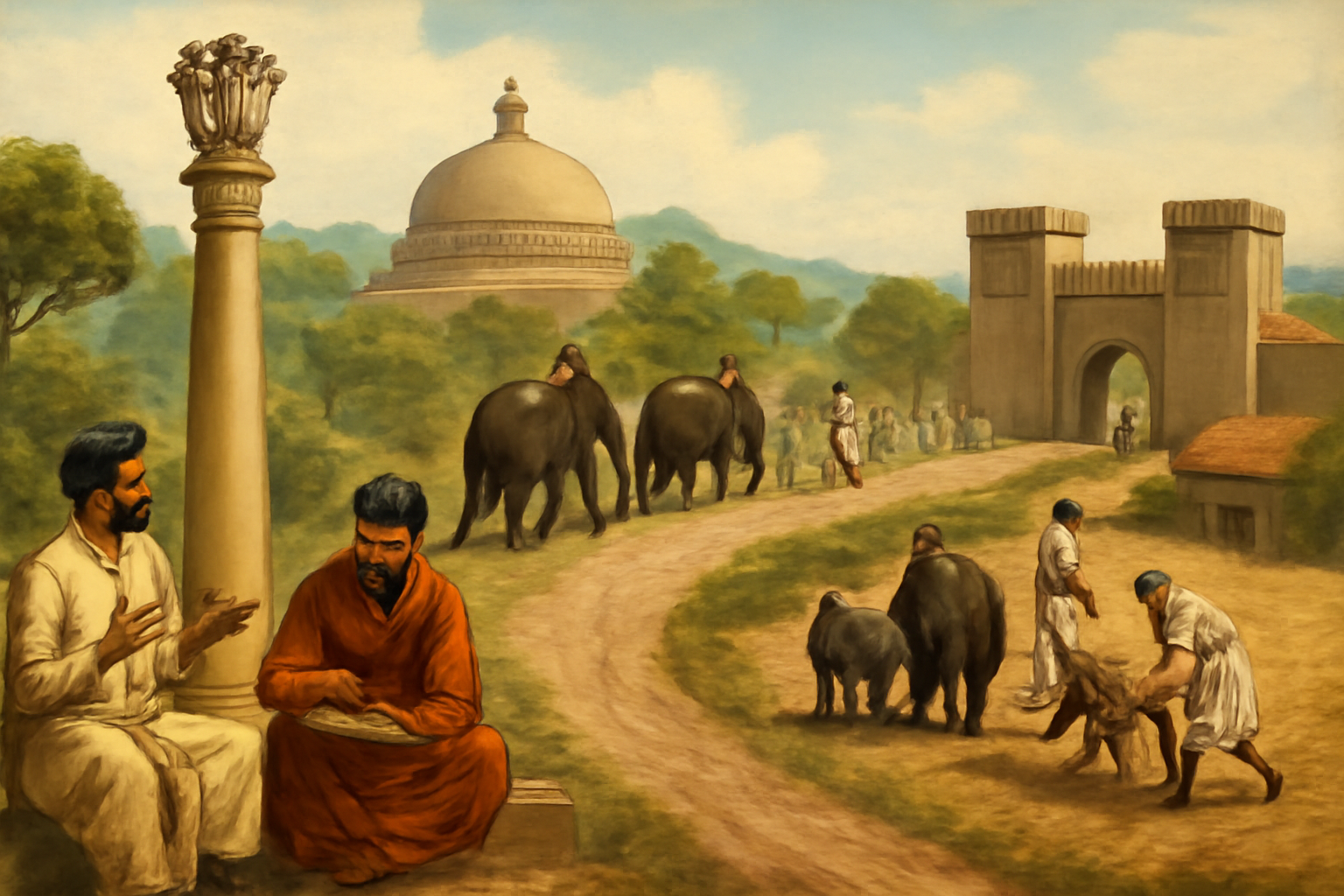
By the early fourth century BCE the political landscape of South Asia had been altered by the decline of older kingdoms and shifting regional power. City-states, regional courts, and dynastic polities persisted, but their boundaries and alliances were fluid; trade, agricultural surpluses, and administrative know-how concentrated certain advantages in particular places. Pataliputra—at the junction of rivers and routes—already carried strategic value as a centre where resources, manpower, and information converged. Those structural currents mattered: they created opportunities for large-scale state formation even as they constrained what any ruler could do. At the same time, personal decisions and networks—leadership, military command, marriage alliances, patronage—could accelerate or redirect these patterns. Historians debate how much weight to give each factor.
Was the emergence of a unified imperial power primarily the result of a bold individual's choices, or the predictable outcome of economic and social trends? This page keeps that dispute visible. What is clear, however, is that by founding the Mauryan polity around Pataliputra, Chandragupta acted at a moment when geography, human capital, and institutional precedents together made a larger state plausible. Administrative practices circulated among courts; military organization, revenue extraction, and the management of trade and irrigation were practical pressures shaping leaders’ choices in forming larger polities. The founding of the Mauryan Empire is richer when it begins with the political landscape of Magadha and the disruptions after Alexander's campaigns.
Chandragupta Maurya did not simply appear as a conqueror; he inherited and reshaped a world of kingdoms, taxes, armies, fortified cities, trade routes, and advisers whose authority depended on turning victory into administration. The empire's scale matters because it made South Asian statecraft visible across regions. Royal roads, provincial governance, revenue systems, military organization, urban centers, and alliances helped convert the Gangetic core into a wider imperial project. Later traditions around Chanakya or Kautilya show how political memory tried to explain that achievement.
The Turning Point
Chandragupta Maurya’s founding of the Mauryan Empire around 322 BCE marks a concrete turning point because it translated these background pressures into a new political arrangement anchored at Pataliputra. The decisive element was not only the presence of an ambitious leader, but the act of establishing a central seat of power where policymaking, military command, and fiscal oversight could be coordinated. Chandragupta gathered supporters, organized resources, and directed authority toward a single capital; in doing so he altered the map of authority in a way that made regional autonomy harder to sustain. Pataliputra’s position on river routes made it a practical hub for provisioning armies and collecting revenue, allowing the new regime to project authority outward.
The change unfolded through concrete choices: selecting a fixed capital, constructing administrative mechanisms, and prioritizing the consolidation of territories that had previously been loosely connected. Interpretations differ about how much this outcome owed to Chandragupta’s individual leadership versus deeper structural shifts already underway; both strands are visible in the record. Either way, the founding transformed a dispersed set of polities into an imperial formation that could govern at a larger spatial scale than its predecessors. The turning point was the move from regional power to durable imperial rule. Chandragupta's success created a structure that later rulers, especially Ashoka, could use for conquest, inscriptions, moral policy, and imperial communication.
Consequences
Near-term consequences were immediate and organisational. Power became more centralized around Pataliputra; decision-making, resource allocation, and military logistics were increasingly coordinated from the capital. This reshaped local elites’ relationships to authority and altered patterns of taxation, land control, and administration wherever Mauryan governance took hold. In the longer term, the empire established a model—both practical and symbolic—for state formation in South Asia. Administrators and later rulers looked back to the Mauryan example when imagining centralized rule; the existence of a precedent changed what future political actors thought feasible.
The empire’s scale and administrative coherence made it a recurring point of reference in political memory: it was not merely a temporary configuration but an enduring idea about how large polities could be organized in the subcontinent. Scholars continue to debate the balance between structural forces (economic integration, communication networks, demographic pressures) and pivotal choices by leaders like Chandragupta. That scholarly uncertainty is itself a consequence: it makes the Mauryan foundation a productive locus for questions about agency, institutions, and the limits of state power. Above all, the founding altered how political power was imagined and practiced across generations. Its traces remained visible in administration and memory long after.
The consequences include the consolidation of one of ancient South Asia's largest empires, contact with Hellenistic powers, new forms of administration, and the later Ashokan attempt to speak to subjects through inscriptions. The founding date is therefore a doorway into both power and political communication.
Interpretation Notes
The memory of Mauryan Empire Founded often depends on who tells the story. A court, army, religious community, merchant network, or later nation can emphasize different causes and make Pataliputra stand for different lessons.
Why Keep Reading
If this moment intrigues you, follow the threads that radiate from Pataliputra: how administrations were staffed and financed, how military logistics functioned at scale, and how later rulers recalled or revised Mauryan precedents. The founding sits at the intersection of political biography and structural history; exploring adjacent events—regional power shifts, economic routes, and the later evolution of state institutions—helps you test competing explanations for imperial growth. Read on to trace timelines of consolidation, to watch how a capital’s decisions ripple outward, and to decide for yourself where agency ends and structural momentum begins. Next pages explore contemporaneous rulers, administrative practices, and how memory preserved the idea of a pan-subcontinental state.
Read this event with Magadha, Alexander's eastern campaigns, Ashoka, Buddhism, and ancient empire routes. That sequence shows how conquest, advice, bureaucracy, and moral rule fit together.
Reading Path
Follow the story without losing the thread
Before This
- Battle of Gaugamela331 BCE
- Peloponnesian War Begins431 BCE
- Battle of Thermopylae480 BCE
After This
- Seleucid Empire Founded312 BCE
- First Punic War Begins264 BCE
- Ashoka Turns Toward Buddhismc. 260 BCE
Same Period
Wider Timeline
Mind Map
How to think about Mauryan Empire Founded
Decline of older kingdoms
The retreat or weakening of earlier polities created openings for larger-scale political consolidation.
Map Layer
Where this event sits geographically
Gold pins mark the approximate locations of published event pages. This is a schematic locator map, not a historical border map.
Coordinates are approximate and are used to help readers orient themselves before opening a full event page.
References
Where to Check the Facts
- Encyclopaedia Britannica: Mauryan EmpireSpecific reference for Mauryan state formation, Pataliputra, chronology, and imperial scale.
- The Metropolitan Museum of Art: Mauryan EmpireMuseum reference for Mauryan chronology, Magadha, and South Asian imperial context.