How to Read the Year
Why does 1915 reveal World War I as imperial war and mass violence?
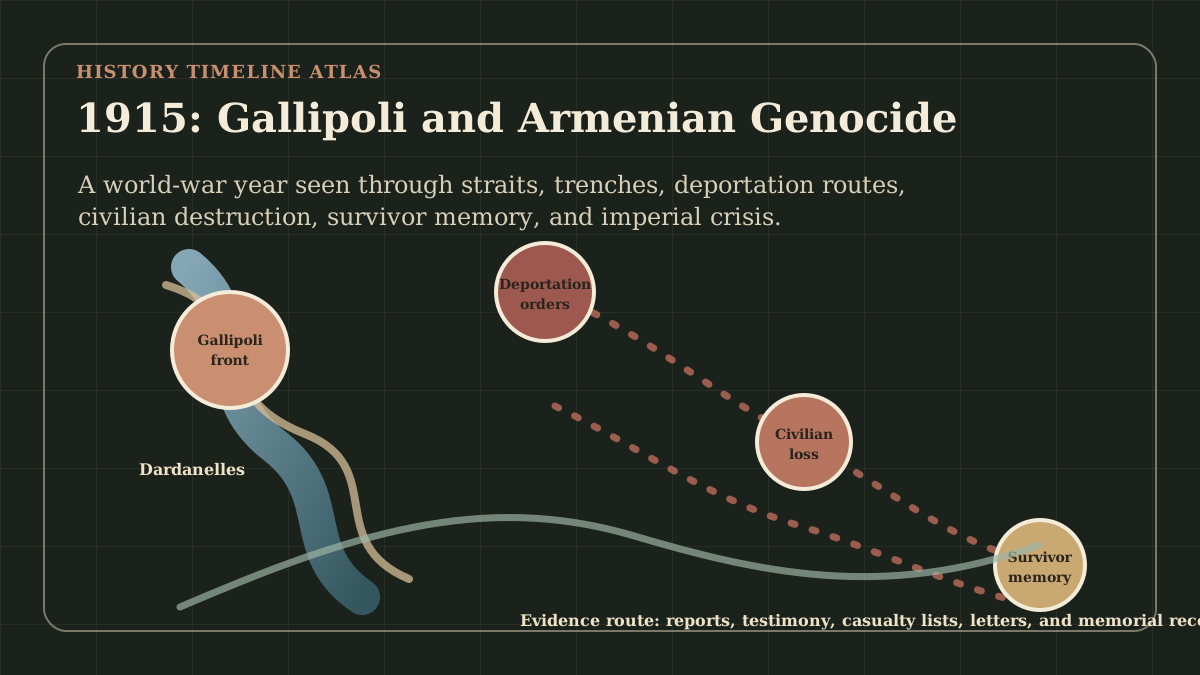
1915 is anchored by Gallipoli and the beginning of the Armenian Genocide. Together they show that World War I was not only a western-front trench war. The Ottoman Empire was fighting for survival across straits, fronts, provinces, and internal security fears, while Armenian civilians faced deportation, killing, dispossession, and the destruction of communities.
Gallipoli makes geography visible. The Dardanelles mattered because sea routes, Russia, the Mediterranean, Istanbul, and Allied strategy all met there. The campaign became a costly failure for the Allies and a formative moment for Ottoman defense and later Turkish memory, including Mustafa Kemal's rise.
The Armenian Genocide demands a different kind of attention. It is not a battlefield setback or ordinary wartime displacement. It was a campaign of mass deportation and killing by Ottoman authorities during the war, remembered by Armenians as a defining catastrophe and recognized by many scholars and governments as genocide. A responsible historical account keeps civilian destruction at the center.
The source trail is part of the history. Military reports, survivor testimony, diplomatic records, relief documents, photographs, memoirs, denial campaigns, and later recognition debates do not carry the same weight or purpose. Naming those source types helps readers see why atrocity history requires careful language and why memory remains contested.
Gallipoli's human geography also matters. Australian, New Zealand, British, French, Ottoman, Arab, Armenian, Greek, and other communities encountered the war through landings, trenches, disease, evacuation, casualty lists, censorship, and mourning. The campaign's later memory in Australia, New Zealand, and Turkey gives the year a powerful afterlife, but that memory cannot replace the wider imperial context.
The genocide layer requires victim-centered scale. Deportation routes, confiscated homes, destroyed churches and schools, starvation, massacre, orphaned children, women facing abduction and violence, rescue networks, and diaspora memory all show that 1915 was not only a state decision. It was the destruction of everyday Armenian communal life across towns, villages, roads, and deserts.
The year also teaches why denial and recognition become part of history. Survivors, descendants, governments, courts, historians, museums, and memorial days have argued over language because naming shapes responsibility. Readers need that context to understand why 1915 remains present in diplomacy, scholarship, family memory, and public commemoration.
1915 CE in History gathers events that help readers move from a single date into wider historical patterns. A useful year entry does more than answer what happened; it shows why people keep using the year as a marker for change.
The connected events show how decisions, institutions, conflicts, ideas, and consequences crossed beyond one location or one person. The event links explain the immediate story, while the topic routes and timelines show what came before and after.
The year also helps organize broad questions. It gives readers a concise answer and a direct path into deeper event pages where causes, turning points, consequences, maps, and references are easier to inspect.
Read the date in three passes. First ask what happened inside the year itself. Then ask which older pressures made the event possible. Finally ask which later pages reuse the same vocabulary, institutions, borders, technologies, or memories. That sequence keeps the page from becoming a trivia answer.
Even when only one event is currently attached, the year still has a job: it gives students and curious visitors a stable chronological doorway into the atlas. The page makes the doorway useful by pointing to the event, the topic route, the timeline, the map, and the evidence trail that can turn a date into a broader explanation.
This year matters because it connects Gallipoli Campaign, Armenian Genocide Begins, 1915: Deportation, Violence, and Evidence to a wider sequence of causes and consequences. It gives the reader a chronological anchor while still pointing outward to people, places, institutions, and later effects. A thin year page would only name the event; a useful year page explains why this date is a handle for a larger route through history. 1915 matters because it forces readers to hold military strategy and mass violence together. The year connects imperial collapse, wartime fear, nationalist politics, civilian vulnerability, memory, denial, and the question of how historians name atrocity. It deepens World War I beyond a Europe-only battlefield frame.
Reader Lenses
Look for the pressures that made change possible.
Identify who acted and what options were available.
Follow what changed after the event.
Ask why this date still appears in historical summaries.
Place the Ottoman state inside wartime pressure, straits strategy, provincial politics, and imperial collapse.
Keep deportation, killing, dispossession, survivors, and memory central rather than peripheral.
Ask why genocide, denial, recognition, evidence, and commemoration remain historically charged.
How This Year Connects
1915 CE in History is anchored by Gallipoli Campaign and Armenian Genocide Begins, 1915: Deportation, Violence, and Evidence. Read those pages together and the year stops being a date label; it becomes a crossroads where immediate choices met older pressures and opened later consequences.
The setting matters as much as the date. The year moves through Gallipoli Peninsula and Ottoman Anatolia and belongs to World War I. That combination helps readers avoid treating the year as isolated; geography, institutions, conflict, belief, economy, and communication all shape what a date can mean.
The year also opens into people and themes. Figures such as Winston Churchill, Mustafa Kemal Ataturk, Armenian civilians, and Committee of Union and Progress appear because their choices made the year visible, while themes such as World War I, Ottoman Empire, Warfare, and Armenian Genocide explain why the consequences outlived the moment. A useful next step is usually an event page, then a topic route, then a timeline.
Evidence changes the way a date reads. A treaty, battle report, inscription, newspaper, census, court record, memoir, photograph, or archaeological trace does not answer the same question. Looking at source type helps separate what happened in the year from how later people remembered it.
A year page is most useful when it keeps two scales open at once. The first scale is immediate: what happened, where, and who was involved. The second scale is interpretive: why later readers use this date to organize a wider story. Holding both scales together makes the page a starting point for deeper reading rather than a dead-end answer.
The before-and-after frame matters too. A date rarely begins the forces it reveals. Earlier pressures made the linked event possible, while later pages show which effects were temporary, which became institutions, and which turned into memory. Reading the year this way helps students avoid the false impression that history changes only when the calendar flips.
Use this page as a junction. If the event feels too brief, follow the topic route for background; if the cause feels too abstract, open the event page for sequence; if the consequence feels larger than the date, move into the timeline. The value of a year page is that it lets readers change scale without losing their place.
Read 1915 beside Gallipoli, Armenian Genocide, World War I, Ottoman decline, Ataturk, Wilson, Versailles, and genocide-memory routes.
Then compare 1915 with 1914, 1918, 1939, 1945, and later mass-violence pages. The comparison asks how war can produce both battlefield history and civilian destruction.
Events in This Year
- 1915-1916Gallipoli Campaign
Allied forces attempted to force the Dardanelles and open a path to Russia, but the Gallipoli campaign became a costly failure against Ottoman defenses.
- 1915 CEArmenian Genocide Begins, 1915: Deportation, Violence, and Evidence
The Armenian Genocide began in 1915 as Ottoman authorities moved from wartime suspicion to arrests, deportations, and mass violence against Armenian communities. April 24 marks one remembered start, but the destruction unfolded through a wider system of removal, killing, starvation, exile, and evidence.
Map Layer
1915 CE in History geography
Gold pins mark the approximate locations of published event pages. This is a schematic locator map, not a historical border map.
Coordinates are approximate and are used to help readers orient themselves before opening a full event page.
References
Where to Check the Facts
- National WWI Museum and Memorial: All About WWIMuseum reference hub for World War I chronology, maps, articles, and educational context.
- U.S. National Archives: World War I CentennialArchive reference hub for World War I records, photographs, documents, and educational resources.
- Encyclopaedia Britannica: Armenian GenocideReference for the genocide, deportations, killings, and historical interpretation.
- United States Holocaust Memorial Museum: Armenian GenocideSpecialist museum reference for genocide chronology, victims, and evidence.