Historical Role
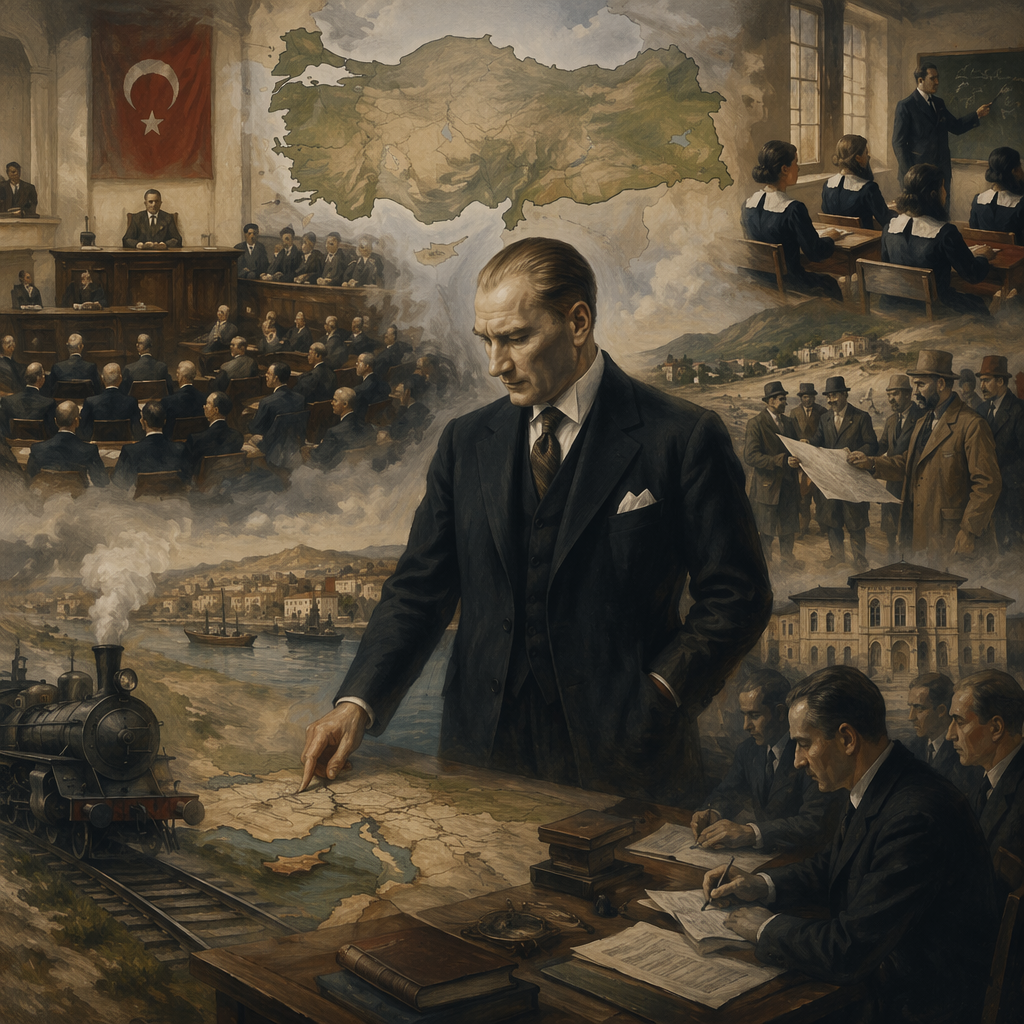
Mustafa Kemal Ataturk belongs at the hinge between Ottoman imperial collapse and Turkish republican state formation. His biography is not only a founder profile. It runs through World War I, the armistice crisis, occupation, nationalist military organization, the rejection of the Treaty of Sevres, the War of Independence, Lausanne, the abolition of the sultanate, and a reform program that tried to remake public authority.
The Young Turk and late Ottoman background matters because Ataturk did not emerge from nowhere. He was trained in an imperial military and political world already wrestling with constitutionalism, nationalism, centralization, European pressure, minority questions, and the survival of the state. Republican Turkey inherited both the possibilities and the violences of that late Ottoman transition.
The reform layer is state power, not only modernization. Alphabet reform, secular legal change, education, dress policy, language reform, party rule, women's public rights, and nationalism all tried to make a new citizenry legible. The same program also narrowed pluralism and imposed a strong state narrative over Kurds, Armenians, Greeks, religious conservatives, and other communities whose memories did not fit the official founder story.
Gallipoli helps explain why Ataturk's later authority could feel military and national at once. His wartime reputation came before the republic, and it mattered during the crisis after 1918 when Istanbul's government, Allied occupation, local resistance groups, and nationalist officers disagreed over what survival required. The biography becomes stronger when readers see how battlefield prestige became organizational capital in Anatolia rather than treating 1923 as a sudden beginning.
The Ankara phase gives the founding story institutions. The Grand National Assembly, the National Pact, military campaigns against Greek forces, diplomacy with neighboring powers, supply networks, local notables, and the struggle to replace imperial legitimacy with national sovereignty all belonged to the same project. Lausanne did not merely sign a new map; it recognized a state built through war, negotiation, forced movement, and claims about who belonged.
The population exchange between Greece and Turkey keeps the human cost visible. The republic's creation stabilized one national frame while uprooting communities whose lives had crossed language, religion, town, and family boundaries for generations. That does not erase Ataturk's importance as a founder, but it prevents the page from making state-building look clean when it also involved displacement, silence, and hard borders.
The later reform program changed everyday life through schools, courts, calendars, surnames, dress codes, public ceremonies, bureaucratic records, and the supervision of religion through state institutions. Readers should see reform as a lived administrative process: people learned new letters, new legal categories, new civic rituals, and new limits on opposition. Modern Turkey was built through persuasion, law, discipline, and memory work together.
Mustafa Kemal Ataturk helps connect individual action with wider historical change in Turkey. The biography works best when it keeps the surrounding world visible: authority, conflict, belief, reform, or discovery moved through decisions made under pressure.
The related events show how roles such as Turkish nationalist leader, President, Reformer can be read through dates, places, institutions, and consequences rather than through reputation alone. The biography explains why this person matters, while the linked events explain what changed around them.
A richer reading starts with the limits around the person. Some figures acted through offices, armies, courts, laboratories, churches, parties, ships, trade networks, or protest movements; others became important because later communities turned their lives into symbols. The page therefore asks what this person could actually change, what was already moving before them, and which consequences later readers attached to the name.
Read the biography against absence as well. Many lives around Mustafa Kemal Ataturk are less visible in the record: opponents, collaborators, family members, workers, soldiers, students, subjects, victims, translators, scribes, or local communities. Keeping those surrounding people in view makes the page less like a name card and more like an entry point into historical systems.
Mustafa Kemal Ataturk also works as a navigation point. Open the linked event pages to see where the biography becomes chronology, then use the topic routes to test whether the same pattern appears beyond one life. That extra step matters because historical importance is rarely contained inside a single decision; it usually spreads through institutions, witnesses, opponents, imitators, and later arguments over memory.
Sources and Method
Source method: read Ataturk through late Ottoman reform, the Young Turk Revolution, the armistice of 1918, and Turkish republican formation. The page treats modernization, nationalism, secularism, and coercive state-building as linked rather than as separate labels.
Evidence Notes
How Sensitive Claims Are Sourced
- 1
War of Independence and republican founding
Ataturk's leadership is anchored in the post-1918 crisis, where occupation, treaty pressure, military organization, and diplomacy produced a new Turkish state.
- 2
Reform as state-making
The biography frames reforms as institutional projects that changed law, language, education, religion-state relations, gender politics, and public identity while also limiting opposition.
Why This Person Matters
Mustafa Kemal Ataturk matters because the connected events make a larger historical pattern easier to follow. The page links biography to consequences so readers can move from a life story into the wider atlas, compare the person with contemporaries, and understand why later memory kept returning to this figure. Mustafa Kemal Ataturk matters because his career shows how an imperial defeat became a nationalist republic through war, diplomacy, institutional reform, and memory-making. The biography helps readers understand modern Turkey as a constructed political order rather than a simple break from the Ottoman past.
How did Ataturk turn Ottoman collapse into republican state-building, and what did that transformation include, exclude, and silence?
How to Read This Life
Mustafa Kemal Ataturk is easiest to understand when the biography is read beside Young Turk Revolution, Armistice of 1918. Those events show the historical setting in motion: dates, places, institutions, conflict, and consequences give the life a structure that a short biography alone cannot provide.
The surrounding route crosses Late Ottoman Empire, World War I and locations such as Ottoman Empire, Compiegne. That matters because influence rarely stays inside one person. It moves through offices, armies, movements, laws, texts, speeches, institutions, and later memory.
A useful reading path starts with the role labels, then opens the event pages to see what changed, and finally compares this person with other actors facing similar pressures.
For readers who arrive on a biography first, this page is meant to become a doorway rather than a stop. Read one paragraph for the answer, then use the turning points, topic routes, and event links to test whether the person's reputation matches the wider evidence.
Read Ataturk beside Abdulhamid II, the Young Turk Revolution, the armistice of 1918, Ottoman-Safavid and modern Middle East routes, and World War I pages. That route connects empire's end to republican beginning.
Then compare him with Sun Yat-sen, Nasser, Lenin, and Meiji reformers where available. The comparison asks how national founders use reform, army, party, law, and memory to remake political identity.
Read Mustafa Kemal Ataturk through the roles of Turkish nationalist leader, President, Reformer rather than as reputation alone.
Place the biography inside Turkey and the wider events linked below.
Ask which choices were personal and which were constrained by institutions or crisis.
Follow how later memory simplified, contested, or reused this person's role.
Start with World War I, occupation, treaties, military organization, and survival after empire.
Read law, language, education, dress, gender, and secularism as tools of state-making.
Ask how founder narratives honor transformation while hiding coercion, minorities, and opposition.
Legacy, Limits, and Memory
A useful biography keeps scale in view. Mustafa Kemal Ataturk mattered because individual choices met a wider structure: institutions, enemies, allies, audiences, technologies, beliefs, and inherited conflicts. The related event pages help separate personal agency from conditions that no single person controlled.
Memory is part of the biography too. Later readers often simplify a figure into a hero, villain, founder, reformer, conqueror, prophet, scientist, or symbol. Those labels can be helpful, but they become misleading when they hide conflict, compromise, exclusion, uncertainty, or the experiences of people outside the main biography.
For the next step, compare this life with a topic route rather than stopping at the name. If the same pattern appears across several figures, the reader has found a historical structure; if this person breaks the pattern, the contrast is usually where the most interesting question begins.
The main risk is heroic founder shorthand. Ataturk's historical importance is clear, but a serious reading keeps war, coercion, minority exclusion, party control, and contested memory visible beside reform.
A second risk is treating secularization as a smooth cultural choice. It was implemented through law, schools, bureaucracy, symbols, and state enforcement under a one-party order.
Turning Points to Read Next
Young Turk Revolution
The Young Turk Revolution restored the Ottoman constitution and parliament, challenging Abdulhamid II's autocracy while intensifying debates over empire and nationalism.
Armistice of 1918
Germany signed an armistice with the Allies, ending the fighting on the Western Front after four years of industrialized warfare.
Related Timeline
- July 1908Young Turk Revolution
The Young Turk Revolution restored the Ottoman constitution and parliament, challenging Abdulhamid II's autocracy while intensifying debates over empire and nationalism.
- November 11, 1918Armistice of 1918
Germany signed an armistice with the Allies, ending the fighting on the Western Front after four years of industrialized warfare.
References
Where to Check the Facts
- Encyclopaedia Britannica: Mustafa Kemal AtaturkBiographical reference for Ataturk's military, nationalist, and reform role.
- Encyclopaedia Britannica: Ottoman EmpireReference for Ottoman imperial chronology, institutions, reform, war, and decline.
- Encyclopaedia Britannica: TanzimatReference for the nineteenth-century Ottoman reform program and its administrative setting.