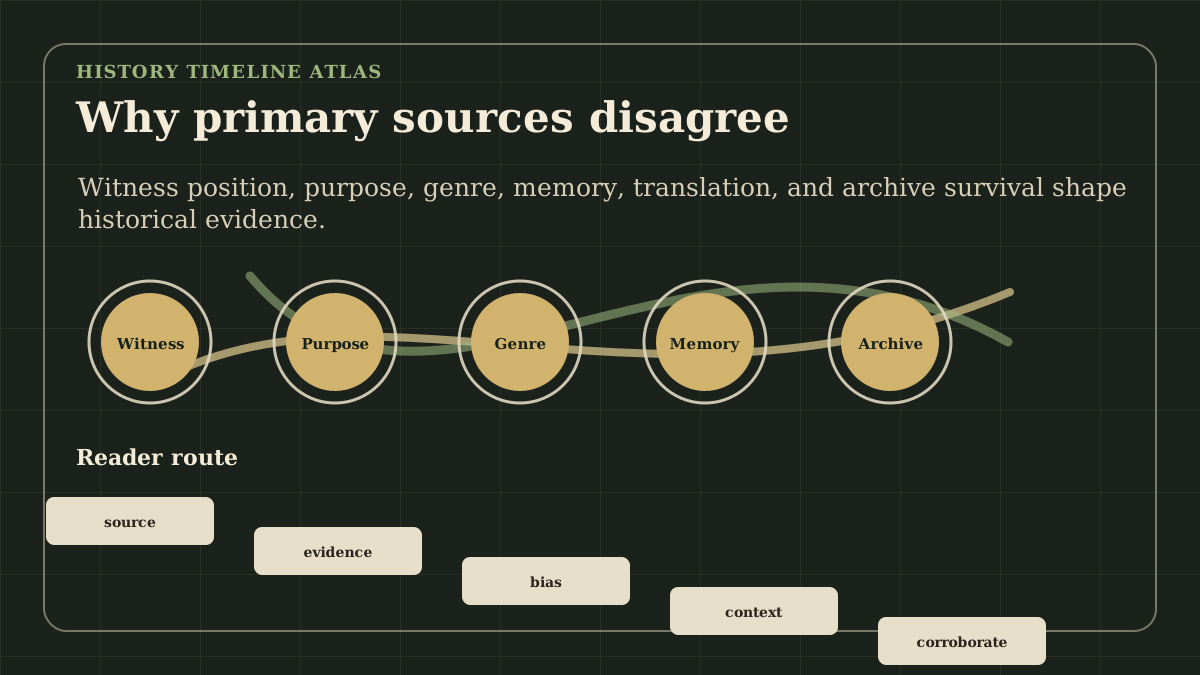
Fast Answer
Sources may disagree about facts or interpretation, but differences can also arise from scope, date, genre, copying or the version being compared. State the alleged contradiction in a complete sentence before explaining it by “bias.” Ask whether both records actually answer the same question.
Test the exact claim with dated documents; separate what a record states from what it can establish.
Reading Paths
Choose a reading path
Why Primary Sources Disagree: Wording, Versions and Interpretation becomes clearer when the broad answer stays tied to sequence, place, and concrete next pages.
Start with a concrete event, then return to the fast answer with evidence in view.
Armistice of 1918
Germany signed an armistice with the Allies, ending the fighting on the Western Front after four years of industrialized warfare.
Treaty of Versailles
The Treaty of Versailles ended formal war between Germany and the Allied powers while assigning responsibility, reparations, and territorial changes.
Fall of Constantinople, 1453: Siege Timeline, Causes, Aftermath
The Fall of Constantinople happened on May 29, 1453, when Mehmed II's Ottoman forces captured the city after a 55-day siege. Read the event through a four-step sequence: Ottoman artillery and blockade pressure on the Bosporus map, Byzantine wall defense, the final assault before dawn, and the aftermath in which Constantinople became an Ottoman imperial capital.
How to Think About It
Read events in order before drawing a cause-and-effect conclusion.
Check where the events happened and which borders or paths are anachronistic.
Distinguish source-backed claims from later memory and simplified textbook labels.
Ask how the event was reused by later states, movements, classrooms, or public memory.
First identify the exact proposition that differs
Sources may disagree about facts or interpretation, but differences can also arise from scope, date, genre, copying or the version being compared. State the alleged contradiction in a complete sentence before explaining it by “bias.” Ask whether both records actually answer the same question.
A participant’s position can help explain a disagreement without proving that every claim is equally accurate. Some errors are errors; some uncertainties cannot yet be resolved. Your task is to distinguish those possibilities and select the evidence appropriate to each.
The worked cases below use two kinds of difference: an explicit interpretive disagreement in a diplomatic exchange, and differences between archival versions or reproductions. Treating them as one generic problem would hide the research step each needs.
Worked case: the Swiss note and French reply in 1919
Article 435 in the Versailles text concerns, among other matters, neutralized Savoy and the free zones of Upper Savoy and the district of Gex. These are distinct arrangements. Do not combine neutralization, customs treatment and political borders into a single undefined “zone.”
In the annex reproduced by Yale Avalon, the Swiss note dated 5 May 1919 sets out reservations about the proposed language. It says the free-zone wording should not necessarily be read as abandoning the existing regime: Switzerland considers that it can allow a more limited adjustment of exchanges between the regions concerned.
The French reply dated 18 May 1919 disputes that reading. It describes the wording as clear and relates the change to France’s right to place its customs line at its political frontier. These passages provide a real difference in interpretation, expressed by identifiable governments, at identifiable dates, within the same documentary setting.
| Record | Question addressed | Position in the posted text | Evidence limit |
|---|---|---|---|
| Swiss note, 5 May 1919 | What change does the proposed free-zone language imply? | It need not mean abandonment of the existing regime. | A reservation and interpretation, not the final record of all later arrangements. |
| French reply, 18 May 1919 | Does that interpretation fit the provision? | The reply rejects it and asserts the clarity of the wording. | France’s position does not alone prove a later legal or administrative outcome. |
Do not settle the dispute by repeating “the treaty changed the map.” First identify which layer of a map would be changing. To explain its later resolution, obtain subsequent agreements or adjudication and implementation records. This annex is evidence of the disagreement, rather than a complete history of its outcome.
Yale’s page is a modern documentary publication, checked here on 5 November 2026. Its English text allows this comparison; this guide does not claim to have examined an original signed annex or independently collated every language version.
Different layouts do not always mean different claims
The National Archives’ Treaty of Paris page explains that signed originals have different arrangements of signatures and seals. That is a provenance and physical-layout issue. It is not, by itself, a contradiction about what Article 1 acknowledges.
The same archival commentary warns that some online transcripts omit Delaware even though it is included in the original treaty. That is a wording problem with a clear checking route: compare the posted authoritative text and the relevant original evidence. It should not be explained away as simply two participants expressing different perspectives.
Keep the two tests separate. “Why are the signatures arranged differently?” calls for information about originals and document production. “Is Delaware named?” calls for verification of the clause’s text. Neither question is answered by a general observation that historians have different viewpoints.
The archive’s modern explanation is itself a source layer. When citing the layout information, attribute it to the National Archives rather than writing as if an eighteenth-century signatory made that observation.
A changed purpose is not automatically a contradiction
Wilson’s 2 April 1917 address requests war action from Congress. His 8 January 1918 Fourteen Points address sets out proposed peace terms. One is not automatically refuted by the existence of the other: they were delivered at different times and had different immediate purposes.
That does not make them immune from comparison. You can examine a repeated principle, a new qualification or a tension between rhetoric and policy. But identify the exact claim and passage before calling the pair contradictory. A proposal also differs from proof of implementation.
Use the existing Wilson source worksheet for the detailed short extracts and answered comparisons. This page provides the diagnostic method and the distinct diplomatic/version examples, rather than duplicating that exercise.
Use an evidence grid rather than a list of biases
- Record identity: creator, date, genre, audience, edition and provenance.
- Exact proposition: the factual claim or interpretation you are comparing.
- Scope: time, place and population covered by that claim.
- Transmission: original document, copy, translation, excerpt or later memory.
- Difference: wording, observation, inference, layout or purpose.
- Resolution: the additional evidence that could support, weaken or refine each claim.
After filling the grid, write a bounded conclusion. You may be able to say that the two governments disputed the meaning of a clause without being able to say which later arrangement prevailed. You may also be able to correct a transcript word without reaching any conclusion about political motives.
When evidence does not resolve the issue, describe the remaining question specifically. “More sources are needed” is less useful than “we need the subsequent agreement governing these free zones.” The latter tells the next reader what to seek.
Three questions with worked answers
- The Swiss and French notes interpret the same proposed free-zone wording differently. Is that merely a difference in chart scale?
- No. Their passages express different interpretations of the provision. Identify the dates and positions, then investigate later records if the question asks how the dispute was resolved.
- Two signed Paris originals arrange signatures differently. Does that establish contradictory recognition clauses?
- No. Layout and operative wording are different issues. NARA’s provenance note explains why authentic originals may differ in arrangement.
- A war request in 1917 and peace proposals in 1918 have different contents. What should I do before declaring a contradiction?
- Identify a proposition that the texts respectively affirm and deny under the same relevant conditions. Otherwise their dates and purposes may explain why their contents differ.
For date and action distinctions, use the timeline method. For the two American independence documents, use the declaration and recognition worksheet. These exercises are original teaching aids rather than reports of a historical classroom or professional review.
Source and Uncertainty
Sources do not preserve every voice equally. Official documents often show what institutions wanted to record. Memoirs, oral history, material culture, maps, newspapers, photographs, court records, and archaeology may reveal different layers of experience.
Uncertainty belongs inside the explanation. Dates can be approximate, motives can be debated, and later memory can change the meaning of an event. Naming uncertainty helps the reader trust the route because it shows where confidence is strong and where the record is uneven.
The best source habit is comparison. Read a reference source for chronology, then follow a linked event for context, then ask whose voice is still missing. That habit turns source notes into part of the historical argument.
Map Layer
Why Primary Sources Disagree: Wording, Versions and Interpretation map examples
Gold pins mark the approximate locations of published event pages. This is a schematic locator map, not a historical border map.
Coordinates are approximate and are used to help readers orient themselves before opening a full event page.
Examples
Events That Make the Pattern Visible
Armistice of 1918
Germany signed an armistice with the Allies, ending the fighting on the Western Front after four years of industrialized warfare.
Treaty of Versailles
The Treaty of Versailles ended formal war between Germany and the Allied powers while assigning responsibility, reparations, and territorial changes.
Fall of Constantinople, 1453: Siege Timeline, Causes, Aftermath
The Fall of Constantinople happened on May 29, 1453, when Mehmed II's Ottoman forces captured the city after a 55-day siege. Read the event through a four-step sequence: Ottoman artillery and blockade pressure on the Bosporus map, Byzantine wall defense, the final assault before dawn, and the aftermath in which Constantinople became an Ottoman imperial capital.
References
Where to Check the Facts
- Yale Avalon — Versailles Part XV, Article 435 and annexSwiss note of 5 May 1919 and French reply of 18 May: disagreement about meaning of provision on free zones; distinguish free zones from neutralized zone.
- US National Archives — Treaty of ParisSigned-original layout differences and warning about Delaware omission in some transcripts. Archive note is modern commentary, not an 1783 participant statement.
- US National Archives — Wilson, 2 April 1917Public request for Congress to act; comparison of purpose rather than automatic contradiction.
- US National Archives — Wilson, 8 January 1918Proposed peace terms, not evidence that they were all implemented.