Practical guide
Why Did Britain Enter World War I? Belgium, Treaties and August 1914
Britain entered the war against Germany on 4 August 1914 after German forces violated Belgian neutrality and the British demand for a satisfactory assurance was not met. Belgium was the immediate issue, but ministers also argued about France, naval security, British interests and the danger of European domination. Four parliamentary records show how those arguments became a decision—and where the evidence needs careful reading.
Explain Britain’s entry, not the whole war with one cause
The decision to enter a war is different from the explanation of why that war began. By the time Foreign Secretary Sir Edward Grey addressed the Commons on 3 August, he could already describe Russia and Germany as at war. He traced the crisis to Austria and Serbia, then asked what Britain should do in the new situation. Britain’s choice was one part of a widening conflict, not the starting point of every country’s war.
For Britain, Belgian neutrality became the immediate test. But Grey’s speech did not consist only of a treaty citation. It linked friendship with France, naval dispositions, trade routes, national honour and concern about power across the Channel. Prime Minister H. H. Asquith’s statements on 4 and 5 August then documented the reported violation, the demand for an assurance and the state of war.
This guide uses four specific British parliamentary records. They include diplomatic communications and a treaty translation as ministers presented them to Parliament. They are strong evidence for what the government publicly said and the dates it reported. They are not a complete private cabinet archive, a survey of public opinion or an independent verification of every claim made inside a quoted telegram.
Start with the timeline, inspect the treaty clauses, then compare the arguments about France and Belgium. Use the final questions to check your interpretation. For the wider chronology, continue to the World War I timeline; this article concentrates on Britain’s decision in early August.
A decision timeline: separate action from later reporting
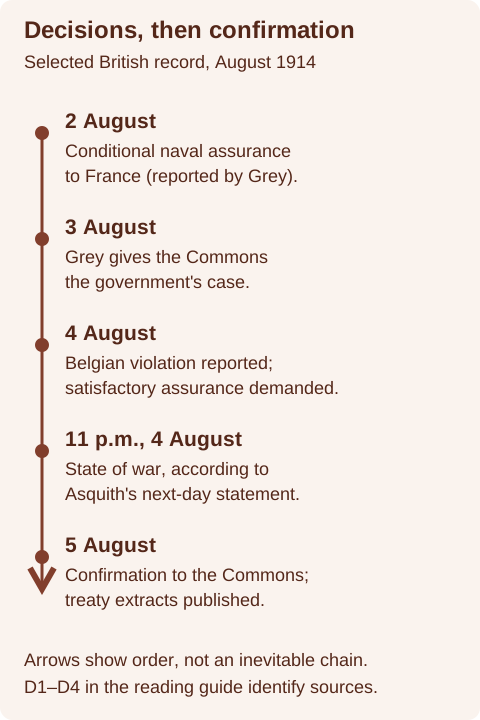
| Date | Decision or record | What changed | Evidence and limit |
|---|---|---|---|
| 19 April 1839 | Treaty framework | The treaty and annex placed Belgian independence and neutrality under the named powers’ guarantee. | D4, Article I and Annex VII; extracts printed in 1914, not the complete treaty. |
| 22 November 1912 | Consultation, not an automatic war promise | The letter Grey read to the Commons said expert consultations did not restrict either government’s freedom to decide about armed assistance. | D1, columns 1813–14; this is the document as presented in Grey’s address. |
| 2 August 1914 | A conditional naval assurance | Grey told the Commons on 3 August that he had given the French ambassador an assurance “yesterday afternoon” about protection against specified German naval action. | D1, columns 1817–18; subject to parliamentary support and the stated contingency. |
| 3 August 1914 | The parliamentary case | Grey discussed France, British interests and Belgian neutrality while explicitly saying his information about the Belgian ultimatum was not yet complete. | D1, columns 1809–27; an argument for policy, not a declaration that war had already begun for Britain. |
| 4 August 1914 | Violation reported and an assurance demanded | Asquith relayed the report of German entry at Gemmenich, rejected Germany’s assurance against annexation as insufficient, and demanded a satisfactory reply about neutrality. | D2, columns 1925–27; German explanations appear as communications quoted by the British government. |
| 11 p.m., 4 August 1914 | State of war | Asquith said on the following day that a state of war had existed since eleven o’clock the previous night. | D3, column 1963; distinguish the date of the event from the date of the statement. |
| 5 August 1914 | Confirmation and publication | Asquith confirmed the state of war and relayed Belgium’s appeal; Acland supplied the translated treaty extracts in a written answer. | D3 and D4; publication explains the government’s case, not every private decision leading to it. |
The 2 August date is derived from Grey’s 3 August description of what he had done “yesterday afternoon.” The 4 August event time comes from Asquith’s statement on 5 August. Keep those relationships visible instead of assuming that a document’s date is always the date of the action it describes.
This is a selected decision sequence, not an exhaustive diplomatic diary. It leaves out many military orders, conversations and foreign-government decisions. Nor does its first row imply that an 1839 treaty made a particular August 1914 response automatic. The intervening documents show governments interpreting commitments, seeking assurances and making choices.
What the 1839 treaty extracts actually say
The text printed in the Commons written answers on 5 August gives a translation of extracts from the treaty signed at London on 19 April 1839. Its treaty Article I places the annexed provisions under the guarantee of the named monarchs. The annex’s Article VII describes Belgium as an independent and perpetually neutral state, within the territorial limits defined by other articles, and requires it to observe neutrality toward other states.
“under the guarantee of their said Majesties”
That phrase comes from D4, treaty Article I. The same document’s annex Article VII contains the description “an independent and perpetually neutral State.” The distinction matters: the guarantee wording and the definition of the neutral state are in different provisions. These are translated extracts, not the complete treaty or its full annex.
British ministers treated Belgian neutrality as an obligation and an interest. In D1, Grey called the treaty the governing factor and discussed the precedent of 1870. He quoted Gladstone’s refusal to treat a guarantee as an inflexible demand on every party irrespective of its particular circumstances. Grey’s use of that precedent combined legal, moral and strategic considerations rather than eliminating them with one automatic formula.
A careful explanation therefore says that Britain was a guarantor of Belgian neutrality and invoked that commitment in choosing intervention. It should not turn the published clauses into a claim that the treaty specified one identical military response for all guarantors, regardless of circumstances. Nor should it dismiss Belgium as an invented excuse: neutrality and independence were substantive issues in the text and in the government’s stated demands.
France mattered before the final Belgian test
Grey distinguished cooperation with France from an automatic war alliance. His formulation in the Commons was:
“The Triple Entente was not an Alliance—it was a Diplomatic group.”
In D1, columns 1811–14, he read the 22 November 1912 letter explaining that consultations by military and naval experts did not restrict either government’s freedom to decide about armed assistance. That was his public account of the status of those conversations. It does not mean that consultations had no practical effect or created no expectations.
Grey then described a different, newer assurance. Given to the French ambassador on 2 August, it concerned German naval action through the Channel or North Sea against French coasts or shipping. British naval protection was promised within that contingency and subject to the government’s policy receiving parliamentary support. Grey expressly said he was not announcing immediate aggressive action through that statement.
The practical setting was important to his argument. France had concentrated its fleet in the Mediterranean, leaving its northern and western coasts exposed in the situation he described. Grey argued that standing aside could force a French redeployment and leave Britain facing risks to its Mediterranean position and trade. Friendship, credibility and British security thus appeared together in the speech.
Keep the limits of that commitment clear. A conditional naval assurance was not the same as a promise to send an expeditionary army. Grey told the House that no such engagement had yet been taken. The article’s evidence concerns his statement at that moment; it does not substitute for the later records of army deployment or every private military conversation.
What changed on 4 August: violation and a rejected assurance
On 3 August, Grey discussed the reported German ultimatum to Belgium but said he was not yet sure he had its facts completely and accurately. On 4 August, Asquith read communications describing Belgium’s refusal of passage and the reported entry of German forces at Gemmenich, near Aix-la-Chapelle. Subsequent information, he said, indicated a further advance into Belgian territory.
D2 also records a German assurance against annexing Belgian territory. The quoted German message justified disregarding neutrality by an alleged French threat. That claim about French plans is evidence of Germany’s argument as relayed in the speech; the selected record does not independently establish that the alleged plan existed.
“We cannot regard this as in any sense a satisfactory communication.”
Asquith’s answer in D2, columns 1925–27, distinguished a promise against annexation from respect for neutrality. An army’s passage through a neutral state could violate its neutrality even if its territory would not be formally annexed afterward. Britain repeated its demand for a satisfactory assurance rather than accepting a narrower undertaking.
The next day, D3, column 1963, reported that a state of war had existed since eleven o’clock the previous night. That places Britain’s entry against Germany on 4 August. The 5 August date belongs to Asquith’s confirmation to the House. When quoting the final-demand timing, preserve D2’s wording and context; these selected records do not print a separate time-zone explanation for its phrase “before midnight.”
The sequence contains both pressure and choice: a reported violation, competing assurances, their rejection, a demand and a state of war. It explains why an account limited to “Britain had an alliance” or “one old treaty declared war” misses the actual decisions visible in these documents.
Compare explaining factors with publicly stated reasons
A cause and a public reason need not be mutually exclusive. A strategic concern can shape a decision and also appear in the speech defending it. A treaty can influence policy while supplying legal language for its justification. The task is to identify what a source supports, rather than sorting every statement into “real motive” or “mere excuse” without evidence.
| Factor | How it helps explain the choice | How it appears in the public record | What it does not prove |
|---|---|---|---|
| France and prior cooperation | Planning and expectations made French security an important British question. | Grey distinguished the 1912 consultation letter from the later naval assurance. | A formal automatic commitment to enter every French war. |
| Naval and trade interests | French fleet dispositions, British routes and the Channel shaped Grey’s account of the risks of standing aside. | D1 discusses the Mediterranean, undefended French coasts and British interests. | That Grey’s predictions were certain or every neutral alternative impossible. |
| Belgian treaty framework | Belgian independence and neutrality supplied a longstanding diplomatic and legal concern. | D4 prints the guarantee clause and neutrality provision; D1 invokes the 1870 precedent. | One uncontested mechanical rule specifying all guarantors’ military response. |
| German passage through Belgium | The immediate violation sharpened the choice about intervention. | D2 reports entry at Gemmenich and distinguishes neutrality from a promise against annexation. | That Belgium was the sole background cause of the entire world war. |
| Honour, credibility and the European balance | Grey presented future British influence and the danger of domination opposite Britain as reasons to act. | D1 repeatedly links honour, interests and Belgian independence. | A complete record of private cabinet motives or unanimous public consent. |
| Government decision and rejected assurances | A demand for a satisfactory answer moved policy into the final decision sequence. | D2 sets out the demand; D3 confirms the ensuing state of war. | That a treaty acted without interpretation, diplomacy or decisions by people. |
Grey linked Belgian independence to the possibility of one power dominating countries opposite Britain. He also argued that staying neutral would not necessarily spare Britain severe economic harm or preserve its future influence. Those are arguments and predictions he made in support of policy, not outcomes this article assumes were guaranteed.
His account explicitly included Britain’s responsibilities in India and elsewhere in its empire. That helps locate the policy inside an imperial government’s concerns. The speech does not show that colonial populations were asked to consent or that an appeal to Belgian independence described the British Empire’s own political arrangements. A source can be important evidence without being a complete moral account of the state speaking through it.
For a short essay, connect one factor to a particular passage and then state the limit. For example: “Grey’s discussion of French fleet dispositions shows how he presented naval security as a British concern; it does not establish that every alternative policy would certainly have failed.” That sentence makes an assessable historical argument instead of treating a minister’s prediction as hindsight proof.
Support, dissent and the limits of the parliamentary record
The 3 August debate was not unanimous. Bonar Law offered Grey the support of the opposition party he led. Ramsay MacDonald rejected the government’s case and said Britain ought to have remained neutral. He questioned whether Grey had established a danger to Britain and objected to being drawn into a wider European war.
MacDonald’s position included qualifications. He said that a conflict confined to protecting Belgium could receive support, but argued that the policy before the House was a whole European war whose consequences could not be reduced to that one objective. This gives the reader an actual disagreement about scope and risk, rather than two caricatures of honour and indifference.
The Speaker stated that no motion was before the House at that point. Do not describe the speech and responses as a recorded unanimous formal vote for war. Likewise, Bonar Law’s assurance and MacDonald’s dissent do not measure every citizen’s opinion, all members of a party or the private reasoning of every minister.
All four records come through British parliamentary publication. D1 includes a speech, quoted earlier correspondence and responses; D2 and D3 include incoming communications selected for presentation; D4 is a minister’s published translation of treaty extracts. A fuller study would compare cabinet records, the original diplomatic papers, Belgian and German records and historians’ interpretations. These documents supply a strong starting point while leaving that larger inquiry open.
Six source-reading questions with explained answers
Use D1–D4 in the source list below. Give a passage and its date before drawing a conclusion. Treat a quoted diplomatic assertion as an assertion by its speaker, not automatically as an independently established fact.
Download the timeline, document list, questions and answer key. The plain-text sheet contains the same six original questions, with a separate answer section for self-study.
Case 1
In D4, which passage puts the annexed provisions under a guarantee, and which passage describes Belgium as neutral? Why should these two jobs be distinguished?
Show answer and explanation for case 1
Article I supplies the guarantee wording; Article VII of the annex describes Belgian independence and perpetual neutrality.
The translated extracts perform different jobs. Article I says the annexed articles have the same force and validity as if inserted in the act and places them under the named monarchs’ guarantee. Annex VII specifies Belgium’s independent, perpetually neutral status and its duty to observe neutrality toward other states. Identifying those clauses shows what the published text says. It does not establish one uncontested legal procedure requiring every guarantor to take an identical military action. Grey’s discussion of the 1870 precedent in D1 shows that the scope and circumstances of action were themselves discussed.
Case 2
Use D1 to compare the 22 November 1912 letter with the naval assurance given “yesterday afternoon.” Does the first document already promise automatic British entry into any French war?
Show answer and explanation for case 2
No. The letter preserved freedom to decide. The later assurance was a specific conditional commitment about German naval action against French coasts or shipping.
Grey read the 1912 letter to explain that military and naval consultations were not themselves binding engagements to assist by force. He then described a newer assurance, given on 2 August, under specified circumstances and subject to parliamentary support. These are not interchangeable pieces of evidence. Saying there was no automatic alliance does not mean there were no preparations, expectations or later commitments. Conversely, the later naval assurance was not an announcement that an expeditionary army had already been promised: Grey explicitly separated that question in the same address.
Case 3
Compare Grey’s comments on 3 August in D1 with Asquith’s statement on 4 August in D2. Identify the difference between a reported ultimatum and a reported border violation.
Show answer and explanation for case 3
Grey described incomplete information about the ultimatum. Asquith subsequently quoted a report that German forces had entered Belgian territory at Gemmenich.
The source dates matter. Grey said he did not yet have complete and definite information on the ultimatum when addressing the House. On 4 August, Asquith presented the Belgian legation’s report that territory had been violated, followed by information of a further advance. Reading the later report back into every sentence of the earlier speech erases an important change in the government’s information. Both reports reach the reader through British parliamentary statements; checking their provenance is different from assuming that the historian has independently inspected every original incoming telegram.
Case 4
D2 quotes Germany’s assurance that Belgian territory would not be annexed. Why did the British government reject that assurance as an adequate answer about neutrality?
Show answer and explanation for case 4
Not annexing territory after the war did not mean respecting neutrality while moving an army through it.
The quoted German message acknowledged that neutrality had to be disregarded and justified that course by alleged French danger. Asquith said the communication was not satisfactory and repeated the request for an assurance about neutrality. In this record, territorial annexation, military passage, present neutrality and future independence are distinct questions. The message’s assertion about French plans is a German claim quoted by the British government, not a fact this worksheet independently establishes. A guarantee about one issue therefore cannot be silently treated as an answer to all the others.
Case 5
D3 is dated 5 August. Asquith says a state of war existed “since eleven o’clock last night.” What event date should you write, and what should remain dated 5 August?
Show answer and explanation for case 5
Write 4 August 1914 for the state of war beginning at eleven o’clock that night. Date the parliamentary confirmation 5 August.
The statement describes an event on the preceding evening. It does not move the beginning of the state of war to the day on which the House heard the report. This distinction is useful whenever a source was written after what it describes. D2’s request for a reply “before midnight” and D3’s retrospective statement should be quoted with their own context; the selected records here do not by themselves print a time-zone explanation for the deadline. This guide does not convert that phrase into a separately verified deadline for another city.
Case 6
In D1, compare Bonar Law’s response with Ramsay MacDonald’s. Does the record justify saying that everyone supported Grey or that the speech was a unanimous formal vote for war?
Show answer and explanation for case 6
No. Bonar Law offered opposition-party support; MacDonald opposed the policy. The Speaker also stated that no motion was before the House at that point.
MacDonald argued that Grey had not persuaded him that Britain was in danger and questioned entry into a wider European war. He expressed conditional support for a conflict confined to protecting Belgium, while rejecting the policy as presented. Those qualifications matter: the speech is not simply indifference to Belgium. Bonar Law’s support and MacDonald’s dissent demonstrate different positions in this debate, but neither speech measures all public opinion or every party member’s view. The Speaker’s procedural statement prevents treating the exchange as a recorded unanimous war-resolution vote.
Build a concise answer, then follow the wider history
A useful answer has three levels. First, name the immediate Belgian issue and Britain’s entry against Germany on 4 August. Second, explain how the treaty framework, expectations about France and British strategic interests entered the government’s case. Third, identify the source boundary: these public statements show what ministers argued and reported, while the full private decision process requires further evidence.
A model paragraph is: Britain entered the war against Germany on 4 August 1914 following German violation of Belgian neutrality and the failure to obtain the satisfactory assurance Britain demanded. The 1839 treaty framework mattered, but Grey also defended action through concerns about France, naval security, British honour and power in western Europe. His 3 August address, Asquith’s next two statements and the printed treaty extracts show those issues becoming a policy decision. They do not show a unanimous country or a treaty acting without human interpretation.
Keep that answer separate from the origin of the whole war and from its eventual outcomes. The comparison of the two world wars helps distinguish triggers, background conditions and choices. To follow what came after entry, use the wider World War I timeline. For the later endpoint, the war-ending terms guide separates military cessation from a peace settlement.
Sources and further reading
- D1 — Hansard, 3 August 1914: Grey’s statement and Commons responsesComplete 48,434-character visible record read. The 1912 letter, 2 August naval assurance, Belgium and the 1870 precedent, British interests, Bonar Law’s support, MacDonald’s dissent and the Speaker’s procedure. A public debate, not a complete private cabinet record.
- D2 — Hansard, 4 August 1914: Violation of Belgian NeutralityComplete statement read: quoted Belgian and German communications, reported entry at Gemmenich, no-annexation assurance, the British rejection and final demand. Claims within quoted telegrams retain their stated provenance.
- D3 — Hansard, 5 August 1914: Belgian Neutrality Violated by GermanyComplete statement read: confirmation that war existed from eleven o’clock the previous night, Belgium’s appeal and the report of French cooperation.
- D4 — Hansard written answer, 5 August 1914: treaty extractsComplete written answer read, including treaty Article I and Annex Article VII, translated from the treaty signed on 19 April 1839. These are extracts, not the full treaty.