At a Glance
The shape of the event
- Date
- 264 BCE
- Place
- Sicily
- Type
- War
Rome and Carthage entered the First Punic War over influence in Sicily, beginning a series of conflicts for western Mediterranean power.
264 BCE; place the event in Sicily before comparing causes or consequences.
The Punic Wars transformed Rome from an Italian power into a Mediterranean empire and made Carthage its defining rival.
Roman Republic / Carthage are the first names or groups to compare before widening the story.
The war pulled Rome into large-scale naval conflict and ended with Roman control of Sicily.
The war pulled Rome into large-scale naval conflict and ended with Roman control of Sicily.
The Punic Wars transformed Rome from an Italian power into a Mediterranean empire and made Carthage its defining rival.
Follow the sequence that begins here to see how naval warfare, imperial ambition, and shifting alliances unfolded into prolonged conflict.
Background
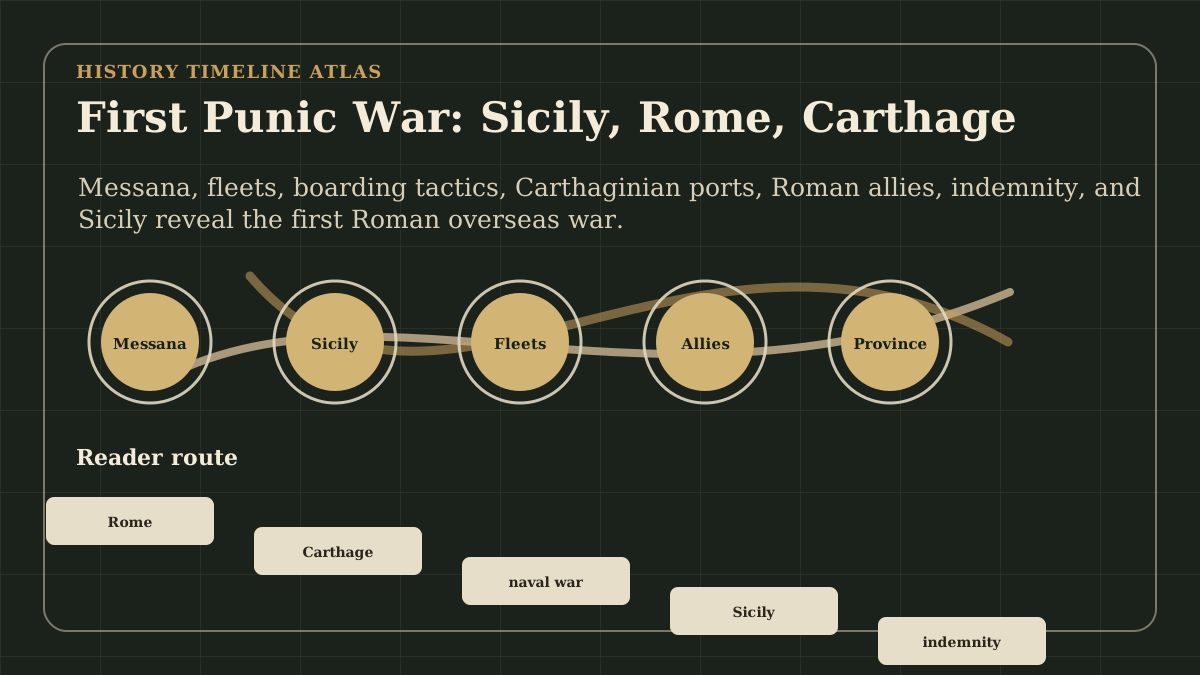
By the mid-third century BCE the central Mediterranean was a crowded arena of trading routes, colonies, and competing claims. Carthage stood as an old maritime power with networks of ports and economic interests across the western sea. Rome remained primarily an Italian land power, expanding influence on the peninsula through treaties and armies. Sicily occupied a strategic position between these two powers; its coastal cities and fertile plains mattered to both security and commerce. These pressures — commercial competition, competing alliances on Sicily, and the strategic value of sea lanes — created recurring frictions.
Historians debate whether the war began mainly from contingent decisions by leaders or from deeper structural forces: economic rivalry, the momentum of expansion, and the geography of the Mediterranean. This page keeps that dispute visible. What is clear is that by 264 BCE confrontation over Sicilian influence drew Rome and Carthage into open war. The First Punic War is useful because it shows how a local dispute can become a regional system war. Messana in Sicily was not the whole Mediterranean, but its position exposed the rivalry between Rome, a rising Italian land power, and Carthage, a maritime and commercial power with deep interests in western Mediterranean routes. Once both powers treated Sicily as a security problem, compromise became harder.
Rome's decision to cross into Sicily changed more than one campaign. It forced Roman leaders to think beyond Italy, naval supply, shipbuilding, crews, allied manpower, and the political costs of a long overseas war. Carthage brought older experience at sea, fortified positions, mercenary forces, and trade networks, but it also had to sustain war across distance and domestic political pressure. The event also helps readers see imperial growth before it looked inevitable. Rome did not begin the war as an unquestioned naval empire. It learned through loss, adaptation, public expenditure, and repeated mobilization. Carthage did not begin as a doomed opponent. Both states made choices that turned Sicily into a testing ground for Mediterranean power.
The Turning Point
The moment when a local dispute hardened into a state-on-state war is the crucial turning point. In 264 BCE both the Roman Republic and Carthage made the choice to contest control around Sicily rather than to confine their rivalry to diplomacy or limited skirmishes. That decision converted a regional competition into sustained warfare. The conflict pulled Rome into large-scale naval engagement—an arena long dominated by Carthage—so the Republic found itself confronting unfamiliar strategic challenges as well as the immediate task of projecting power across water. For Carthage, a power rooted in seafaring and commerce, the war meant defending established routes and positions against a growing land-based challenger prepared to contest influence overseas.
Those concrete choices—escalation by both parties, commitment of resources to Sicily, and the acceptance of naval contest—changed the scale and character of their rivalry and set the war’s subsequent trajectory. The turning point was Rome's movement from Italian security politics into a Sicilian and maritime contest. That decision widened Roman ambition, even if Roman leaders did not yet know how expensive sea power would become. A second turning point was technical and organizational. Rome's naval learning, including new fleets and boarding tactics, showed that a land power could build maritime capacity when state resources, allies, and political persistence aligned.
Consequences
The First Punic War reshaped political and strategic realities in the near term and across generations. In the immediate aftermath, the war ended with Roman control of Sicily, marking the island’s transition from contested ground to Rome’s first province beyond the Italian peninsula. More broadly, the conflict transformed Rome’s capacity and orientation: from an Italian land power it became a state accustomed to projecting force across the Mediterranean and to confronting a maritime rival on the sea lanes. For Carthage, the war consolidated a long-standing enmity with Rome that would define diplomacy and conflict for decades.
Over time the Punic Wars — of which this was the opening — remade both states: they redirected resources, influenced political priorities, and hardened mutual hostility. While details of motives and decisions remain debated, the war’s outcome is a clear hinge: it began the process by which Rome became a Mediterranean empire and Carthage its defining rival. The immediate consequence was a long and costly war over Sicily, sea lanes, fortresses, and prestige. Victory gave Rome its first overseas province and a new relationship to taxation, administration, and imperial responsibility beyond the Italian peninsula. The longer consequence was bitterness and escalation. Carthage paid indemnities and lost ground; Rome gained confidence and strategic reach. The settlement did not end rivalry.
It helped create the conditions for the Second Punic War and Hannibal's later challenge to Rome.
Interpretation Notes
The hardest question around First Punic War Begins is causation. The event had immediate actors, but its meaning also came from institutions, geography, resources, and expectations already present in Central Mediterranean.
Why Keep Reading
Follow the sequence that begins here to see how naval warfare, imperial ambition, and shifting alliances unfolded into prolonged conflict. The First Punic War is the opening act of a struggle that changed Mediterranean politics, military practice, and imperial identity. Read next to track how Rome adapted to fighting at sea, how control of islands and ports mattered for supply and diplomacy, and how this early confrontation set patterns that would return in later wars between the two powers. Read this page before Hannibal, Cannae, the Roman Republic's expansion, and the fall of Carthage. That sequence shows how one Sicilian crisis became the opening chapter of Roman Mediterranean empire.
Reading Path
Follow the story without losing the thread
Before This
- Seleucid Empire Founded312 BCE
- Mauryan Empire Foundedc. 322 BCE
- Battle of Gaugamela331 BCE
After This
- Ashoka Turns Toward Buddhismc. 260 BCE
- Qin Unification of China221 BCE
- Battle of Cannae216 BCE
Same Period
Wider Timeline
Mind Map
How to think about First Punic War Begins
Strategic island
Sicily's position gave whoever controlled it leverage over western Mediterranean routes
Map Layer
Where this event sits geographically
Gold pins mark the approximate locations of published event pages. This is a schematic locator map, not a historical border map.
Coordinates are approximate and are used to help readers orient themselves before opening a full event page.
References
Where to Check the Facts
- Encyclopaedia Britannica: First Punic WarSpecific reference for the war's dates, Rome-Carthage frame, and western Mediterranean stakes.
- Encyclopaedia Britannica: Punic WarsContext reference for the series of wars and Rome's Mediterranean expansion.