At a Glance
The shape of the event
- Date
- June 1947
- Place
- Cambridge, Massachusetts
- Type
- Economic Program
The United States announced a European recovery program that offered aid for reconstruction and helped stabilize western European economies after World War II.
June 1947; place the event in Cambridge, Massachusetts before comparing causes or consequences.
The program connected economic recovery to Cold War strategy and helped bind western Europe more closely to the United States.
George C. Marshall / Harry Truman are the first names or groups to compare before widening the story.
Marshall Plan aid supported rebuilding, trade, and political stability in participating European states.
Marshall Plan aid supported rebuilding, trade, and political stability in participating European states.
The program connected economic recovery to Cold War strategy and helped bind western Europe more closely to the United States.
This announcement is a hinge between wartime collapse and a new international order.
Background
By mid‑1947 Europe was exhausted in ways that monetary sums cannot fully capture. Cities, factories and transport networks had been disrupted by six years of war; food shortages, currency instabilities and displaced populations made daily life precarious across much of western Europe. Governments struggled to re‑establish markets, trade and public services while confronting political tensions at home and the Soviet Union’s expanding influence in eastern Europe. American officials saw economic fragility not merely as humanitarian failure but as a political vulnerability that could reshape the postwar order. Washington’s own choices mattered: leaders debated whether to offer direct government aid, rely on private investment, or press Western European states into coordinated recovery plans.
Domestic politics in the United States — the public mood after war, congressional attitudes toward foreign spending, and presidential priorities — shaped how far and how fast aid could flow. At the same time deeper structural forces were at work: wartime destruction, disrupted trade networks, and the geopolitical rivalry brewing between the United States and the Soviet Union. Historians still argue about which factors were decisive. Some emphasize the agency of figures like George C. Marshall and President Harry Truman; others point to larger economic and strategic pressures that made international assistance almost inevitable. This page keeps those debates visible rather than settling on a single explanation. The Marshall Plan was not simply a generous aid package.
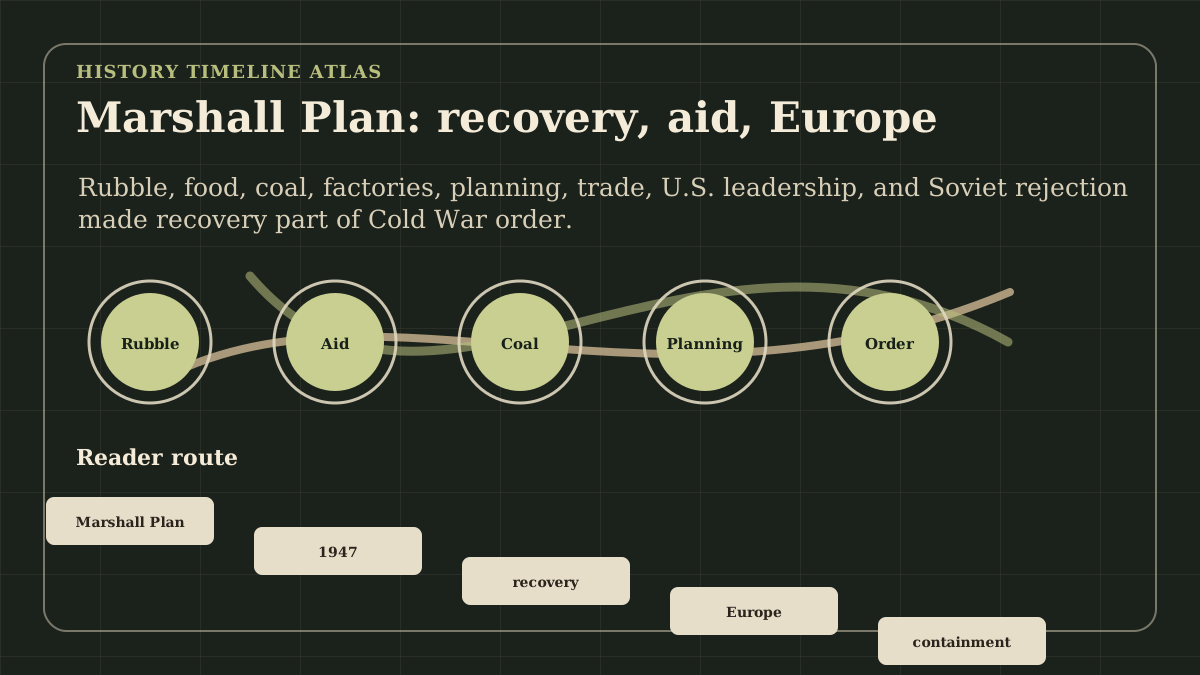
It was a recovery strategy built from rubble, hunger, currency shortages, coal bottlenecks, industrial damage, political anxiety, and fear that economic collapse would make democratic government fragile in western Europe. The speech at Harvard became famous because it connected reconstruction to security without presenting the program as only military containment. Its mechanics matter for readers. European governments had to cooperate, list needs, plan production, receive shipments, stabilize trade, and rebuild confidence. American factories, ships, administrators, economists, diplomats, farmers, labor groups, and congressional politics all shaped the program. Aid was material, but it was also organizational.
The Turning Point
In June 1947, on a campus stage in Cambridge, George C. Marshall made a public case that shifted Washington’s posture from ad hoc relief to a structured program of assistance. The announcement matters because it translated competing policy debates into an actionable offer: coordinated aid to rebuild infrastructure, revive trade and restore economic confidence across western Europe. President Harry Truman’s administration backed the initiative, signaling that the executive branch would marshal political capital for overseas reconstruction. That choice altered both rhetoric and institutions. What had been a series of bilateral charities and emergency shipments began to be imagined as a concerted transatlantic enterprise. Marshall’s name provided a banner under which U. S. resources, diplomatic weight and policy coherence could converge.
At the same time the announcement made explicit a tension that would define the Cold War: economic recovery was framed as essential to political stability and resistance to Soviet influence. Some contemporaries argued this linkage was pragmatic realism; others saw it as a deliberate strategic alignment. The turning point was not instantaneous triumph. The plan required congressional approval, negotiation with European governments, and a rethinking of how American aid would be delivered and monitored. Yet the Cambridge speech converted diffuse anxieties about deterioration in Europe into an international program with a clear American sponsor — and set in motion the practical steps that would lead to organized Marshall Plan aid flows and institutional cooperation.
The turning point was the move from emergency relief to coordinated recovery. Instead of treating Europe as a set of separate national shortages, the plan encouraged regional planning and tied economic revival to a wider western political order. A second turning point was Soviet rejection and pressure on eastern European states not to participate. That response helped divide the continent's recovery paths and made economic policy part of bloc formation.
Consequences
In the years after the announcement, Marshall Plan aid became an engine for reconstruction in participating western European states. Programs of investment, loans and material assistance helped repair infrastructure, revive trade relations and restore industrial capacity—measures that policymakers credited with stabilizing fragile economies and tempering political unrest. In the near term, recipients coordinated policies on currency convertibility, trade liberalization and economic planning in ways that made cross‑border commerce more feasible and predictable. Longer‑term consequences reached beyond balance sheets. The plan reinforced political ties between the United States and western Europe, encouraging institutions and practices that favored market revival under American influence.
Linking economic assistance to broader strategic goals also made recovery an explicit element of Cold War competition: economic policy became a tool for bolstering friendly governments and checking Soviet political appeal. Scholars debate how much of western Europe’s postwar prosperity stemmed directly from Marshall Plan funds versus broader trends in productivity, technology and American demand; this page preserves that uncertainty. Practically, the Marshall Plan accelerated cooperation among European governments and set precedents for multilateral economic programs. Politically, it helped frame a postwar order in which economic integration and political alignment were intertwined—and in which the United States emerged as a central guarantor of western Europe’s recovery and security.
The immediate consequence was support for reconstruction, trade, production, food supply, and political stability in participating states. The plan did not rebuild Europe alone, but it gave recovery a framework and a powerful symbol. The longer consequence was a western European order closely linked to the United States. The Marshall Plan belongs beside NATO, European integration, German recovery, and Cold War competition because it made prosperity part of strategy.
Interpretation Notes
Marshall Plan Announced can look simple when reduced to one date, but the evidence usually points to a wider setting. The useful debate is which part mattered most: leadership, logistics, belief, social pressure, or the institutions that survived afterward.
Why Keep Reading
This announcement is a hinge between wartime collapse and a new international order. Readers who continue will see how debates in Washington and negotiations in European capitals turned an idea into policy, how aid was allocated and contested, and how economic choices rippled into political alliances. Follow the timeline that traces congressional deliberations, European coordination, and the first years of aid distribution to understand why recovery and security became inseparable in Western thinking. That path leads directly into the contested early Cold War: flashpoints where economic policy, diplomatic pressure and military posture converged. Keep reading to watch policy become practice — and to decide for yourself how much was planned and how much was improvised.
Read the Marshall Plan before the Berlin Blockade, NATO, German division, and European integration. That path shows why money, coal, wheat, shipping, administration, and public confidence became Cold War instruments.
Reading Path
Follow the story without losing the thread
Before This
- Truman DoctrineMarch 1947
- Iron Curtain SpeechMarch 5, 1946
- Long TelegramFebruary 22, 1946
After This
- Berlin Blockade, 1948-1949: Causes, Airlift Timeline, Result1948-1949
- Universal Declaration of Human RightsDecember 10, 1948
- NATO FoundedApril 4, 1949
Same Period
- Cuban Missile CrisisOctober 1962
- Apollo 11 Moon LandingJuly 20, 1969
- Fall of the Berlin WallNovember 9, 1989
Wider Timeline
Mind Map
How to think about Marshall Plan Announced
Postwar Destruction
Wartime damage and shortages made coordinated reconstruction urgent
Map Layer
Where this event sits geographically
Gold pins mark the approximate locations of published event pages. This is a schematic locator map, not a historical border map.
Coordinates are approximate and are used to help readers orient themselves before opening a full event page.
References
Where to Check the Facts
- U.S. National Archives: The Cold WarArchive reference hub for Cold War records, federal documentation, and research guidance.
- Office of the Historian: The Early Cold War, 1945-1952Official diplomatic history reference for early Cold War foreign-policy context.
- United Nations: History of the United NationsOfficial institutional reference for United Nations founding, charter drafting, and postwar aims.